
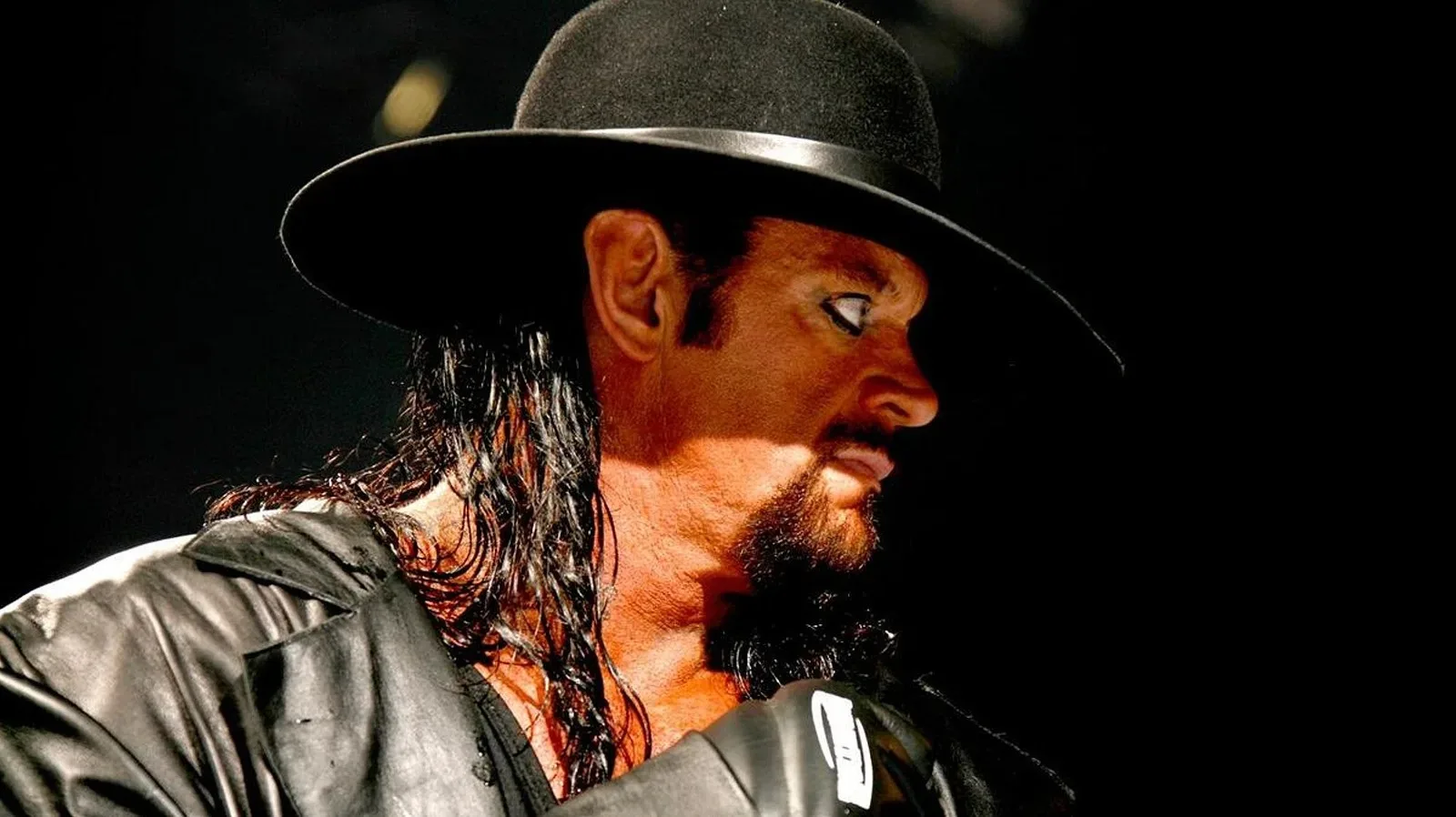
Eric Bischoff believes WWE made the wrong long-term call when it ended The Undertaker’s historic WrestleMania undefeated streak.
For more than two decades, The Undertaker’s run at WWE’s biggest annual event became one of professional wrestling’s most recognizable attractions. Every WrestleMania match involving the character carried the question of whether that year’s challenger could accomplish what no one else had managed: defeat The Deadman on the grandest stage. The answer remained no through 21 consecutive wins, before Brock Lesnar delivered one of the most startling outcomes in WrestleMania history at WrestleMania 30.
Lesnar defeated The Undertaker in New Orleans on April 6, 2014, ending the streak at 21-1. The result immediately became a defining moment for WWE audiences, marked by the stunned reaction inside the Superdome and the on-screen announcement confirming that the record was no longer perfect. The Undertaker continued wrestling periodically after that loss, ultimately having his final match against AJ Styles in the cinematic Boneyard Match at WrestleMania 36 in 2020.
Bischoff, however, sees the decision through a different lens. Speaking on 83 Weeks, he argued that the undefeated record was more valuable as an enduring piece of mythology than as something to be used to elevate another performer in a single match.
For more background on this topic, read Mickie James Recalls Nearly Leaving WWE Development Before Finding Her Breakthrough Character.
“I would’ve left the streak intact; I was disappointed,” Bischoff said on 83 Weeks. “It was a golden opportunity to create Babe Ruth, a character that lives forever.”
A WrestleMania attraction unlike any other
The Undertaker’s streak began with a victory over Jimmy Snuka at WrestleMania VII in 1991. It was not initially framed as WWE’s central WrestleMania story, and the idea of an unbeaten run was built gradually over time. As The Undertaker’s victories accumulated, though, the streak shifted from an interesting statistic into an annual institution.
By the late 2000s and early 2010s, a match with The Undertaker at WrestleMania was among the most prized positions on the card. The opponents attached to the streak included Ric Flair, Shawn Michaels, Triple H, CM Punk, Kane, Randy Orton, Batista, Edge and others. Several of those contests are widely viewed as defining matches of their respective WrestleManias, particularly the two encounters with Michaels and the pair of matches against Triple H.
The importance of the streak was not merely that The Undertaker kept winning. It was the way WWE made the possibility of defeat feel increasingly plausible as the level of opposition rose. Michaels came close in their WrestleMania 25 classic, then put his career on the line for a rematch the following year. Triple H took The Undertaker to a physically punishing conclusion at WrestleMania 27, then faced him again inside Hell in a Cell at WrestleMania 28, with Michaels serving as special guest referee. Punk delivered another celebrated performance against The Undertaker at WrestleMania 29.
Those matches reinforced the feeling that the streak was a championship-level achievement even though it was not represented by a physical title belt. The record had its own stakes, its own history and its own aura. A challenger did not need to win a championship to leave WrestleMania with a career-altering accomplishment; ending The Streak would have been enough.
Bischoff rejects the traditional retirement logic
One of wrestling’s oldest conventions is the idea that an established star should help make a younger talent on the way out. Bischoff pushed back strongly against applying that traditional thinking to The Undertaker’s WrestleMania record. In his view, preserving the unbeaten streak would have created a singular legacy that could have continued to distinguish The Undertaker long after he was finished competing.
“I don’t believe in that bulls***! That’s old school!” Bischoff said on 83 Weeks, rejecting the notion that an established performer must necessarily lose as part of their departure.
Bischoff’s comparison to Babe Ruth speaks to the broader cultural power of a record and a legend. Professional wrestling has no shortage of all-time greats whose influence is secure. Hulk Hogan, Ric Flair and Steve Austin are all names whose contributions and star power will remain central to virtually any discussion of wrestling history. Bischoff acknowledged that level of permanence, but contended that The Undertaker had the opportunity to possess a distinction none of those peers could match.
His central point was that an undefeated WrestleMania career could have become inseparable from The Undertaker’s identity forever. The Undertaker was already a unique creation: a character who survived changing eras, evolving from a supernatural giant in the early 1990s into a layered veteran presence whose WrestleMania appearances were treated as major events. Retiring with the record intact, Bischoff argued, would have completed that story in a way that no future WWE booking decision could replicate.
“Only one could’ve been remembered for being undefeated,” Bischoff said on 83 Weeks. “I just wouldn’t have given it up for a match.”
Why Brock Lesnar remains at the center of the debate
Lesnar was an unusual choice to end the streak because he was not presented as an emerging prospect in need of an introduction to the main-event level. He had already been a WWE Champion, a major attraction during his first run with the company, an UFC Heavyweight Champion and one of the most legitimate combat-sports figures ever to work regularly in professional wrestling. When he returned to WWE in 2012, he was immediately positioned as a special attraction.
That profile is central to Bischoff’s criticism. He questioned what Lesnar gained from being the man to end the record, given that Lesnar had already established himself as an elite-level star. Bischoff argued that Lesnar was as popular and as important as he was going to be at that stage, making the result less useful than it might have been for a developing talent whose entire career could have been transformed by the victory.
“Brock didn’t need it. Why did Brock need to be the guy?” Bischoff said on 83 Weeks.
There is, of course, another side to that argument. WWE’s decision gave Lesnar an extraordinary credential and changed how viewers perceived him for the remainder of his run. Lesnar’s status after WrestleMania 30 was not simply that of a dominant former champion; he became the man who defeated The Undertaker when nobody else had done it at WrestleMania. That accomplishment fed directly into the aura of “The Beast Incarnate” and helped make his later championship reigns feel even more formidable.
The booking choice also created a moment that remains difficult to duplicate in an era when audiences are often accustomed to predicting major outcomes. The disbelief that followed the three-count was real because the streak had seemed close to indestructible. WWE had conditioned fans to believe that The Undertaker could survive nearly anything at WrestleMania, and Lesnar’s win overturned that expectation in an instant.
The value of preserving wrestling mythology
Bischoff’s position is less about denying the shock value of WrestleMania 30 and more about prioritizing a legacy that could never be recreated. Once the streak ended, it could not be restored, and The Undertaker went on to lose additional WrestleMania matches to Roman Reigns at WrestleMania 33 and to Styles at WrestleMania 36. The WrestleMania record that once stood at 21-0 ultimately finished at 25-2.
For Bischoff, that final number does not carry the same mythic force as an undefeated mark. He regards the preservation of a rare, career-spanning accomplishment as more meaningful than honoring what he characterized as an outdated rule of the business.
“If you’re going to operate in today’s world with the way business used to be? Good luck with that,” Bischoff said on 83 Weeks.
The debate around The Streak has endured because there is no neutral answer. Ending it gave WWE one of its most unforgettable modern moments and reinforced Lesnar’s position as a near-unbeatable force. Keeping it intact could have allowed The Undertaker to leave behind a perfect WrestleMania record that would stand as an untouchable piece of wrestling folklore.
Bischoff firmly favors the latter path. In his assessment, WWE had a chance to protect something greater than a single result: a legacy built around the idea that, no matter how many legends stood across the ring from The Undertaker at WrestleMania, one record would always remain beyond reach.
In pictures

Darryl Polo
Darryl Polo is a passionate wrestling fan covering WWE, AEW, TNA and beyond. He loves great rivalries, breakout stars and the moments that keep fans talking long after the bell. How we work.