
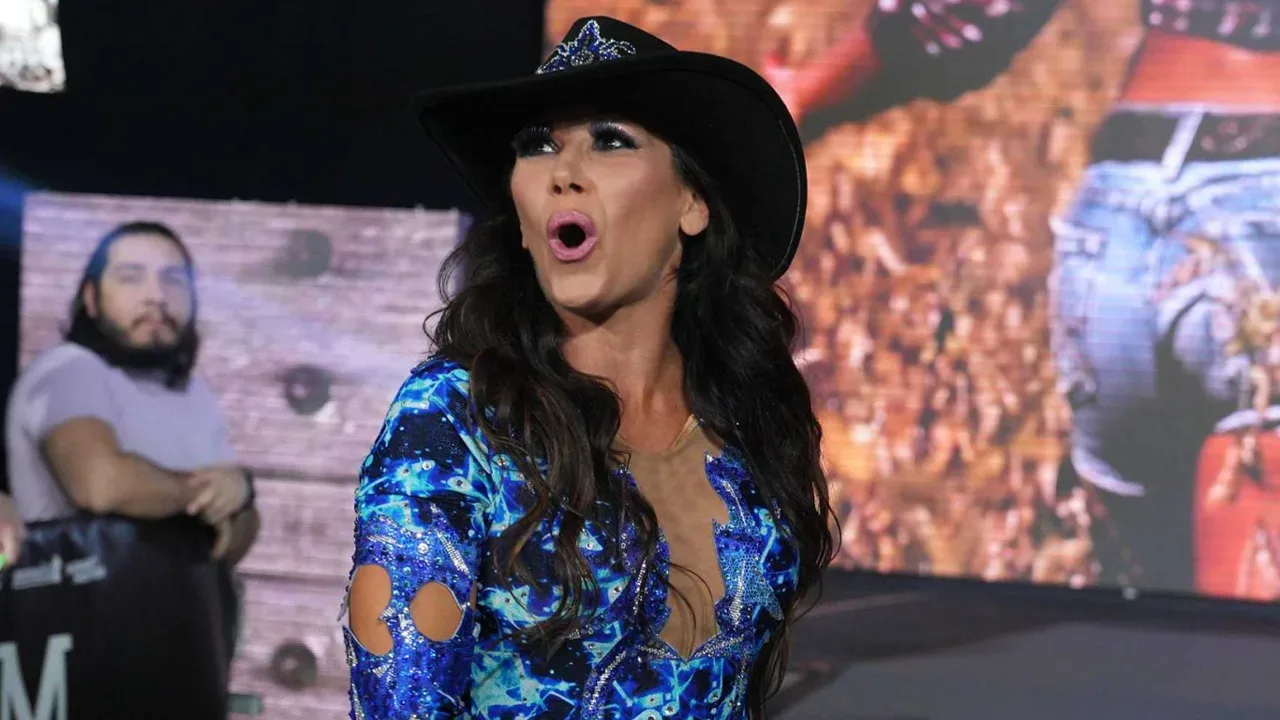
Mickie James’ path to becoming one of WWE’s most memorable women’s division stars nearly ended before her main-roster debut ever happened.
James arrived on WWE television in October 2005 as the enthusiastic, seemingly devoted fan of Women’s Champion Trish Stratus. What began as an admiration angle quickly developed into a deeply personal and distinctive storyline, with James’ character becoming increasingly obsessed with Stratus. The program ultimately gave James a major platform, established her as a featured performer, and led to one of the defining rivalries of that era of WWE women’s wrestling.
Before that opportunity emerged, however, James says she was seriously questioning whether she belonged in WWE at all. While reflecting on her developmental years, James described a difficult stretch in Ohio Valley Wrestling in which she watched fellow talent lose their jobs while WWE’s approach to its women’s division appeared to be moving in a different direction.
James had already committed years to pursuing professional wrestling by that point. She began training and wrestling in 1998, then spent approximately two years in OVW after joining WWE’s developmental system. Yet the environment left her uncertain about whether the company was looking for a performer with her background and ambitions.
For more background on this topic, read Sol Ruca Calls WWE Main Roster Transition a Major Adjustment After NXT Success.
A difficult period in OVW
James recalled feeling worn down as she observed wrestlers around her being released. At the same time, WWE’s Diva Search was underway, and several of the women involved were being brought to OVW for training before appearing on television. James said she was helping teach basic wrestling fundamentals, including headlocks, while trying to determine what WWE wanted from its female talent.
“I remember I was kind of over it. I was in a place where I’d watched a lot of people get fired at OVW. I’d been there for two years. They had started the Diva Search. All the divas were coming down, training and then going to TV. I was helping teaching them how to do headlocks and stuff. I had moment of like, ‘Maybe this isn’t the journey for me.’”
Her frustration was not simply about waiting for a call-up. James had chosen wrestling as her career, made the sacrifices required to pursue it, and earned a WWE developmental position. But she felt that the model being presented on television did not necessarily prioritize the kind of wrestler she had worked to become.
“Every female they’re bringing up to the show, they’re not wrestlers. They don’t want wrestlers,” James said while describing how she saw the situation at the time. “Maybe I’m in the wrong place. Maybe I’m doing the wrong thing. I don’t know what I’m doing wrong.”
James had attempted to broaden her skill set in an effort to fit the mold. She took acting and modeling classes, hoping to become more versatile and better align with what was then expected of a WWE Diva. Still, the uncertainty remained. With friends being fired and no clear backup plan in place, she reached a point where quitting felt like a realistic option.
Tommy Dreamer encouraged James to take time
During that period, James spoke with Tommy Dreamer, who was her boss at the time. She told him directly that she was considering walking away, unsure how much longer she could continue in the same circumstances.
“I remember talking to Tommy Dreamer about it because he was my boss at the time. I’m like, ‘I think I’m gonna quit. I don’t know how much longer I can do this.’”
Dreamer did not dismiss her concerns. Instead, James said he encouraged her to take additional time before making a decision, believing it would be a shame for her to leave after coming so far.
“He’s like, ‘I’m gonna give you some extra time. I really want you to think about this because it would be a real shame.’”
That response gave James room to step back and consider what she wanted next. Rather than immediately ending her wrestling career, she went home for Christmas and spoke openly with her mother about the doubts she had been carrying.
A family conversation changed the direction
James said she told her mother that she believed she was going to quit. Her mother urged her not to make a permanent decision out of a discouraging moment, especially after the years James had already invested in wrestling.
“She was the one who was like, ‘I think you’re making a terrible choice. You’ve dedicated a long time.’”
James placed the conversation around 2003 or 2004, several years after beginning her career in 1998. Her mother did not discourage other possible paths, including returning to school and pursuing a degree. But she emphasized that James should think carefully before abandoning a goal she had pursued for so long.
“Don’t give up,” James recalled her mother saying. “You’ve come too close.”
The message resonated. James chose to return rather than leave, but she also recognized that returning with the same approach might not be enough. Over Christmas break, she began thinking creatively about how she could differentiate herself from everyone else on WWE programming.
That process was crucial. James was not merely looking for a new outfit, a catchphrase, or a minor adjustment to her presentation. She was searching for a character concept that could give WWE a reason to see her differently and, more importantly, provide a story that had not been presented in the same way among the women on television.
“As I was going back and during that Christmas break, I’m really thinking, ‘Okay, so I need to just come up with something that’s different. What is different than what everyone else is doing on television right now?’”
The superfan concept became the Trish Stratus story
The result was the superfan character that would introduce James to WWE audiences. Her original idea was pitched with Lita in mind, but it eventually evolved into a program with Stratus. That change proved enormously significant for all involved.
James debuted as Stratus’ biggest supporter, bringing an exaggerated enthusiasm that initially played as harmless fandom. As the angle unfolded, it revealed a more obsessive and manipulative side to James’ character. The gradual shift gave the story a dramatic foundation that went beyond a conventional championship feud, while James and Stratus had the opportunity to develop layers in both their characters and their interactions.
The rivalry culminated with James challenging Stratus for the WWE Women’s Championship at WrestleMania 22 in 2006. James defeated Stratus to win the title, completing the rise from a developmental talent who had considered quitting to a WrestleMania winner and WWE Women’s Champion.
Looking back, James credited the collaborative nature of the creative process. She said the character was used, and the overall story came together through the work of the writers, herself, and Stratus. In James’ view, Stratus’ willingness to embrace an unusual concept was vital to the angle’s success.
“They used the character and then the story itself between the writers, myself and Trish, it just came together. It was awesome. It was fun, it was fresh and it was different.”
James added that Stratus’ openness made the difference between a fully developed rivalry and an idea that could have been cut short before reaching its potential.
“She was so open to the story and to the character as well, which is why it worked. Because if she had not been into it, not been open or receptive to this new story, this new character and this kind of different type of thing, it would not have gone the way it did. It would have been much shorter and probably not as cool.”
From uncertainty to a lasting WWE legacy
James’ recollection illustrates how precarious the developmental process can be, particularly for performers trying to find a place amid changing creative priorities. Her doubts were rooted in the circumstances she was seeing: releases around her, a division in transition, and the belief that the company might be seeking something other than an experienced wrestler.
Rather than walking away, James ultimately used that uncertainty as motivation to create something distinctive. The superfan concept gave her a clear identity, but it was the execution alongside Stratus that transformed it into a major WWE storyline.
James went on to become a multi-time women’s champion in WWE and built an accomplished career across several major promotions. Yet her account of nearly quitting before her debut underscores the importance of the decision she made during that Christmas break. A conversation with Dreamer, advice from her mother, and the determination to find a fresh creative direction helped keep her in wrestling long enough for her defining WWE opportunity to arrive.
For James, the breakthrough was not simply the result of being assigned a storyline. It came after she confronted the possibility that her wrestling dream might be ending, then returned with a more focused idea of how to make herself impossible to overlook.

Darryl Polo
Darryl Polo is a passionate wrestling fan covering WWE, AEW, TNA and beyond. He loves great rivalries, breakout stars and the moments that keep fans talking long after the bell. How we work.