
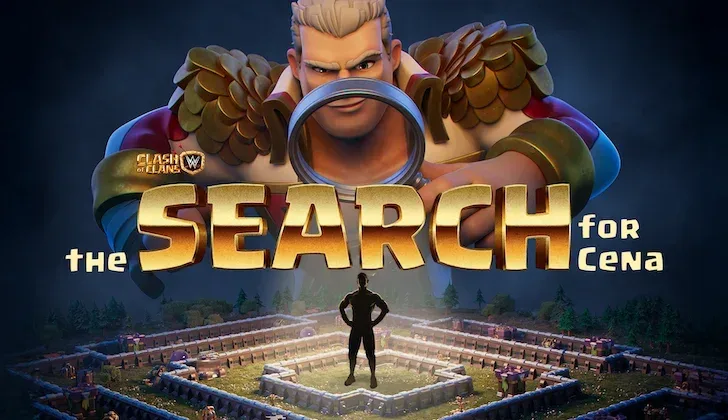
John Cena’s recent involvement with Clash of Clans is rooted in considerably more than a promotional appearance. The WWE icon has explained that he was a dedicated player long before the game’s “Search for Cena” campaign, viewing it as an ideal way to maintain a connection with fellow wrestlers during the relentless travel schedule that defined much of his full-time career.
For Cena, the appeal was not simply the chance to build a village, deploy troops, or compete against other players. It was the social structure surrounding the game. Its clan system and chat function gave WWE talent a virtual meeting place at a time when the practical realities of Cena’s schedule often left him separate from the usual locker-room environment.
That combination of strategy, convenience and camaraderie made the game especially suited to wrestling life. Cena said it felt as though it was practically designed for people in WWE, particularly during an era when performers were away from home far more often than they were there.
Cena Saw Clash of Clans as a Way to Stay Connected
Cena described the clan feature as the key to keeping an active social connection with other talent. In an industry built around constant movement, being able to participate in a shared game from separate locations gave wrestlers an outlet that did not depend on everyone being in the same room, vehicle or hotel.
“I think it’s kind of built for us over at WWE,” Cena said. “Especially when we got into it, and gosh, you were on the road far more than you were home. The way that they set up making your clan, and being able to have people participate was just kind of a way for me to stay interactive with the guys.”
The circumstances were particularly meaningful for Cena because he was intentionally creating more personal space around himself at the height of his WWE responsibilities. As he balanced a thriving business as a top WWE performer with the early stages of his on-screen entertainment career outside the ring, he said his work did not necessarily stop when he arrived at an arena.
Rather than spending every available moment in the communal setting of the locker room, Cena traveled on a tour bus and used that space to handle his commitments, rest and prepare. It was a professional necessity, but it also meant he was less present for the informal interactions that often help performers build relationships over years on the road.
“Normally the locker room vibe is, you know, guys breaking on each other and it’s very relaxed and loose,” Cena said. “But I would be doing business up until the first bell rung. I would just need an office space.”
He also noted that the bus changed how he approached travel. After spending many years driving between towns, Cena wanted to use travel time to sleep rather than remain awake throughout the trip. The decision made sense for a performer carrying major in-ring, promotional and business responsibilities, but it further limited the time available for traditional backstage socializing.
Clash of Clans helped bridge that gap. It allowed Cena to compete and communicate with colleagues without requiring anyone to alter their travel arrangements or work routines. The game could be accessed in the gaps between obligations, making it an easy fit for people whose schedules were rarely predictable.
Strategy Was the Initial Draw
While the social element became central to Cena’s experience, he made clear that he enjoyed the game on its own merits immediately. He is drawn to the strategic process of constructing an environment, selecting the right troops and measuring those choices against the competition.
That is a significant part of why the game clicked with him. Wrestling requires performers to constantly consider timing, positioning, preparation and adaptation. Cena did not directly compare wrestling matches to the game’s mechanics, but his enthusiasm for planning and executing a strategy is clear in the way he described his experience.
“I loved the game immediately,” Cena said. “I love the essential strategy that is part of building your own environment and using essential troops to see what you can do with the competition and see what’s out there. I love those strategic games.”
Cena also pointed to the scale of the game’s audience, noting that two billion people have downloaded the app. That popularity made his own attachment to it less unusual, even as he became heavily invested in developing his clan and helping others within it.
Once Cena recognized that he could use in-game resources to support teammates, he had an easy way to recruit fellow players. His pitch was straightforward: join the group, and he would help them get the upgrades they needed.
“If you guys need upgrades, I got you. If you need anything, I got you,” Cena recalled telling potential clan members.
That approach helped turn individual players into a more organized group. Cena said he got deeply involved in the game from both a time commitment and a financial investment perspective. He expressed pride in that commitment, especially because the experience retained the communication element that had made it valuable in the first place.
The return of the game’s chat feature has also been a point of excitement for Cena. For him, the feature is not an insignificant add-on; it is tied directly to the ability for a group of friends and coworkers to stay in touch while living on different schedules and moving from city to city.
From Card Games to Mobile Gaming
Cena placed his Clash of Clans memories in the broader context of wrestling’s road culture. For earlier generations, card games were a familiar way for talent to pass the time, compete and trade jokes during long stretches of travel. Cena said that tradition had begun to fade by the time of the groups he came up around.
He specifically referenced the Hardy Boyz and the Ohio Valley Wrestling class as eras in which cards were no longer the same shared pastime they had been for prior generations. In Cena’s view, Clash of Clans became a modern replacement for that kind of interaction.
“Before Clash, all the boys used to play cards, and cards kind of fell by the wayside with the generation that I came up with,” Cena said. “Clash became the new conduit for busting each other’s chops and conversation just for us to stay friends, and it worked, and it was awesome.”
That description captures why Cena’s relationship with the game carries more personal weight than a standard celebrity crossover. Wrestling can create unusually close bonds, but the same job that creates those bonds also separates talent from friends, family and one another for extended periods. A game that offers strategy is useful; a game that also keeps a group talking can become part of the fabric of life on the road.
Cena said he was surprised by how many people joined in. The result was a shared space where players could plan, compete, tease each other and maintain friendships. It replicated some of the casual interaction associated with card games and locker-room downtime, while fitting the realities of an increasingly mobile and digitally connected generation.
A Personal Connection Behind the Search for Cena Campaign
The “Search for Cena” promotion now has a clearer context. Cena’s participation reflects a genuine history with Clash of Clans, one that began during his demanding WWE travel years and grew through both gameplay and interaction with other wrestlers.
His explanation also underlines a side of WWE touring that is easy to overlook. The audience sees the matches, television appearances and major events, but performers also spend countless hours managing travel, sleep, business obligations and the challenge of keeping up with their peers. For Cena, a mobile strategy game became an unexpectedly effective answer to that challenge.
It was a place to build, battle, chat and help teammates advance. More importantly, it offered a way to remain part of the group even when he needed distance from the physical locker room. Cena’s story is ultimately less about a branded campaign than it is about how WWE talent found a new version of an old road tradition: spending time together, competing with one another and keeping the conversation going wherever the next town happened to be.
Keep reading on SmackDownOnYou

Darryl Polo
Darryl Polo is a passionate wrestling fan covering WWE, AEW, TNA and beyond. He loves great rivalries, breakout stars and the moments that keep fans talking long after the bell. How we work.