
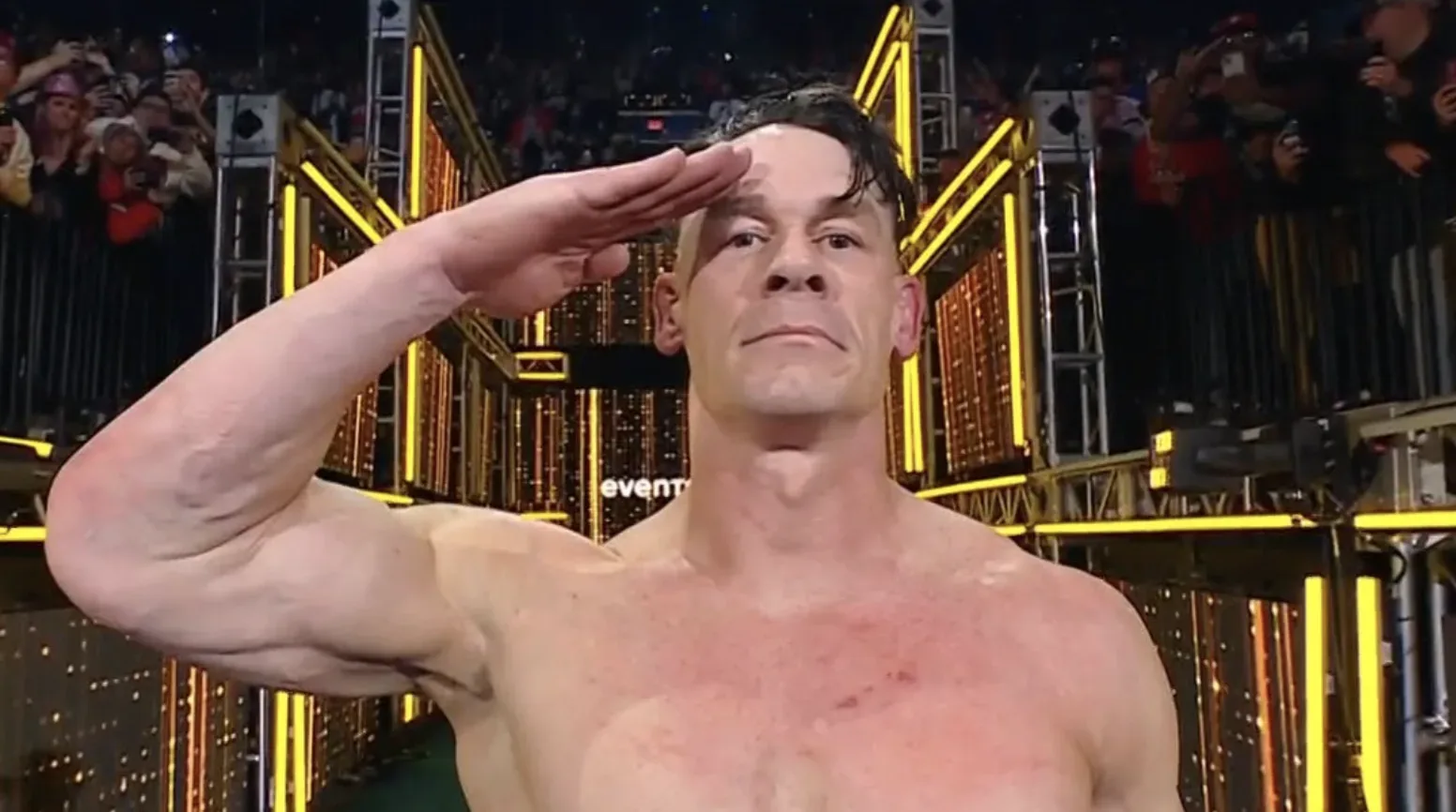
John Cena spent a career in WWE making physically demanding moments look routine, but he says that experience did not erase one particular fear. If anything, it may have sharpened it.
Speaking about his work on the upcoming Matchbox movie, Cena discussed a helicopter-based stunt that pushed him well outside of his comfort zone. The former WWE star said he had moments during production when he believed the work had reached the point where a stunt performer would normally take over. Instead, director Sam Hargrave encouraged Cena to do as much as possible while maintaining the safety standards required for such a sequence.
The experience gave Cena the chance to confront his fear of heights, though he was clear that confronting a fear is not the same as completely beating it. He connected that anxiety directly to the knowledge he gained through years of taking falls in a wrestling ring.
“I think my fear of heights stems from falling down most of my life in the WWE,” Cena said. “Knowing like a fall that is gonna hurt and a fall that is gonna injure and the fall that it’s gonna be greater than that.”
For more background on this topic, read Joe Hendry Reflects on Building Confidence, Finding Wrestling Later in Life.
That distinction is central to Cena’s comments. Professional wrestling is often described as controlled, but that control does not make it painless or without risk. Wrestlers train extensively to fall, absorb impact and protect both themselves and the people they work with. Even with that preparation, every physical sequence depends on timing, positioning, communication and trust. Cena’s remarks show that years of working in that environment gave him a practical awareness of consequences rather than an absence of fear.
For a performer accustomed to athletic contact and planned impact, a helicopter stunt presents a very different kind of vulnerability. In the ring, the action is built around established technique and direct cooperation between performers. On a film set, especially during an aerial sequence, the performer is also relying on harnesses, rigging, camera placement, weather considerations, stunt coordination and a larger technical team. The setting changes, but the need for trust remains the same.
Cena says Hargrave understood the risks
Cena credited Hargrave’s background for helping him approach the demanding material. Hargrave has experience as a performer as well as a second-unit director and coordinator, a combination Cena said gave the filmmaker an understanding of what a fall feels like and what safety equipment can and cannot do.
Rather than presenting the helicopter material as a simple dare or a reckless attempt to make an action scene appear more authentic, Cena described a process led by professional judgment. He said there were multiple instances in which he thought the stunt should shift to a specialist. Hargrave, however, would assess the situation and determine what Cena could safely handle himself.
“He knows what it feels like to fall,” Cena said of Hargrave. “He knows what all the rigs feel like. He knows what’s safe.”
That background mattered to Cena because it allowed the production to pursue realism without dismissing the limits of the person on camera. Cena said Hargrave wanted him to take on as much of the work as possible, but the request came with an assurance that the situation would remain safe. Cena, in turn, committed to leaning into the discomfort rather than withdrawing from every moment that triggered his anxiety.
“I didn’t overcome my fear,” Cena said, explaining that he remained scared during the process. But he felt both sides fulfilled their commitments: Cena faced the challenge, and Hargrave protected the environment in which he did it.
A WWE career built on physical trust
Cena’s perspective reflects the unusual education that comes with a long WWE career. Wrestling requires performers to create the illusion of chaos while repeatedly making split-second decisions designed to minimize danger. A move can look explosive to an audience, but its success depends on a foundation of practiced technique. The same is true of high-impact falls, dives and collisions: they are designed for effect, but they are never consequence-free.
For someone who spent much of his professional life landing on a ring mat, Cena’s awareness of height is understandable. A fall does not need to begin at an extreme distance from the ground to carry risk. The body remembers impacts. So does the mind. Cena’s comments suggest that his concern is rooted not in abstract nerves, but in years of firsthand experience recognizing the difference between manageable discomfort, a painful landing and a situation that can become more serious.
That is also why his comments about stunt professionals deserve emphasis. Film and wrestling both depend on audiences believing they are seeing something spontaneous and dangerous. Yet the people creating those moments are typically drawing from systems developed to make danger more manageable. Cena did not portray himself as someone who could replace every specialist because of his WWE history. He instead described a collaboration in which experienced coordinators knew when to push him and when a professional had to step in.
It is a useful distinction in an era when action projects are often promoted through stories of stars doing their own stunts. The appeal of that approach is obvious: viewers can see the performer’s face, reactions and physical commitment more clearly. But Cena’s account places the focus on preparation and oversight. The point is not that fear disappears. The point is that trained people establish conditions in which a performer can work through it responsibly.
Fear did not stop Cena from taking part
Cena’s willingness to take on the sequence does not mean he views fear as a weakness. His description was notably candid. He did not claim that stepping out of a helicopter suddenly made him comfortable with heights, and he did not frame the experience as a clean victory over anxiety. Instead, he said he made a promise to lean into something that made him uneasy.
That approach has clear parallels to the mindset expected of top-level wrestlers. Entering a WWE ring in front of a live crowd demands confidence, but it also demands an ability to perform through nerves, pressure and physical uncertainty. The performer is not required to be unafraid; the performer has to be prepared, communicative and committed to the task at hand. Cena’s film work appears to have called on that same discipline in a new environment.
His comments also underline why his transition from WWE to Hollywood has not required him to abandon the instincts developed during his wrestling career. The medium is different, and the production structure is different, but many of the core demands overlap. Physical storytelling still depends on rhythm. Action still depends on reacting convincingly in the moment. Most importantly, both fields require trust among people whose work is interconnected.
In Matchbox, Cena is taking that physical commitment into a setting that directly challenges him. The helicopter material was not simply another action beat for him. It forced him to confront a fear he believes was shaped, at least in part, by the accumulated experience of falling during his time in WWE.
There is an honesty in the way Cena has explained it. Decades of physical performance can build toughness, awareness and confidence, but they can also leave someone with a vivid understanding of what can go wrong. Cena did not say wrestling made him fearless. He said it taught him how to recognize a fall that will hurt, one that will injure and one that could be worse. That knowledge followed him to the Matchbox set.
For Cena, the achievement was not eliminating that fear. It was choosing to do the work while respecting it, trusting the experts around him and accepting the discomfort that came with an ambitious stunt. That is a mindset familiar to anyone who has watched the physical demands of WWE up close, and it remains a defining part of his approach as his acting career continues.
In pictures

Darryl Polo
Darryl Polo is a passionate wrestling fan covering WWE, AEW, TNA and beyond. He loves great rivalries, breakout stars and the moments that keep fans talking long after the bell. How we work.