
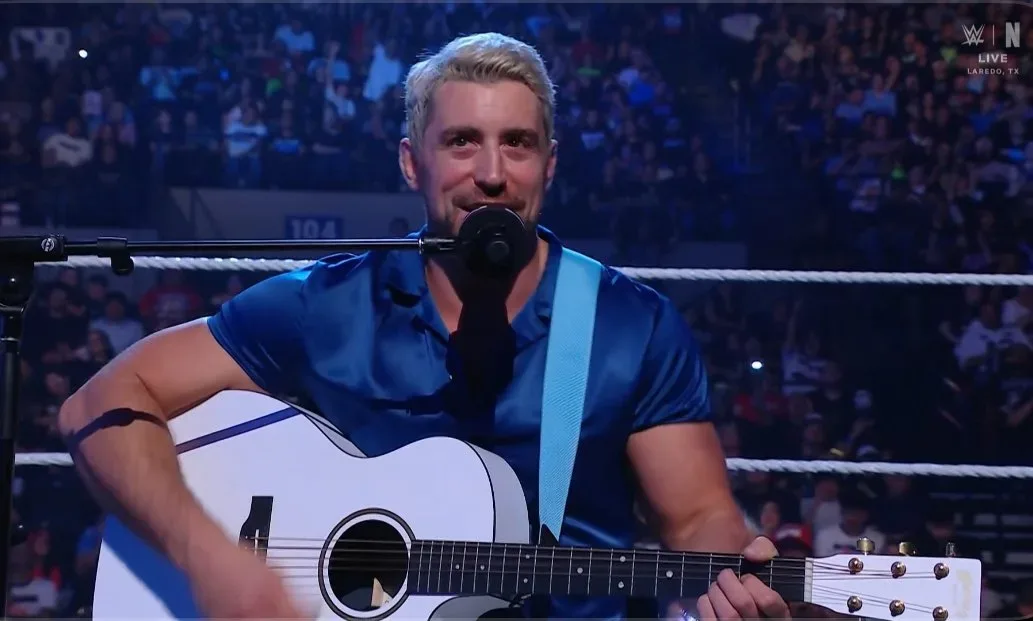
Joe Hendry’s rise in professional wrestling has been closely tied to a skill set that extends beyond the ring. His original entrance music, promotional songs and videos have become central parts of his presentation, helping him establish a distinctive identity with audiences while giving him another way to target opponents. For Hendry, however, the success he has found in both wrestling and music was not built simply on youthful belief. It came through a process of being humbled, improving and developing the tools necessary to turn ambition into a career.
Speaking in a recent interview, Hendry addressed whether he always expected to become successful in wrestling and music. His answer offered an honest look at how his outlook changed from his teenage years to the point he has reached in WWE.
“So the weird thing is when you’re young, you know, when I was a teenager, I was like, ‘yeah, I’m going to take over the world. I’m going to do all this,’ and then life humbles you a little bit. Then eventually you go, okay, I’m going to have to build some serious skills here. So your confidence is kind of like this curve that starts high, goes down, but comes back up as you build the skills, and that’s kind of what I’ve been doing is just trying to get better at what I do every day, and it’s led me to here in WWE.”
Joe Hendry describes confidence as a process, not a guarantee
Hendry’s comments draw a distinction between having big goals and possessing the experience required to achieve them. The initial confidence he described was familiar teenage optimism: the conviction that major accomplishments were possible and that he could take on the world. But he also acknowledged that life can challenge that certainty, forcing a person to take a more realistic assessment of what they need to learn.
For more background on this topic, read Chantel Monroe Reveals She Initially Turned Down WWE NIL Opportunity in 2021.
Rather than presenting that period as a setback, Hendry described it as part of a larger progression. In his view, confidence does not simply remain at one level. It can begin high, fall when reality and inexperience set in, and then return in a more grounded form as abilities improve. That latter form of confidence is based on work, preparation and proof that the skills are there.
The emphasis on getting better every day is especially relevant to Hendry’s body of work. His act has required him to operate in multiple areas at once. He is a wrestler, but his presentation has also involved writing and performing music, producing memorable material around rivalries, and delivering a personality that connects those pieces. The songs and videos are not separate from the wrestling persona; they have been among the clearest ways Hendry has communicated that persona to viewers.
That approach has been part of his career dating back to his time on the independent scene. Instead of relying only on a conventional verbal confrontation to build an issue, Hendry has repeatedly used music as a weapon against an opponent. His creative material has allowed him to frame rivalries in a different way, combining comedy, criticism and self-promotion into one recognizable formula.
It is an approach that also demands consistency. A musical hook or a video can draw attention, but maintaining momentum requires a performer to continue evolving as a wrestler and as an on-screen character. Hendry’s description of building “serious skills” reflects that broader challenge. Reaching WWE represents a major milestone, but he framed it as the product of continuous improvement rather than a destination he could assume would arrive.
Wrestling was not part of Hendry’s childhood
Hendry also revealed that he was not someone who grew up watching professional wrestling from early childhood. He became a fan later than many performers do, saying that his serious interest began when he was around 14 or 15 years old.
“So here’s the weird thing. I actually didn’t have wrestling as a kid. I got into it when I was a teenager. I got obsessed when I was about 14 or 15 years old. So a little bit later than most, and I didn’t start wrestling until I was about 24, about to turn 25. So it’s never too late to become a fan or to get involved.”
That timeline makes Hendry’s journey different from the familiar story told by many wrestlers, who often cite childhood viewing habits as the beginning of their connection to the industry. Hendry’s fandom arrived in his teens, and the decision to begin training came much later. He did not start wrestling until he was around 24 and nearing his 25th birthday.
His message was direct: there is no single age at which someone must discover wrestling or begin pursuing it. For prospective wrestlers, fans and performers who may feel they started too late, Hendry’s experience provides a personal example of a path that did not follow the earliest possible timeline. He became deeply invested after discovering the product as a teenager, then eventually made the move from fandom to participation years later.
There is an important difference between discovering a passion and immediately having the opportunity or readiness to make it a profession. Hendry’s comments recognize that gap. Becoming obsessed with wrestling in his mid-teens did not mean he entered a ring at that same age. The eventual start to his in-ring career came after additional time and development, underscoring his broader point about acquiring skills rather than assuming confidence alone can carry someone forward.
Music remains a defining piece of the Hendry presentation
Hendry’s career has made the overlap between wrestling and music impossible to ignore. In professional wrestling, entrance themes have long been important in setting a first impression, signaling a character’s arrival and helping create crowd participation. Hendry has taken that concept further by making original music and music-based videos an active part of his rivalries and identity.
That creative lane has helped set him apart. His material has often been designed to get under the skin of whoever he is facing, transforming musical performance into part of the competitive conflict. It is a distinctive way to generate attention because it can function as entertainment for the audience while also serving as an in-character insult or challenge to an opponent.
But Hendry’s recent remarks make clear that he does not view the musical side of his career as an effortless extension of a natural persona. His comments about confidence returning through skill-building apply to both sides of what he does. The finished material seen by fans is the visible end point of work intended to make him better each day.
That perspective also explains why his journey to WWE carries weight. Hendry did not portray the move as the result of expecting success from the beginning. Instead, he described a route shaped by early ambition, a period of recalibration and a commitment to improvement. The result is a performer whose identity was built through more than one discipline.
A message for fans and aspiring wrestlers
At the center of Hendry’s comments is a message that applies beyond his own career. He acknowledged that early confidence can fade when people encounter the difficulty of trying to make a dream real. Yet he did not suggest that the answer is to abandon the goal. His answer was to build the abilities that can support renewed confidence.
His late start as a wrestling fan and eventual entry into training reinforce the same theme. There is no requirement that a person be a lifelong viewer before falling in love with wrestling, and there is no universal deadline for taking the first steps toward becoming involved. Hendry’s own experience began with teenage fandom, progressed to an obsession with the industry and eventually developed into a career that has brought him to WWE.
For Hendry, the path has been defined by persistence and versatility. Wrestling and music have both become vehicles for his expression, and his ability to combine them has made his act recognizable. While the confidence of his youth may have been broad and untested, the confidence he described now is rooted in the work that followed.
That is why his remarks are less about declaring that success was inevitable and more about explaining how it was pursued. Hendry’s story, as he tells it, is one of learning, adapting and continuing to improve — with the belief that it is never too late to become a fan, get involved and begin building the skills needed to move forward.

Darryl Polo
Darryl Polo is a passionate wrestling fan covering WWE, AEW, TNA and beyond. He loves great rivalries, breakout stars and the moments that keep fans talking long after the bell. How we work.