
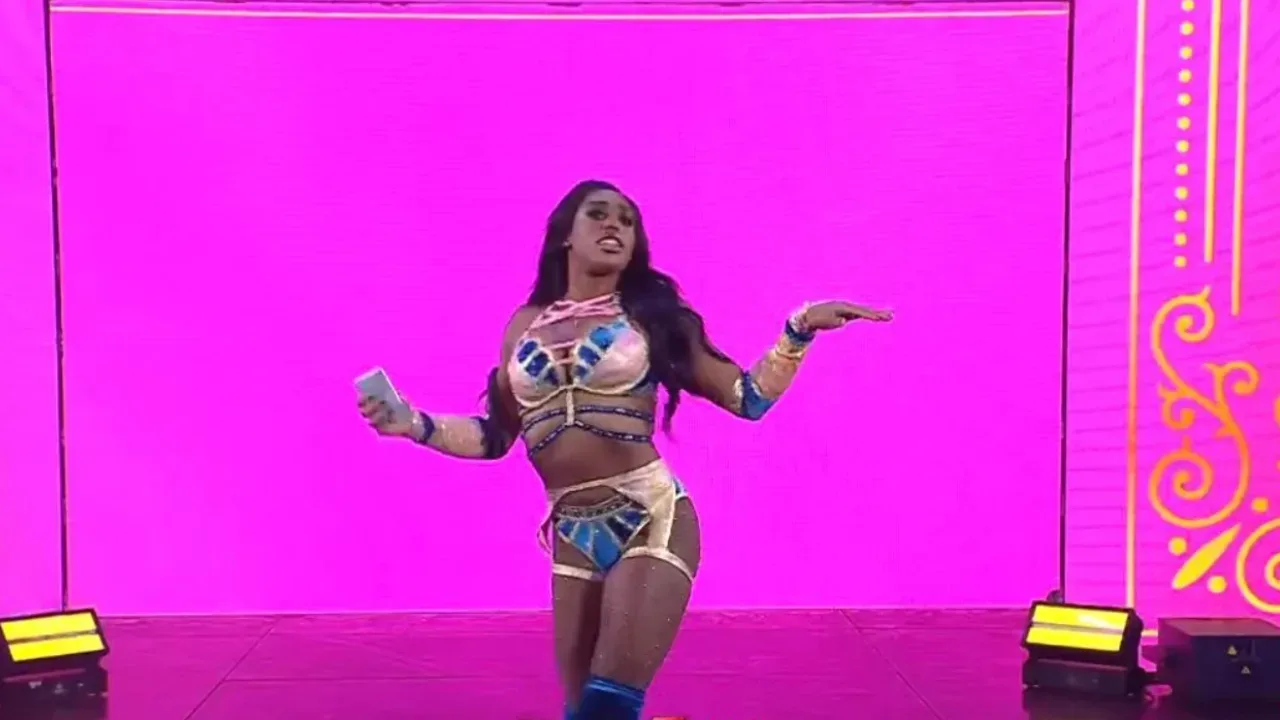
Chantel Monroe’s route to WWE was not a straight line, and the performer has revealed that she initially passed on a chance to enter the company’s NIL program when it first came calling in 2021.
Monroe discussed her journey during a recent interview ahead of her return to WWE in-ring action. She explained that WWE reached out during the launch year of its Name, Image and Likeness initiative, but she was still in college and uncertain about what direction she wanted her life and career to take. Rather than make a commitment before she felt ready, Monroe declined the initial approach.
When the opportunity emerged again, however, Monroe saw a better fit between WWE’s developmental environment and the qualities she believes she brings to the table. She identified her enjoyment of connecting with people and performing as major reasons she chose to explore professional wrestling the second time around.
“I love to connect with people, I love to perform and I just have, I feel like, that factor. That ‘it factor’ people like to say when it comes to entertaining and I was like, oh! That’s what drew me to it because at first — funny story — they reached out to me in like 2021 when N.I.L. was first a thing and I turned it down… I was still in college and I didn’t know what I wanted to do with my life, and then it came up again and I was like, ‘I love to entertain’ so I wanted to see what this has for me…”
For more background on this topic, read Tiffany Stratton Addresses Viral WWE Performance Center Training Botch, Vows to Try Dive Again.
The comments offer a useful look at a decision that could have changed Monroe’s path several years earlier. WWE’s NIL program was designed to identify athletes with strong backgrounds outside wrestling and provide a route into the company’s talent pipeline. For prospects still balancing college, athletics, studies, and major career decisions, though, an invitation does not always arrive at the ideal moment.
In Monroe’s case, waiting appears to have allowed her to approach the opportunity with more clarity. Her explanation was not centered on a specific wrestling goal she had held since childhood. Instead, she framed the appeal around performance, audience connection, and the chance to test herself in a new form of entertainment. Those are important building blocks for any wrestler entering WWE’s system, where athletic training is only one part of the overall process.
A return after an ankle injury
Monroe’s reflections on joining WWE came shortly before she returned to competition following an extended absence. She had been sidelined since early 2026 because of an ankle injury, putting a pause on her momentum during a formative stretch of her development.
Her comeback took place at a WWE Main Event taping in late September. Returning to the ring after an injury layoff can be an especially significant step for a developing talent. Beyond being medically cleared, a performer must regain in-ring timing, confidence, and the physical rhythm that comes from working matches in front of a live audience. For someone still establishing their identity in WWE, every opportunity to get reps can be valuable.
Monroe has also competed on an NXT house show loop in Florida, which represents her most recent run of matches as of this writing. The NXT live event circuit gives talent a setting to work in front of audiences while continuing to develop fundamentals and adapt to the pace of professional wrestling. It can also provide a chance to experiment with presentation and crowd interaction away from the pressure of weekly television.
That environment fits with the motivations Monroe described. A wrestler who places a premium on entertaining and connecting with people needs opportunities to learn how different audiences respond. Live events offer immediate feedback. A reaction to an entrance, a moment in a match, or a shift in body language can help a newer performer discover what feels natural and what needs more refinement.
The significance of timing for NIL recruits
WWE’s NIL strategy has created an alternate entry point into pro wrestling. Traditionally, many talents arrived after working the independent scene, building their craft across smaller promotions, or coming from other established athletic backgrounds. NIL recruiting has widened the search by allowing WWE to identify collegiate athletes and other prospects who may not have previously considered a wrestling career.
That model also means WWE is reaching people at a particularly transitional time in their lives. A college athlete may be weighing professional opportunities in their original sport, pursuing a degree, considering work outside athletics, or simply trying to determine what kind of public-facing career suits them. Monroe’s 2021 decision reflects that reality. She did not reject the idea because she lacked interest in performance; she was not yet certain what she wanted to pursue.
Her eventual decision to give WWE a chance illustrates why a second conversation can matter. Not every recruitment process ends with an immediate signing, and not every prospect who says no is closing the door permanently. Circumstances change, priorities become clearer, and the appeal of a new path can grow over time.
For Monroe, the key realization was tied to entertainment. Professional wrestling requires physical conditioning and technical learning, but it is also built around presence. Wrestlers are asked to communicate emotion, tell stories through action, and establish a connection that gives viewers a reason to invest. Monroe’s belief that she has an “it factor” speaks to the confidence required to pursue that challenge.
Building a foundation in WWE
Monroe’s return places the focus back on what comes next. She is working her way back from an ankle injury while continuing to gain in-ring experience through WWE opportunities, including the NXT live event circuit. There is no indication in her comments of a timetable for any particular television role or larger storyline, and her immediate priority appears to be continuing to compete and develop.
That measured approach is appropriate for a talent in the early stages of a WWE career. The transition from another athletic or collegiate background into wrestling is demanding. It involves learning mechanics that can take years to master, including match structure, safety, timing, character work, and the ability to respond to an opponent and a crowd in real time. An injury interruption can make that process more difficult, but a return to live competition is a meaningful marker of progress.
Monroe’s recent activity also underscores the value of the work done away from major television programs. House shows and Main Event tapings may not carry the same spotlight as WWE’s flagship broadcasts, but they remain meaningful stages for performers gaining experience. Those matches help talent establish consistency and rebuild comfort after time away.
The broader story is one of patience. Monroe was contacted by WWE in 2021 and decided she was not ready. Rather than force a choice during a period of uncertainty, she stayed on her own path until the proposition made more sense. When it returned, she recognized a chance to apply her interest in performing in a new setting.
Now, after overcoming an ankle injury that kept her out of action from early 2026, Monroe is back in the ring and adding to her WWE experience. Her latest appearances on the NXT house show loop in Florida provide the next opportunity to turn that confidence in her ability to entertain into tangible in-ring growth.
For Monroe, the first WWE call may have come too soon. The second one arrived when she was ready to see where professional wrestling could take her.

Darryl Polo
Darryl Polo is a passionate wrestling fan covering WWE, AEW, TNA and beyond. He loves great rivalries, breakout stars and the moments that keep fans talking long after the bell. How we work.