
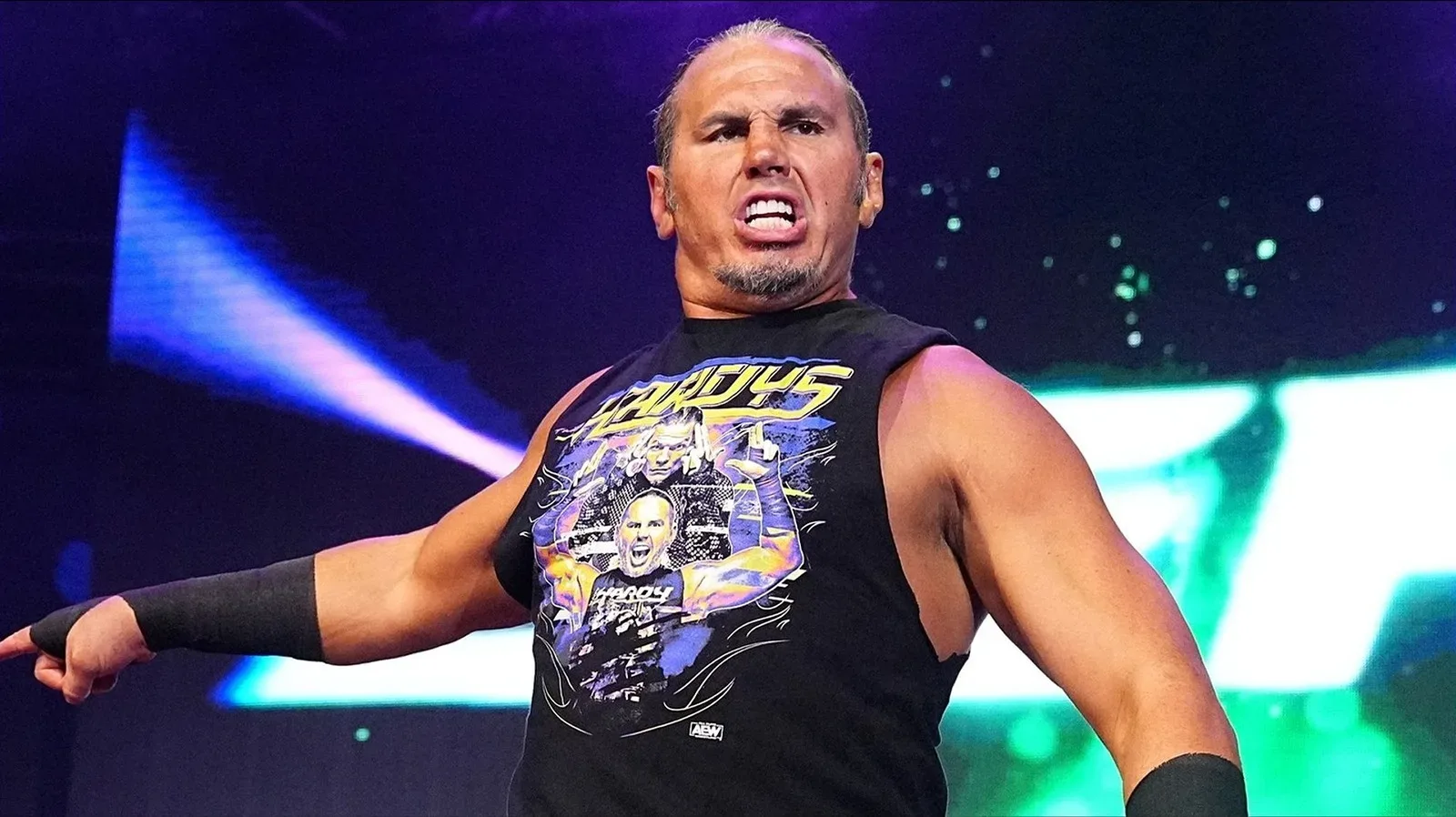
Matt Hardy has looked back on one of the most consequential matches in WWE history, recalling the moment he watched Shawn Michaels and The Undertaker make the first-ever Hell in a Cell match feel like something entirely new.
WWE’s Badd Blood: In Your House in 1997 is remembered most vividly for its closing chapter. While much of the card has not carried the same long-term legacy, the main event between Michaels and The Undertaker changed the direction of both a major rivalry and a stipulation that would become one of WWE’s defining attractions. The match also ended with the shocking debut of Kane, who arrived as The Undertaker’s storyline brother and immediately became a central figure in the company.
Hardy, who was 23 at the time and had not yet established himself as a WWE star, discussed his memory of the event during The Extreme Life of Matt Hardy. For Hardy, even the visual of the structure being introduced carried an enormous sense of occasion.
“It was impressive, yeah,” Hardy said of seeing the cell lowered before the match on The Extreme Life of Matt Hardy.
For more background on this topic, read Mini Vikingo Says Elbow Injury Will Require Surgery, Delaying Rey Fenix Title Rematch.
Hell in a Cell was presented as an escalation beyond the cage matches audiences had previously seen. The imposing roofed structure surrounded ringside and limited the possibilities of escape or outside intervention. In practice, however, it also gave Michaels and The Undertaker a unique setting in which to build their story. Their rivalry had been growing increasingly personal, and the environment made the encounter feel less like a standard pay-per-view main event and more like a battle designed to settle an issue that had become too volatile for conventional rules.
Hardy said that watching the match left a lasting impression on him. He singled out Michaels’ work in particular, describing the performance as an example of the former WWE Champion operating at a remarkable level.
“I’ll never forget sitting back and watching that match, and that was the first time I was like, ‘Whoa,’” Hardy said. “Shawn Michaels is like — we knew he was great, but he was on another level in that match. Such a stand-out. It was so incredible to watch.”
Michaels entered the bout with an already well-established reputation as one of WWE’s premier in-ring performers. Yet the Badd Blood match remains a standout point in his body of work because of the combination of athleticism, vulnerability, pacing, and character-driven drama required by the stipulation. The contest did not simply use the cell as a background. It made the structure part of the conflict, while the two competitors maintained the personal animosity that had fueled their program.
The Undertaker’s role was equally crucial. Hardy noted that the appeal of the match was not merely seeing the “Deadman” dominate another opponent. The Undertaker had often been portrayed as an unstoppable force against many rivals, but Michaels gave him an adversary who could endure punishment, exploit opportunities, and keep the outcome in doubt. That dynamic helped make the encounter compelling. The Undertaker remained an intimidating presence, but Michaels’ performance made the struggle feel more competitive than a straightforward showcase of the larger man’s power.
A Match That Defined A WWE Stipulation
The legacy of the 1997 Badd Blood main event reaches well beyond its immediate storyline. WWE returned to Hell in a Cell over the years for major rivalries and championship matches, turning it into one of the company’s most recognizable specialty attractions. The structure’s first outing set a high standard because it had a clear narrative purpose. Michaels and The Undertaker had reached a point where a regular match no longer seemed sufficient, and the cell provided a fittingly dangerous setting for the confrontation.
The finish also ensured that the night would be remembered for more than the match itself. Kane’s debut brought a dramatic new layer to The Undertaker’s world. Kane appeared in a mask and distinctive red-and-black gear, entering through the entrance area before tearing the door off the cell. He attacked The Undertaker, allowing Michaels to capitalize and escape with the victory. The moment instantly established Kane as a destructive presence while launching a story that would remain deeply connected to The Undertaker for years.
For a young wrestler watching from close enough to absorb the atmosphere around the event, Hardy’s recollection illustrates why the match has endured. It was not only a famous historical milestone viewed in retrospect. At the time, the debuting cell, the intensity of the performers, and the arrival of Kane combined to create a moment that felt unmistakably important in real time.
Hardy’s Early Connection To Glenn Jacobs
Hardy’s recollection of Kane’s arrival also carries a personal element because he and his brother Jeff had crossed paths with Glenn Jacobs before Jacobs became WWE’s Kane. Hardy explained that the brothers had worked with Jacobs in Smoky Mountain Wrestling, where Jacobs wrestled as the Unabomber. Hardy said it was especially striking to see someone they already knew become part of such a prominent WWE presentation.
“We worked with him in Smokey Mountain when he was Unabomber,” Hardy recalled on The Extreme Life of Matt Hardy. “It was so weird, because we’re like, ‘This is crazy, this guy’s getting this amazing character, he’s Undertaker’s brother. We were around him when he was Isaac Yankem.’”
Jacobs’ road to Kane had included multiple identities before the masked character became his defining WWE role. Hardy’s reference to Isaac Yankem points to another earlier WWE incarnation, one that was far removed from the ominous mythology and explosive debut that would accompany Kane at Badd Blood. The contrast was obvious: a wrestler Hardy and Jeff had encountered in earlier stages of his career was now being introduced in one of WWE’s biggest angles, positioned alongside one of the company’s most protected and enduring characters.
That perspective adds another layer to the memory. The Badd Blood main event is often recalled for its landmark stipulation and the feud between Michaels and The Undertaker, but Kane’s emergence was the twist that transformed its ending into a launching point for future stories. Hardy had a firsthand awareness of Jacobs’ prior stops, making the magnitude of the new role particularly clear.
The Hardys would, of course, go on to become major WWE stars themselves, building a legacy around innovation, risk-taking, and tag team matches that helped reshape expectations for the division. But in 1997, Hardy was still looking on as a fan and aspiring performer, taking in a match that showed what a major WWE main event could accomplish when the characters, stipulation, and surprise all aligned.
For Hardy, Michaels’ elevated performance was the strongest in-ring takeaway. The Undertaker’s willingness to engage in a more balanced battle added to the drama, while Kane’s arrival supplied an unforgettable ending. Nearly three decades later, the first Hell in a Cell match remains a benchmark for WWE storytelling, and Hardy’s account underscores how powerful the experience was for those watching it unfold.
In pictures

Darryl Polo
Darryl Polo is a passionate wrestling fan covering WWE, AEW, TNA and beyond. He loves great rivalries, breakout stars and the moments that keep fans talking long after the bell. How we work.