
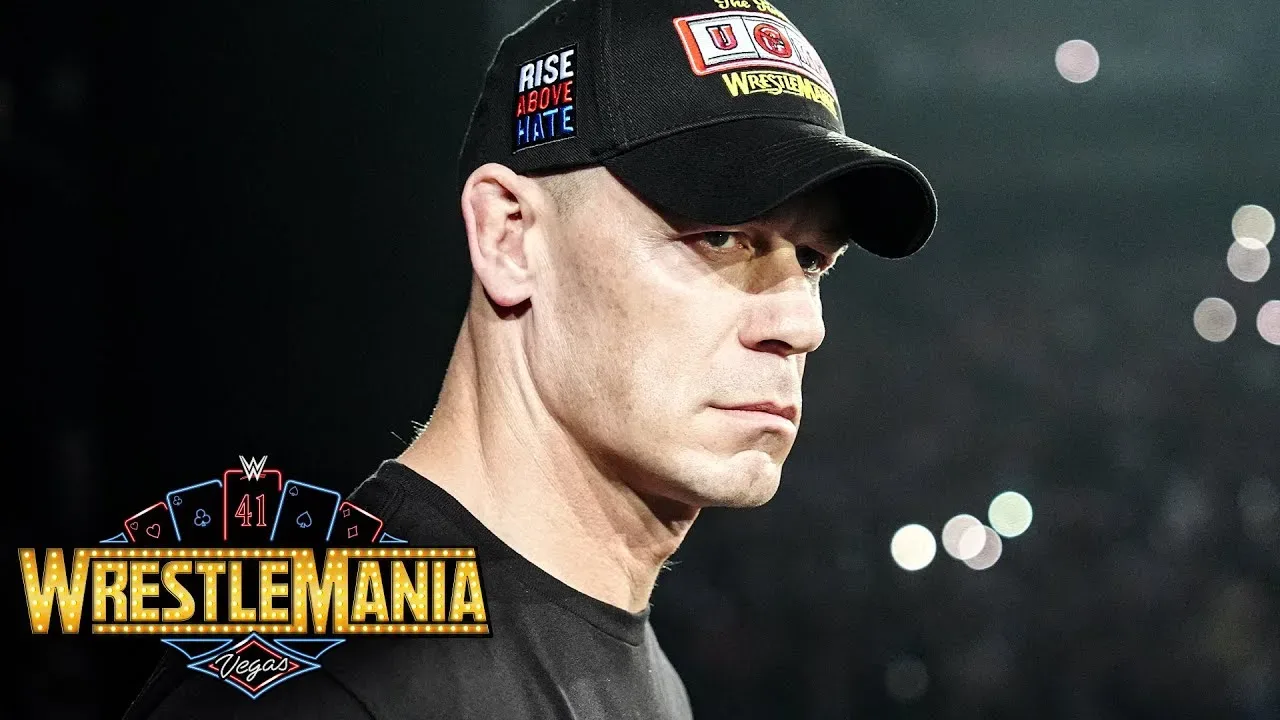
John Cena is not running from the criticism aimed at his WrestleMania 41 main event with Cody Rhodes. Instead, the WWE icon is using it as a central example in the message he delivers to younger performers: take ambitious chances, accept when they do not work, and be willing to make adjustments.
Cena headlined what was billed as his final WrestleMania when he defeated Rhodes for the Undisputed WWE Championship at WrestleMania 41. The bout was a pivotal chapter in Cena's retirement tour, with the veteran embracing a character direction centered on trying to “kill wrestling.” It was also a match that generated a sharply divided response, particularly due to Travis Scott's involvement and the wider creative presentation surrounding the championship change.
Rather than framing the event solely as a landmark title win or an emotional final WrestleMania appearance, Cena acknowledged that the match did not connect in the way WWE intended. He said the experience has become useful when discussing risk and creative confidence with wrestlers still finding their footing.
“I think it’s a great template for when I talk to young talent — and I try to do this all the time, I remind them to swing big and don’t be afraid to fail,” Cena said. “A lot of them think I’m talking from a glass house of like, ‘Yeah, sure, it must be easy for you, because you, you never fail.’ And then I’ll look back, especially on that last year because the retirement tour did have a lot of eyes, and I’ll say I took a big swing at WrestleMania and we stunk up the joint. We failed.”
For more background on this topic, read Ludwig Kaiser Defense Seeks Alleged Victim’s Medical Records in Battery Case.
Cena Sees Value in Taking the Big Swing
For Cena, the important part of the WrestleMania 41 story is not merely that the show received criticism. It is what followed. A performer with Cena's history could have chosen to defend the original plan, minimize the negative reaction, or retreat to a safer style of storytelling for the remainder of a farewell run. His view is that the better response was to acknowledge the misstep and help steer the program in a new direction.
The Cena-Rhodes rivalry continued after WrestleMania, eventually reaching its conclusion in the main event of SummerSlam. Their rematch took place under street fight rules and was received far more positively by fans. The contrast between the two matches has made the program an unusually clear illustration of how a story can evolve after an underwhelming first major chapter.
“But what did I do? I got back up, we dusted ourselves off, course-corrected the ship, and we culminated with a fantastic finishing of the story, as Cody would put it, at SummerSlam.”
That phrasing is notable because Cena does not place the responsibility for WrestleMania's reception on Rhodes, Travis Scott, or any single element of the presentation. He refers to “we” when discussing both the failure and the recovery. It is a perspective that reflects the collaborative nature of WWE's biggest matches, where in-ring execution, character work, production, outside involvement, timing, and audience expectations all contribute to the final result.
Rhodes, meanwhile, had the difficult responsibility of responding to a title loss on WWE's largest stage while continuing to carry the emotional investment fans had built around his championship journey. The SummerSlam street fight gave both men a new setting and a more direct vehicle for their conflict. It also gave the feud an opportunity to regain momentum after the WrestleMania reaction.
The Difference Between Criticism and Defeat
Cena's comments present a useful distinction between failing at an idea and being defined by that failure. WrestleMania 41 was a huge platform, and Cena recognized that his retirement tour brought additional scrutiny to every major decision. That spotlight made the response to his match with Rhodes impossible to ignore. Yet he believes the answer was not to avoid bold choices in the future.
Instead, Cena's lesson is that performers need to be prepared to respond honestly when an experiment falls short. Wrestling is built on audience engagement, and a creative direction that provokes discussion is not automatically successful. At the same time, a negative reaction does not have to end a rivalry or permanently damage the performers involved. The ability to course-correct can be as important as the original concept.
In Cena's case, the eventual SummerSlam bout changed the overall conversation surrounding the Cena-Rhodes series. Fans praised the street fight, and the match gave the program the kind of final chapter that Cena believed it needed. His use of Rhodes' familiar “finish the story” language also emphasized that the SummerSlam contest was intended to provide resolution after the WrestleMania outcome left many viewers dissatisfied.
The episode is especially relevant coming from Cena because he has spent decades as one of WWE's most scrutinized stars. Throughout his career, he has experienced every type of crowd reaction, from being embraced as the company's top hero to becoming a target of sustained fan criticism. His retirement tour has added another layer to that history. Each match, opponent, creative turn, and major appearance carries added weight because opportunities to see Cena in WWE are becoming increasingly limited.
Reflecting on the Final Match
Cena also addressed the creative direction of his final match, indicating that he deliberately chose a path that was not necessarily the most obvious. While he did not detail the specific alternatives considered, he made clear that easier options were available. He valued the decision to attempt something more daring, even with the understanding that the result would invite debate.
“As far as the last match goes, gosh, there were a lot of easy routes we could have gone creatively and I appreciate the bold swing at the end,” Cena said. “So, it’s authentically me. I didn’t leave anything in the tank physically. I gave it my all, got to work with a great opponent. I thought we had an ending that surely everybody talked about. Regardless of whether it was acclaimed or criticized, it sparked conversation and thought, which I think is really cool.”
The remarks underline a consistent philosophy from Cena: broad reaction matters, but a performer cannot build every major moment around the safest possible choice. He considers the conversation surrounding the conclusion meaningful, whether viewers praised it or rejected it. That does not erase his candid assessment of WrestleMania 41, but it does explain why he remains supportive of creative risks.
There is a difference, in Cena's view, between refusing to learn from criticism and being paralyzed by the prospect of it. The WrestleMania match is his evidence that even a heavily promoted, high-profile plan can fail to meet expectations. The SummerSlam rematch is his evidence that the work does not end once that happens.
The Cena Classic and His Focus on WWE's Future
Cena is now putting that mentorship approach into action through the Cena Classic. The tournament will feature main roster WWE talent competing against NXT wrestlers, creating opportunities for developing performers to share the ring with more established names. Rhodes was announced as the first invitee.
The concept fits naturally with Cena's stated advice to young talent. NXT wrestlers entering a setting like the Cena Classic will not simply be asked to execute moves or chase a single polished performance. They will be competing in situations where they must make an impression, adapt to the response around them, and potentially prove they belong alongside main roster stars.
For Cena, who has lived through the pressure of being WWE's face and the vulnerability of having a major creative swing miss the mark, that is an experience worth sharing. His reflections on WrestleMania 41 are unusually blunt, but they also offer an encouraging message. A bad night, a criticized match, or a failed idea does not have to be the end of a wrestler's story.
Cena and Rhodes ultimately found a way to bring their program to a satisfying finish at SummerSlam. Now, as Cena moves into a role that includes helping spotlight WWE's next generation, he is presenting that journey as a lesson: ambition comes with risk, and resilience is what determines what comes next.

Darryl Polo
Darryl Polo is a passionate wrestling fan covering WWE, AEW, TNA and beyond. He loves great rivalries, breakout stars and the moments that keep fans talking long after the bell. How we work.