
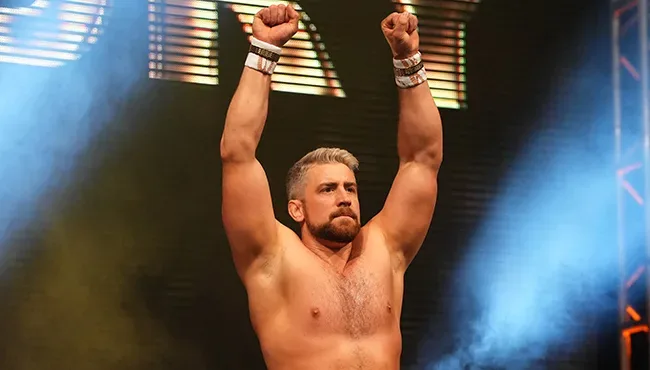
Joe Hendry has reflected on a pivotal moment from his rise through the United Kingdom wrestling scene, identifying a 2016 singles match against Drew McIntyre as the event that coincided with his decision to pursue professional wrestling full-time.
Before becoming part of the WWE roster, Hendry built his name through the UK independent circuit, a period that included working with McIntyre while the former WWE Champion was competing outside WWE under the Drew Galloway name. McIntyre was also working in TNA during that stage of his career, while Hendry was continuing to establish himself as a performer.
Speaking on Insight With Chris Van Vliet, Hendry was asked about his most recent one-on-one meeting with McIntyre. The discussion brought him back to an event in Edinburgh in 2016, held at Meadowbank, a venue that already held personal significance for him long before he entered the wrestling business.
“The last time I had a one-on-one match with Drew McIntyre was 2016,” Hendry said. “It was in Edinburgh, and it was at Meadowbank, which is an arena where I used to play sports when I was seven. I hadn’t even really thought of that until now, actually; that was the show where I quit the job I had at the time to go full time with wrestling. That was the show, 2016.”
For more background on this topic, read Joe Hendry Says All-Title Shot in New Music Video Was Real, Not AI.
The detail adds another layer to what was already a major career milestone. Meadowbank was not merely the location of a notable match against a wrestler with McIntyre’s profile. For Hendry, it was a building connected to his childhood, a place where he had participated in sports as a seven-year-old before professional wrestling became his chosen path.
Years later, Hendry can look back at that same setting as the backdrop for a decision that carried considerably more risk than stepping into the ring for a single match. Leaving a regular job to commit to wrestling full-time is a turning point many performers face, particularly those building their careers outside the major global promotions. The potential reward is clear, but so is the instability that comes with relying on wrestling bookings, travel, training, and the gradual process of developing a name in a crowded field.
A Meeting of Two Different Career Stages
Hendry’s 2016 bout with McIntyre took place at a distinctive moment for both men. Hendry was continuing his ascent in the UK scene, while McIntyre was in the midst of the highly successful post-WWE run that saw him perform internationally as Drew Galloway. McIntyre’s work during that period included TNA appearances, and he had become one of the most recognizable names available on the independent market.
For a developing wrestler, a singles match with an established talent can be an opportunity to test themselves in a meaningful setting. Hendry did not frame the contest as a career-making victory or offer details about the result, but he clearly attached lasting importance to the night because of the life decision that surrounded it.
That distinction matters. Wrestling careers are often discussed through championships, televised matches, and major signings. Hendry’s recollection instead centers on the personal commitment required before those larger opportunities arrived. The 2016 match in Edinburgh represented the point where he elected to remove the safety net of outside employment and bet on himself as a full-time wrestler.
It also serves as a reminder of the overlap between Hendry and McIntyre’s respective journeys. Both performers spent meaningful time building momentum beyond WWE before their paths eventually led to WWE opportunities. McIntyre’s return to WWE ultimately resulted in a run at the top of the company, while Hendry’s own route took him through the independent scene and TNA before he joined the WWE roster.
The Financial Reality Behind the Dream
Hendry’s story did not move in a straight line from quitting his job in 2016 to reaching his current position. He also described a difficult stretch during the COVID-19 pandemic, when a business he had been operating encountered problems. The situation came shortly before he joined TNA in 2022, and it forced him back into regular employment while he attempted to keep his business going and continue chasing wrestling.
His account is a candid illustration of how quickly circumstances can change for a wrestler working outside a guaranteed system. Even after committing to wrestling full-time, Hendry faced a period in which he had to take on a sales job, despite not having confidence in what he was being asked to sell.
“There was one point during lockdown, I had a business as well at one point, but there was one point where the business wasn’t doing so good,” Hendry said. “It was just before I went to TNA. I had to get a job, and it was really tough, man. It was a sales job. I did not have any faith in the product that was supposed to be selling. It was up at four in the morning to drive somewhere for five in the morning. You’re just like, ‘What has gone wrong here?’”
The pandemic created an especially harsh environment for wrestlers and independent businesses alike. With live events heavily affected, performers whose livelihoods depended on appearances, travel, and event-based work had to navigate an extended period of uncertainty. Hendry’s situation involved both the struggle of a business no longer performing as expected and the emotional difficulty of returning to a demanding day job while trying to preserve his larger ambitions.
Rather than presenting that experience as a footnote, Hendry described it as humbling. That word captures the contrast between having a business generating income and then reaching a point where full-time work was necessary in an effort to save that business and remain committed to wrestling.
“That was a very humbling experience,” Hendry said. “Being a pro wrestler and I’ve got this business that’s making money, and then for the business to start to not do so well, and like, ‘Oh man, I’m gonna have to work a full-time job to try and save the business,’ to try and pursue this pro wrestling thing. But again, I just I just kept going, just never gave up.”
Persistence Before TNA and WWE
Hendry joined TNA in 2022, a move that came after the difficult period he described. His comments place that signing in a broader context: it was not simply the next stop in a carefully uninterrupted climb, but an opportunity that followed a stretch in which he had needed to balance financial pressures, business concerns, and his wrestling goals.
That perspective gives additional weight to Hendry’s repeated emphasis on continuing forward. He did not claim that the struggle was easy, nor did he suggest that belief alone solved the practical challenges involved. Instead, his message was rooted in endurance. He continued working, attempted to protect his business, and stayed focused on a wrestling career even when the circumstances around him had changed dramatically.
Now a member of the WWE roster, Hendry has reached a level that makes those earlier crossroads especially notable. His recollection of Meadowbank demonstrates how individual moments can take on greater meaning in hindsight. At the time, the Edinburgh match was a one-on-one contest with Drew Galloway. Looking back, Hendry recognized it as the precise show where he made the leap into full-time wrestling.
The later return to day-job work before TNA did not erase that original commitment. If anything, it underscores the uneven nature of pursuing wrestling professionally. Going full-time is not always a permanent or linear condition; performers may have to make adjustments as opportunities, finances, and the wider industry shift around them.
For Hendry, the defining element is that neither the pressure of leaving a job in 2016 nor the setback during lockdown ultimately ended the pursuit. His story moves from childhood sports at Meadowbank, to facing McIntyre in the same venue, to a difficult pre-TNA chapter, and eventually to his place on the WWE roster.
His 2016 match with McIntyre remains a particularly fitting landmark because it connected several parts of that journey at once: his Scottish roots, his independent wrestling ambitions, and the moment he chose to make wrestling his full-time focus. Hendry’s later experiences show that the road after that decision was far from effortless, but his account makes clear that persistence was central to getting through each stage.

Darryl Polo
Darryl Polo is a passionate wrestling fan covering WWE, AEW, TNA and beyond. He loves great rivalries, breakout stars and the moments that keep fans talking long after the bell. How we work.