
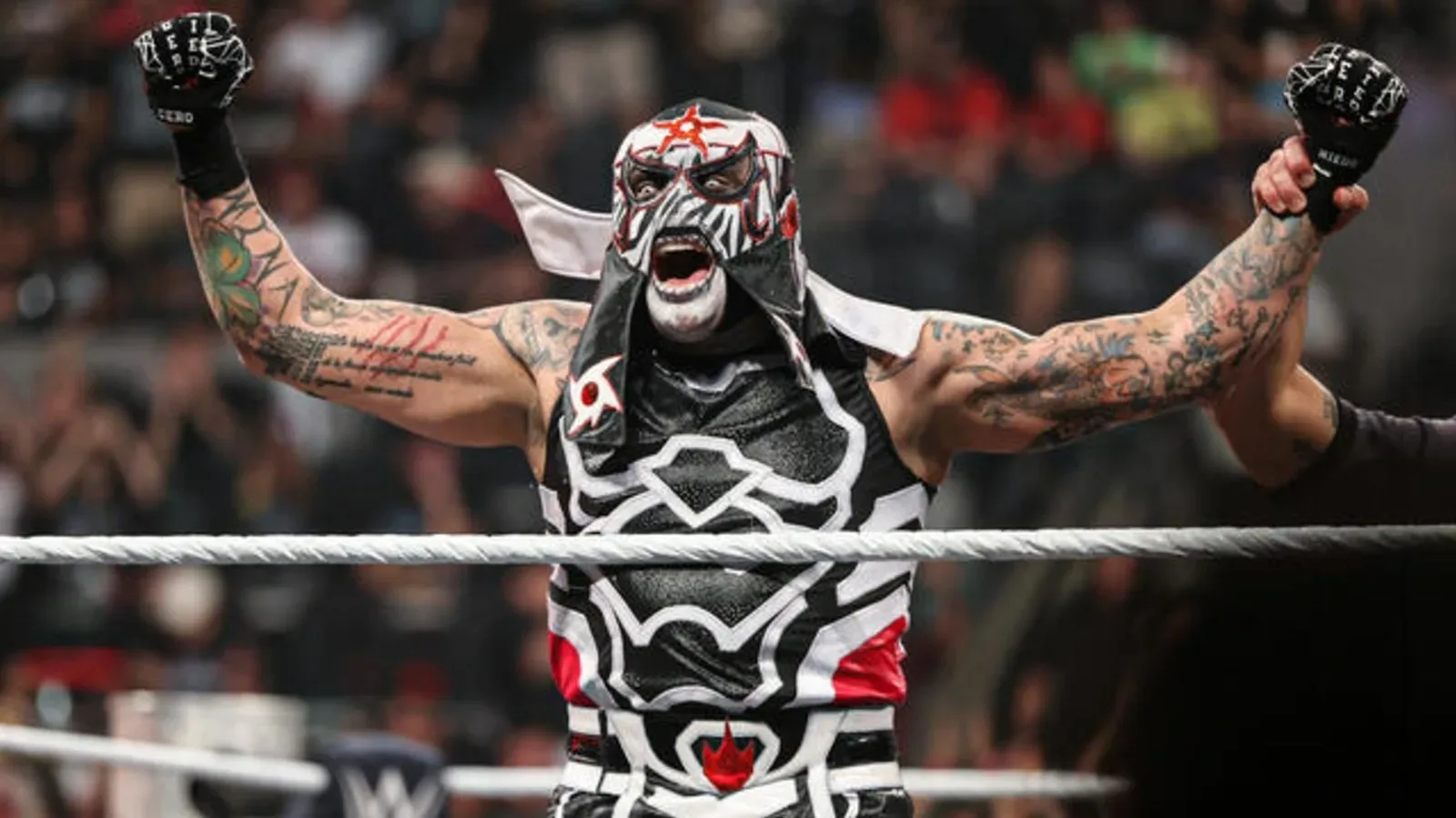
Joe Hendry has shared a warm story from WWE’s South America tour, crediting Penta and Penta’s family with helping him through an unexpected wardrobe problem while he was on the road.
For Hendry, the issue was more significant than simply needing a change of clothes. His on-screen presentation is closely tied to his signature blue shirt and white trousers, a recognizable part of the look audiences associate with him. But while traveling with WWE’s roster in South America, Hendry realized he had left both key pieces of that attire behind.
The situation was made more difficult by the circumstances surrounding the trip. Hendry said he had a black eye at the time and was attempting to shop for replacement clothing in places where he did not speak the language. With time and travel demands adding to the challenge, he knew he needed help from someone familiar with the area and able to point him in the right direction.
That person was Penta.
For more background on this topic, read Big Cass’ Raw Loss to Dragon Lee Raises Questions About WWE Direction.
Hendry turns to Penta for help
Speaking on Insight, Hendry explained that he had been unable to locate the blue shirt and white pants he needed. Since WWE’s itinerary was taking the group to Mexico, he decided to ask Penta whether he knew where Hendry could find suitable replacements.
“I was on the tour, I was trying to find a blue shirt and white pants and I just couldn’t do it,” Hendry said. “So I knew Penta was my guy.”
Hendry approached Penta and explained that he was stuck. Rather than offering directions to a store or simply suggesting where to look, Penta gave him a direct answer: “It’s taken care of.”
When Hendry arrived at the venue, the solution was waiting for him. Penta had arranged for a new blue shirt and a pair of white trousers, items Hendry felt were not merely passable replacements but a step up from what he had been using on WWE television.
Hendry praised both the quality of the clothes and Penta’s eye for style, describing the shirt as beautiful and the trousers as perfect for what he needed. The gesture resolved a potentially awkward practical problem during an international tour, while also ensuring Hendry could maintain the visual presentation fans expect from him.
Penta’s daughter handled the shopping
The story did not end with Penta arranging the gear. Hendry revealed that Penta’s daughter had gone out and purchased the clothing for him. When Hendry tried to find out how much he owed for the items, Penta would not accept payment.
“His daughter went out and got the stuff for me,” Hendry said. “I was like, how much did it cost? And he went, ‘No, it’s a gift from my family.’”
That response clearly stayed with Hendry. In recounting the experience, he emphasized that Penta’s help was not just a useful favor between colleagues. He viewed it as a reflection of the kind of people working together in WWE’s locker room.
Hendry called Penta a “fantastic performer” and a “great human being,” while stressing that he sees similar qualities in many of the people around him in WWE. For Hendry, the blue shirt and white trousers became a memorable example of camaraderie during the demanding routine of touring.
A small detail with major importance for a performer
Ring gear can be an essential piece of a wrestler’s identity. It helps establish a performer’s character before a match even begins, offering an immediate visual connection for a live crowd and television audience. In Hendry’s case, the blue-and-white combination is part of the presentation that accompanies his entrance, his music, and his broader persona.
Replacing that sort of attire on short notice is not always straightforward. Even when the clothing itself sounds simple, matching the color, fit, and overall look needed for television can become difficult, especially while moving between countries. Hendry’s circumstances were even more complicated because he was navigating language barriers and dealing with the visible black eye he mentioned.
Penta’s intervention allowed Hendry to avoid having to settle for an outfit that did not feel right for his character. More importantly, it removed one more concern from a wrestler’s schedule during an overseas run, where performers are focused on travel, appearances, preparation, and matches.
Hendry’s praise also pointed to the personal side of life in a major wrestling company. WWE’s roster includes talent from numerous countries and backgrounds, and international tours can create moments where those different experiences become particularly valuable. In this instance, Penta’s familiarity with Mexico and the support of his family gave Hendry exactly the assistance he needed.
Hendry highlights WWE locker-room camaraderie
The anecdote was ultimately less about clothing than the relationships built between performers. Hendry specifically presented the moment as evidence of the support system that exists among WWE talent.
Professional wrestling is competitive by nature. Wrestlers are seeking opportunities, fighting for crowd reactions, and trying to make the most of limited time in front of audiences. Yet Hendry’s story illustrated the cooperation that can exist away from the spotlight, particularly when somebody on the roster encounters a real-life issue that needs to be solved quickly.
Penta did not make Hendry’s situation a transaction. By having the clothing obtained and then declining payment, he and his family turned the assistance into a gift. Hendry’s recollection made clear that the generosity mattered as much as the practical outcome.
It also offered another glimpse at the regard Penta has earned from fellow WWE performers. Hendry’s comments were rooted in a specific personal experience rather than a broad claim, but he spoke enthusiastically about Penta as both an in-ring talent and a person outside the ring.
For Hendry, a forgotten blue shirt and white trousers could have become an embarrassing headache during a high-profile international trip. Instead, because Penta stepped forward, the situation ended with Hendry receiving gear he felt was better than his usual television attire.
The story stands as a simple but meaningful reminder that the moments wrestlers remember from the road are not always matches, championships, or major announcements. Sometimes they are the gestures made by another performer and that performer’s family when help is needed most.
In pictures

Darryl Polo
Darryl Polo is a passionate wrestling fan covering WWE, AEW, TNA and beyond. He loves great rivalries, breakout stars and the moments that keep fans talking long after the bell. How we work.