
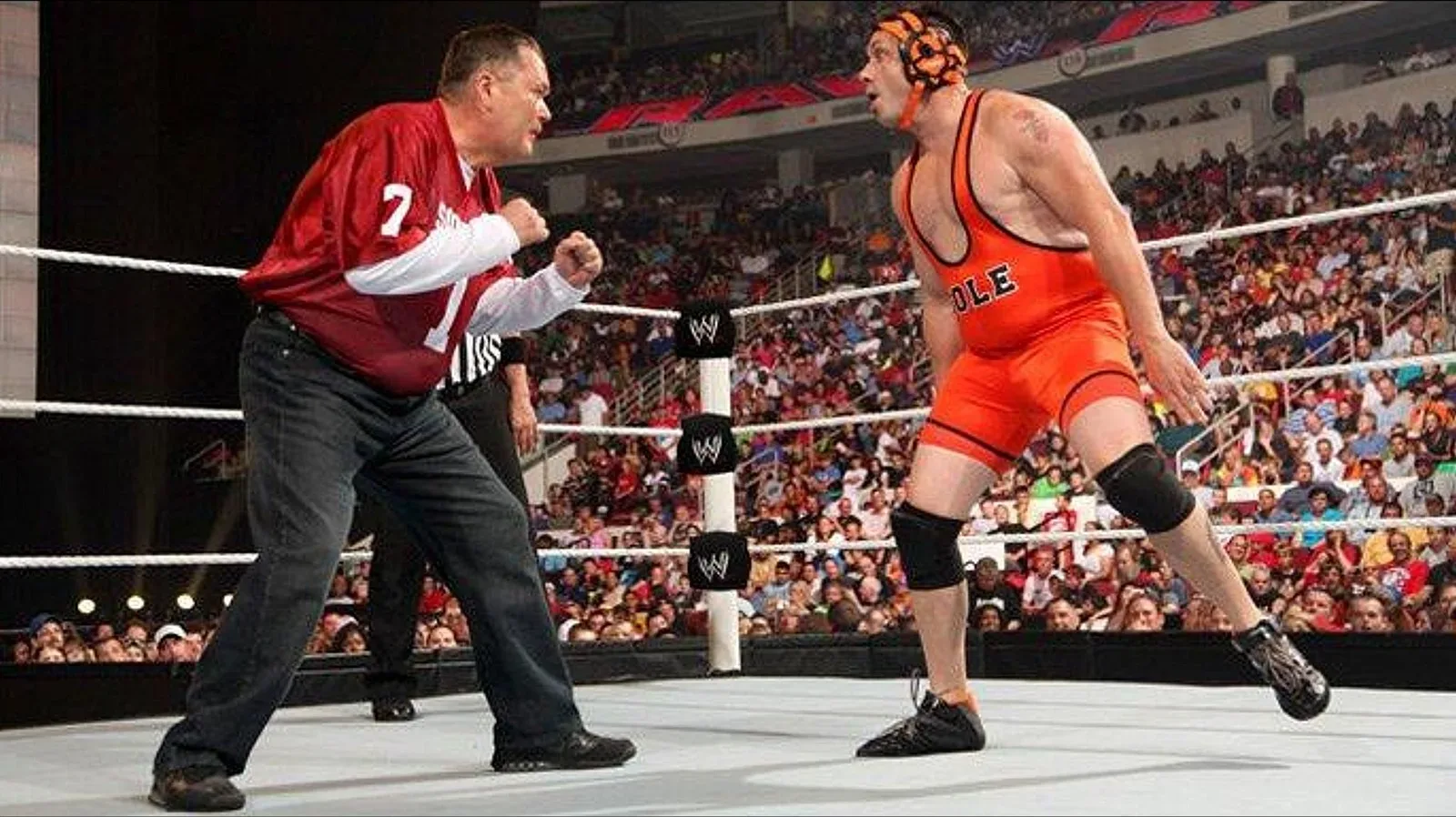
Jim Ross was one of the most recognizable voices in WWE history long before he ever took a bump or stood across the ring from an opponent. His calls helped define major eras, his on-screen presence made him a trusted authority figure, and his connection with viewers meant that WWE could credibly place him in physical storylines when it wanted an emotional reaction.
Ross did exactly that on several occasions. He moved away from the announce desk to become involved in angles with names including Eric Bischoff and Michael Cole, and he also took part in a memorable tag-team match alongside John Cena against Alberto Del Rio and Cole. Those segments showed a side of Ross that audiences were not accustomed to seeing: vulnerable, angry, defiant, and at times willing to fight back.
But Ross has made clear that he never viewed those moments as an ideal use of television time. Speaking on Grilling JR, the longtime broadcaster reflected on his discomfort with being asked to work in the ring, particularly when WWE had a full roster of trained performers who could have benefited from greater exposure.
“I don't need to be in the ring doing this, I've not been trained, I got common sense but (...) it takes away from talents,” Ross said.
For more background on this topic, read AJ Styles Reflects on Undertaker’s Final Match and Wishes Their WrestleMania Clash Happened Sooner.
The point Ross raised is not simply about whether an announcer can participate in a match. WWE has long used commentators, executives, celebrities, managers, and other non-wrestling personalities in physical angles. When used effectively, those appearances can add heat to a feud or give a wrestler a particularly satisfying target. Ross himself understood the dramatic value of that formula. Fans knew him as a familiar and respected voice, so an attack on him could generate immediate anger toward the person responsible.
Still, Ross believes the time spent building and presenting those angles might have been better given to wrestlers seeking a chance to advance. WWE television is finite, and Ross stressed that once the time available to create content is gone, it cannot be reclaimed. His concern was that an angle centered on a commentator could take a spot away from someone whose long-term role was to perform in the ring.
Ross Questions the Use of a Non-Wrestler
Ross' reservations were also practical. He was not trained as a professional wrestler, and he did not see himself as someone who should be working the same physical style or schedule as the men and women on WWE's active roster. In discussing the subject, he noted that he would not have been working house shows, another distinction between an occasional television attraction and a full-time in-ring performer.
That difference mattered to him. A wrestler receiving a featured television segment could potentially use it to establish a character, build momentum, earn a place on premium live events, and prove their value to decision-makers. Ross believed active talent should have been the priority in those situations.
His comments also offer an unusually candid look at how he evaluated his own popularity. Ross did not deny that fans responded when he was placed in peril or when he finally had the opportunity to retaliate. He acknowledged that audiences cared about his selling, even expressing some surprise that “Ol' JR” had managed to get over in those storylines.
That reaction was not accidental. Ross had spent years developing a relationship with WWE viewers from behind the desk. His commentary was emotional without feeling forced, and he often gave major matches a sense of importance. By the time WWE put him into feuds, fans had heard him call countless triumphs, betrayals, title changes, and personal rivalries. They had a strong investment in him as a personality even though he was not presented as a wrestler.
In that sense, Ross' later assessment is balanced. He recognizes why the angles worked, but he remains uneasy about the broader choice to feature him physically. The crowd reaction was real, yet he does not believe that automatically made him the best use of the segment.
A Proven Formula in WWE Storytelling
WWE has repeatedly used announcers in storylines because the format can produce a different kind of emotional payoff than a standard match. A commentator is generally expected to observe and explain the action, not become part of it. When that boundary is crossed, the situation can feel more personal. A villain attacking an announcer can appear especially cruel, while a beloved broadcaster standing up for himself can create a memorable underdog moment.
Ross was a natural fit for that kind of storytelling because he was so closely associated with WWE's presentation. Yet the same qualities that made him effective also explain his criticism. He had already succeeded in his core role. He did not need an in-ring program to establish who he was, and he did not need the match time to become more visible to fans.
For Ross, that was the central issue. An established commentator receiving a featured angle could certainly draw interest, but a younger or underutilized wrestler might have needed that platform far more. His perspective places the emphasis on roster development rather than the immediate novelty of seeing a familiar voice get physical.
Ross had spoken earlier in the month about the embarrassment he felt when stepping into the ring. He said his success in match-related angles was rooted in the popularity he had already earned as a commentator, rather than any belief that he belonged in the role of a wrestler. That distinction remains important in his latest reflection. Ross was not dismissing the audience's investment; he was questioning whether that investment should have led WWE to keep using him in that capacity.
The Cena Team-Up Remains a Positive Memory
Despite his overall reluctance, Ross does not look back on every in-ring appearance negatively. He specifically recalled his pairing with John Cena with considerable affection. Ross and Cena teamed against Alberto Del Rio and Michael Cole, a matchup that brought together two rival commentary personalities and two WWE stars from the active roster.
“What a mighty team we made!” Ross said of working with Cena against Del Rio and Cole on Grilling JR.
The match is an example of why WWE continued to return to the formula. Cena was already one of the company's top attractions, Del Rio had a prominent role, and the Ross-Cole conflict gave the audience an additional emotional hook. Ross' presence did not replace the star power around him; instead, it added a personal wrinkle to a program involving major television figures.
That does not contradict Ross' broader argument. A memorable experience with Cena can coexist with his belief that he should not have regularly occupied a wrestler's spot. He can appreciate the entertainment value, the crowd response, and the chance to share the ring with Cena while still maintaining that active talent should have been positioned first.
It is also notable that Ross frames the issue around opportunity rather than resentment. His comments do not suggest that he failed to understand why WWE booked him into these angles. Rather, he is looking back with the perspective of someone who spent decades around wrestlers and understood how difficult it could be for performers to receive meaningful television time.
Ross' Legacy Was Built at the Desk
Ross' legacy in WWE was never dependent on a match result or a physical confrontation. It was built through his ability to make viewers feel the significance of what was happening in front of them. Whether he was calling an explosive main event, reacting to an unexpected turn, or giving a major rivalry its emotional weight, Ross' voice was a vital part of the presentation.
That established connection is precisely why WWE could generate such a reaction when he was pulled into a storyline. Fans did not respond because Ross suddenly became a conventional in-ring athlete. They responded because he was Jim Ross: a trusted fixture whom audiences had invited into their living rooms for years.
Ross now sees the tradeoff more sharply. The physical angles proved that fans cared about him, but he believes the same valuable television minutes could have helped performers who were trying to get over and create their own lasting connection with the audience. For a commentator who has always understood the importance of making talent matter, that remains the part of the experience he cannot ignore.
In pictures

Darryl Polo
Darryl Polo is a passionate wrestling fan covering WWE, AEW, TNA and beyond. He loves great rivalries, breakout stars and the moments that keep fans talking long after the bell. How we work.