
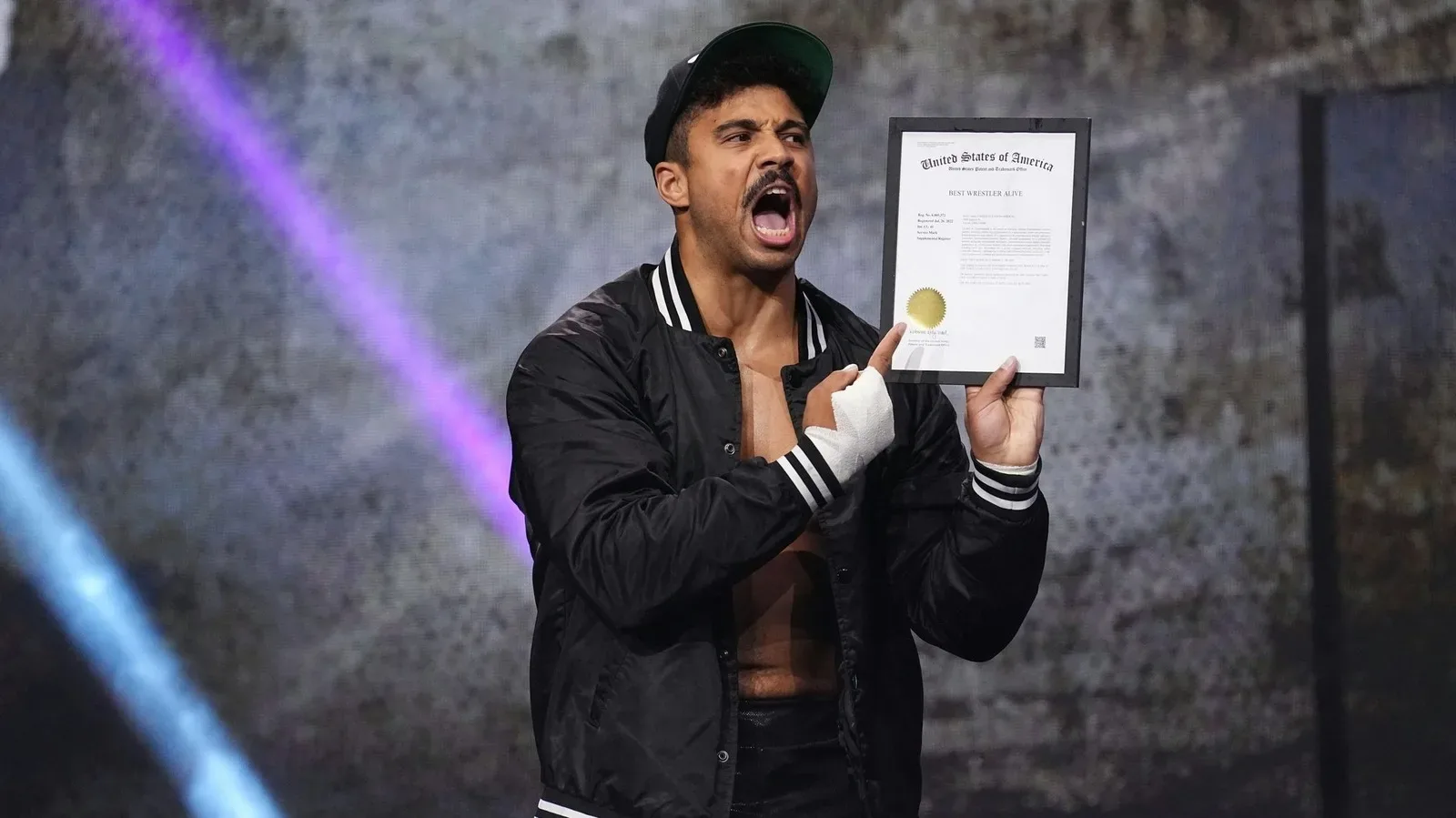
Jeff Jarrett has shared his thoughts on the controversy surrounding Max Caster’s brief TNA Wrestling run, identifying the lack of an immediate public response from Caster as the most disappointing part of the situation.
Caster’s TNA debut became the focus of widespread backlash after a rap delivered during his appearance crossed into political and religious subject matter. The former AEW performer was subsequently fired by TNA. He later issued an apology to fans and the company, then announced a few days afterward that he would be stepping away from professional wrestling for a while.
Speaking on My World, Jarrett made clear that he was viewing the matter from outside the situation and did not claim to know every detail behind the scenes. Still, the WWE Hall of Famer felt Caster needed to address the fallout directly and quickly once the rap had aired.
“We’re at least 24 hours in, and you know what the biggest thing that is disheartening to me as it stands today, and look, I don’t know, Conrad, I am so far on the outside looking in, but obviously Max said it, and I saw the TNA statement. But Max, buddy, we need to hear from you. You have to at least, like, I mean, how can you not go, you know, I probably should, like, get out and talk about it. You scre*ed up. Own it. I mean, take accountability for it.”
For more background on this topic, read Avery Styles Reportedly Seen in Walking Boot After TNA’s Dothan Tapings.
Jarrett’s comments centered less on relitigating the content of the rap itself and more on what he believes should happen when a wrestler makes a mistake on a public stage. In his view, the most important next step is not silence, speculation, or waiting for a company statement to control the discussion. It is the performer acknowledging the error and taking responsibility for it.
That perspective is especially notable given the speed at which controversial moments can travel in modern wrestling. A promo, entrance, social-media post, or live-event appearance can be clipped, shared, debated, and reframed almost immediately. In that environment, Jarrett argued that a wrestler has to recognize when an issue has become bigger than the intended performance and respond with clarity.
Jarrett Says Politics and Religion Have No Upside in Wrestling Promotion
Jarrett also explained why he considers political and religious commentary particularly risky territory for a wrestling product. His argument was not that those subjects lack importance in the broader world. Instead, he stressed that they are deeply personal matters that can quickly divide an audience and pull attention away from the show itself.
“We go out of our way [to not talk about], and rightly so, because politics and religion are a very personal matter that alienate your audience. There’s no upside. None. I hate it, man. I hate it for TNA. I hate it for Max. I hate it for the business because people are talking about that out of an event as opposed to, god, I don’t even know matches.”
That final point captures the larger concern Jarrett expressed. Wrestling promotions spend considerable time building cards, establishing stories, developing talent, and creating memorable matches. When one controversy becomes the dominant topic after an event, it can consume the conversation that otherwise might have gone toward the in-ring product.
For Jarrett, that is damaging on multiple levels. He said he hated the outcome for TNA, which had to issue a statement and move forward after Caster’s firing. He also said he hated it for Caster, whose debut and departure became defined by the backlash rather than an opportunity to establish himself in a new environment. And he viewed it as harmful to the business generally because attention shifted away from the rest of the event.
The distinction matters because wrestling thrives on reaction. Promotions want audiences discussing angles, rivalries, promos, character turns, and matches. Controversy can certainly generate attention, but not every form of attention benefits a company or a performer. Jarrett’s position was that discussions involving personal political and religious beliefs do not create a worthwhile upside for a wrestling broadcast or live event when they instead risk alienating fans.
Caster Eventually Apologized Before Announcing a Break
Following the incident, Caster did apologize to TNA and its fans for the controversial rap. His apology came after the initial period Jarrett referenced, when the issue had already become a major point of discussion. A few days later, Caster announced that he would be taking time away from professional wrestling.
The sequence is central to Jarrett’s criticism. He did acknowledge that Caster ultimately spoke publicly, but he believed the response should have happened sooner. From Jarrett’s perspective, the delay allowed the situation to remain unresolved in the public eye while fans and observers waited to hear directly from the person responsible for the remarks.
There is an important difference between a company responding to an incident and the performer at the center of it responding personally. TNA’s statement established the promotion’s position. Jarrett, however, argued that Caster also needed to communicate that he understood the problem and accepted accountability. His comments did not suggest that an apology would erase the controversy or guarantee a different professional outcome. Rather, he framed it as the necessary first step after making an error.
Caster’s decision to step away from wrestling means there is no immediate next chapter to the situation inside a ring or on a televised program. For now, the story remains one about a debut that rapidly turned into an exit, and about the responsibilities attached to speaking freely within an entertainment setting that reaches a broad and varied audience.
WWE Speculation Has Surrounded the TNA Departure
The circumstances of Caster’s exit also led to speculation about whether WWE had any involvement. Some people believed his departure was connected to WWE’s partnership with Saudi Arabia, particularly because of the close relationship between WWE and TNA.
However, reports have indicated that WWE has distanced itself from the matter and said it had no say in Caster’s exit from TNA. That leaves the issue centered on TNA’s own response to Caster’s rap and the company’s decision to fire him, rather than on an outside directive.
The speculation illustrates how quickly wrestling controversies can expand beyond the original incident. Once questions arise about a promotion’s business relationships, talent movement, or corporate connections, the discussion can become crowded with assumptions. Jarrett’s remarks pulled the focus back toward the more immediate issue: what Caster said, how it affected TNA, and the importance of personal accountability after the fact.
Jarrett was careful to say that he was not speaking from a position of inside knowledge. He did not present himself as someone who knew every conversation or decision that followed the debut. His criticism instead came from his long experience in the wrestling industry and his belief that performers and promotions should avoid putting themselves in situations where an event’s wrestling is overshadowed by avoidable controversy.
The Broader Lesson From a Short-Lived TNA Run
The Caster situation is a reminder that wrestling promos and raps, even when designed to provoke a reaction, exist within real-world boundaries. Wrestlers have long used insults, local references, current events, and personal attacks as tools to draw heat. But the objective is normally to build a match, elevate an opponent, or strengthen a storyline. When a performer veers into subjects that audiences see as personal or inflammatory, the reaction can move beyond conventional heel heat.
Jarrett’s comments suggest that the practical question is not simply whether material is provocative. Wrestling has always been provocative. The question is whether the material serves the show and whether there is any real benefit that outweighs the risk of alienating fans, sponsors, fellow talent, or the promotion itself.
In this case, Jarrett did not see one. He repeatedly emphasized that there was “no upside” to involving politics and religion in that way. His frustration was rooted in the sense that TNA and Caster both lost something from the outcome: the promotion lost attention for its event, while Caster lost the chance to make his new start the story.
For Caster, the immediate future is defined by his announced hiatus. For TNA, the priority will be keeping the focus on its roster, matches, and upcoming programming rather than a moment that ended with a talent departure. And for Jarrett, the episode appears to stand as a straightforward lesson in judgment: if a performer makes a public mistake, acknowledge it promptly, own it fully, and understand that some topics are more likely to divide an audience than enhance a wrestling product.
In pictures

Darryl Polo
Darryl Polo is a passionate wrestling fan covering WWE, AEW, TNA and beyond. He loves great rivalries, breakout stars and the moments that keep fans talking long after the bell. How we work.