
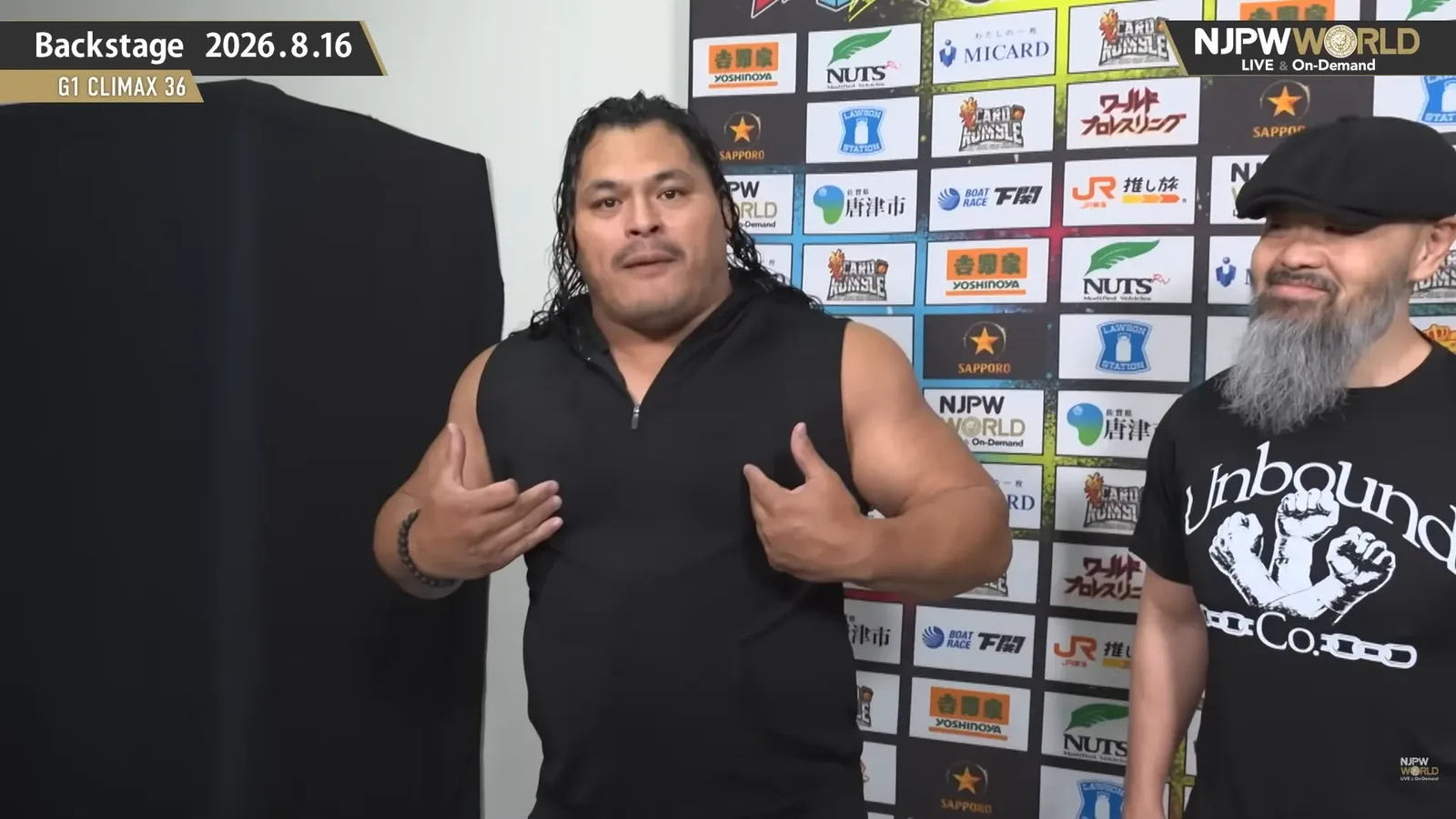
Jeff Cobb has opened up about the difficult period that followed his WWE release, revealing that he briefly considered whether his time in professional wrestling was over.
Cobb, who performed in WWE as JC Mateo and was associated with the MFTs, spent less than a year with the company before being released in May. His exit was followed by a stretch away from the ring that left him questioning his relationship with wrestling itself. The former WWE talent ultimately returned to NJPW in August, but he has now explained that a return to Japan was not an immediate certainty in his mind.
Speaking on Insight with Chris Van Vliet, Cobb was asked whether he had always expected to go back to NJPW following his departure from WWE. He said that while part of him did see that as a possible destination, another part had reached a point of frustration and exhaustion with the business.
“A part of me, yes, but then a part of me was kind of like, I don’t really like wrestling anymore. So May was rough. I didn’t work out. I didn’t do anything. I was just like, I didn’t like wrestling. The first time I have ever been like that, where I was like, man, what the hell?”
For more background on this topic, read WWE NXT Preview: Vanity Project Defends Tag Titles Against Noam Dar And Romeo Moreno On November 10.
The comments offer an unusually candid look at the emotional aftermath of a release. Wrestlers often move quickly from one opportunity to another, particularly performers with Cobb’s résumé and international experience. In Cobb’s case, however, the period after WWE was not simply about identifying the next promotion or accepting the next match. He said he stepped away from training and found himself disconnected from a profession that had long been a major part of his life.
Cobb does not place blame on WWE
Although Cobb described May as rough, he was clear that he was not putting the responsibility on WWE. Instead, he pointed to the internal pressure that wrestlers can place upon themselves and the tendency for performers to scrutinize their own work more severely than anyone else.
“I’m not blaming WWE. I mean, you know, us as wrestlers, we’re kind of our biggest critics. If I do a match or something, and I come back and say, oh, that was good, and I was like, we could have done this a little bit better, whatnot. So, we’re always our harshest critic, right?”
Cobb’s WWE tenure was brief but active. He wrestled 40 matches during his time with the company, including 19 television matches, while appearing as JC Mateo in the MFTs orbit. The total demonstrates that he was used consistently during the period, even if his run did not develop into a longer-term stay.
For a wrestler who had previously established himself across multiple major stages, the transition out of WWE appears to have created a difficult moment of reflection. Cobb’s comments did not frame the issue as one singular disappointment or one particular creative decision. Rather, he described a broader loss of enthusiasm that emerged after his release and led him to wonder whether continuing in wrestling was what he wanted.
That distinction is significant. Cobb did not say that WWE caused him to dislike wrestling, nor did he characterize his return to NJPW as a simple continuation of a plan that had been in place from the beginning. His account suggests that the time away was necessary for him to evaluate what he wanted from the next stage of his career.
Retirement crossed Cobb’s mind
When directly asked if retirement was something he considered, Cobb confirmed that it was.
“Yeah, I was like, man, was that it? But then at the same time, I was like, I don’t want to really end on that note. So, I kicked out.”
The final line reflects the decision that brought Cobb back to NJPW. Rather than allowing his WWE release to become the last chapter of his wrestling career, he chose to continue. His phrasing also makes clear that the decision was not rooted merely in finding another place to work. Cobb did not want his last experience in the industry to be the defining conclusion of his career.
That response has now led to a fresh role in NJPW, where Cobb returned in August and aligned himself with Unbound Co. The return gave him a renewed place on the roster and quickly resulted in championship success.
A new chapter with Unbound Co
Cobb is currently one-third of the NEVER Openweight Six-Man Tag Team Champions alongside the Knockout Brothers, OSKAR and Yuto-Ice. The trio’s championship status gives Cobb an immediate competitive purpose following a period when he was unsure whether he wanted to wrestle at all.
The NEVER Openweight Six-Man titles have often been a platform for factions and trios to establish their identity in NJPW. For Cobb, holding the championship with OSKAR and Yuto-Ice places him directly within the company’s ongoing tag team and group-based landscape. It also signals a substantial turnaround from the inactivity he described after his May release.
His alignment with Unbound Co represents a clear contrast to the uncertainty he felt immediately after WWE. At that point, Cobb said he was not working out or doing anything related to his usual athletic routine. Now, he is back in an active championship role with a defined group and two partners.
There is no indication from Cobb’s comments that his return to NJPW erased the difficulties of the preceding months overnight. What he did make clear is that he eventually found a reason to continue. His decision was shaped by the belief that he did not want to leave the industry on the note of his WWE release.
From WWE departure to NJPW champion
Cobb’s situation underlines how rapidly circumstances can change in professional wrestling. In May, he was released after less than a year in WWE and entered a period where the thought of retirement became real. By August, he was back in NJPW. He is now a NEVER Openweight Six-Man Tag Team Champion as part of Unbound Co.
The path was not presented as easy or inevitable. Cobb’s own words make that clear. He was not immediately eager to resume wrestling, and he acknowledged that the mental side of being a performer can be especially demanding because wrestlers regularly analyze what they could have done differently. That self-criticism can remain present even after a match that is broadly seen as successful.
Still, Cobb’s experience ultimately ended with a choice to move forward. “I kicked out” was a concise way to describe it, but it also captured the larger point of his story: he considered stopping, decided that his previous run would not be the ending, and found his way back into a prominent NJPW position.
Elsewhere in the interview, Cobb also discussed WWE plans that he had heard about but that did not come to fruition. However, his reflections on retirement and his eventual NJPW return stand as the most personal part of the conversation. They show that even an accomplished wrestler with multiple options can reach a point where continuing is not automatic.
For now, Cobb’s focus is back in NJPW, where he and the Knockout Brothers hold the NEVER Openweight Six-Man Tag Team Championship. After a May in which he questioned whether he still wanted to be involved in wrestling at all, the former JC Mateo has found a new chapter—and, by his own account, a better ending than the one he feared might already have arrived.

Darryl Polo
Darryl Polo is a passionate wrestling fan covering WWE, AEW, TNA and beyond. He loves great rivalries, breakout stars and the moments that keep fans talking long after the bell. How we work.