
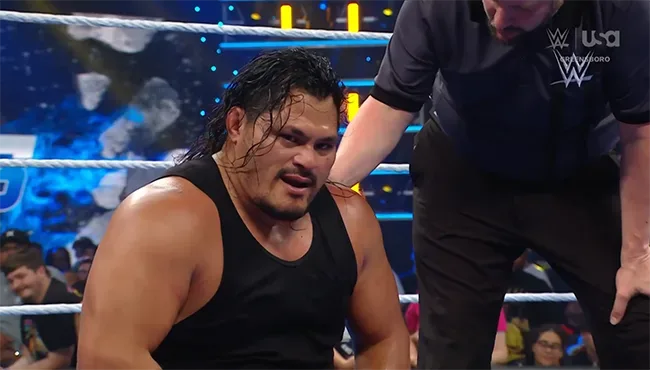
JC Mateo’s WWE arrival took him in a very specific direction: into Solo Sikoa’s orbit and, eventually, into the faction known as The MFTs. But before that presentation became clear, there was speculation among fans about a very different fit for the powerhouse formerly known as Jeff Cobb.
Speaking on Insight with Chris Van Vliet, Mateo recalled hearing fan fantasy-booking that would have placed him alongside Bronson Reed. The idea, as Mateo understood it, was to create a modern heavyweight pairing inspired by The Natural Disasters, the classic WWE tandem of Earthquake and Typhoon.
Mateo said he was not initially aware that his placement with Sikoa’s group had been the intended creative pitch. Instead, he had heard various rumors and fan discussions about potential plans following his move to WWE. One of the more memorable suggestions involved Reed, whose size and hard-hitting style make him a natural match on paper for another athlete with Mateo’s physical profile.
“Well, my strong family lineage, right? I didn’t even know that was the pitch to begin with because I heard a couple other rumors out there as well. I mean, just rumors from fans fantasy booking that I was like, oh, they’re gonna put you with Bronson Reed and be like the new Natural Disasters. I was like, oh man, so it would be like tsunami and volcano or something?”
For more background on this topic, read Jeff Cobb Reveals ‘JONAH’ and ‘Jafar Smash’ Were Considered as WWE Name Options.
From Jeff Cobb to JC Mateo
Mateo signed with WWE in May 2025 and made his debut at WWE Backlash. His first major association on the main roster came through Solo Sikoa, as he aligned himself with the version of The Bloodline that Sikoa had assembled. Though Mateo is not part of the Samoan family lineage central to the group’s identity, the alliance positioned him beside a collection of established and imposing names.
That unit later evolved into The MFTs, featuring Sikoa, Mateo, Tama Tonga and Tonga Loa. The group’s makeup gave Mateo an immediate role within a larger WWE story rather than introducing him as a completely independent act. For a performer transitioning into a new company, that type of placement can define the first phase of a WWE run, particularly when it connects a debuting wrestler to an ongoing faction dynamic.
Mateo’s comments make clear that he had not viewed the group assignment as the obvious expectation before it happened. The conversation about “strong family lineage” addressed the unusual aspect of a performer outside the Samoan family tree being connected to a group built around Sikoa and the broader Bloodline framework. In WWE, factions often operate through both literal family relationships and storyline loyalty, and Mateo’s role fell into the latter category.
The eventual MFTs lineup did not include Bronson Reed. Reed instead became aligned with The Vision, putting the two heavyweights on separate paths rather than establishing them as a regular tandem.
The Natural Disasters Comparison
The fan idea Mateo referenced was based on a simple and recognizable wrestling concept: two enormous athletes paired together under a shared presentation. The Natural Disasters were an especially easy historical comparison because their names, visuals and combined size created an instantly understandable tag team identity. Mateo’s joking response leaned into that kind of theme, suggesting “tsunami and volcano” as possible names or imagery for a hypothetical partnership with Reed.
It was a lighthearted remark, but it also shows why the concept gained traction in fan discussion. Reed has long used the “Tsunami” name for his splash, while Mateo’s explosive power and amateur wrestling background have helped establish him as a credible force in his own right. A team featuring both men would have offered WWE a straightforward size-versus-size spectacle and a potentially destructive presence in the tag team division.
However, there is an important distinction between fans identifying an appealing matchup and WWE making it an actual creative plan. Mateo described what he heard as rumors and fantasy booking. He did not state that a Reed partnership was officially pitched, planned or considered internally. The discussion was instead about the many possibilities fans raised while his WWE future was taking shape.
That uncertainty is significant because wrestler arrivals frequently create a wave of speculation around potential names, alliances and directions. In Mateo’s case, the possibilities ranged from entering a heavyweight tag team to joining Sikoa’s faction. WWE ultimately chose the latter route, and his onscreen identity became connected to The MFTs rather than a new partnership with Reed.
Reed Took a Different WWE Direction
Bronson Reed’s WWE path also developed separately. Before signing with WWE, Reed was known as JONAH, a name that carries added relevance to Mateo’s interview comments. Mateo revealed elsewhere in the conversation that JONAH had been among the names he could have used upon joining WWE.
The detail underlines how much can change during a wrestler’s transition from one promotion and persona to another. A name is not merely a label in WWE; it can influence how a performer is presented, how audiences first identify them and whether a new character is framed as a continuation of prior work or a fresh chapter. Mateo ultimately became JC Mateo, while Reed’s previous JONAH identity remained part of his own career history.
Reed’s eventual alignment with The Vision ensured that the rumored heavyweight duo never materialized. Rather than working as a single unit, he and Mateo became associated with different groups and different creative structures. That does not rule out future interactions between the two, but Mateo’s comments did not point to any current plan for a partnership, rivalry or reunion of the fan concept.
For now, the key takeaway is that the idea existed in the realm of fan speculation, not as a confirmed WWE storyline that was later abandoned. Mateo’s account was humorous and reflective, centered on how wrestling audiences often begin mapping out possible roles for an incoming performer before the company reveals its actual direction.
The Importance of Immediate Placement
Mateo’s debut at WWE Backlash and subsequent placement beside Sikoa gave WWE a defined way to introduce him. Rather than requiring fans to wait for a long series of matches to understand his position, the association immediately established him as someone connected to a powerful group. That kind of introduction can be particularly useful for a wrestler whose reputation was built outside WWE, because it supplies context for the broader WWE audience while allowing the performer to show his strengths within a high-profile framework.
At the same time, the Bronson Reed speculation illustrates an alternate version of that introduction. A tag team could have emphasized Mateo’s physicality through a more direct presentation: two large athletes overwhelming opponents and relying on a shared theme. The MFTs role, by comparison, made him part of a factional hierarchy centered around Sikoa and the group’s collective agenda.
Neither approach is inherently the only fit for Mateo. His background and in-ring power make a variety of WWE roles conceivable, whether as a faction enforcer, a tag team wrestler or a singles competitor. But the route that became reality was the MFTs route, while the Reed concept remains an example of the creative possibilities fans discussed before the picture came into focus.
Mateo’s recollection also offers a small look at the gap between external expectation and WWE’s eventual decisions. Fans saw two sizable wrestlers and imagined a revival of a familiar big-man tag team formula. WWE instead put Mateo with Solo Sikoa, Tama Tonga and Tonga Loa, while Reed found his place with The Vision.
As a result, the “tsunami and volcano” idea remains just that: a memorable hypothetical from Mateo, not an established WWE pairing. Still, it is the sort of idea that demonstrates how quickly audiences look for connections when new talent arrives—and how different the final presentation can be once WWE commits to a direction.

Darryl Polo
Darryl Polo is a passionate wrestling fan covering WWE, AEW, TNA and beyond. He loves great rivalries, breakout stars and the moments that keep fans talking long after the bell. How we work.