
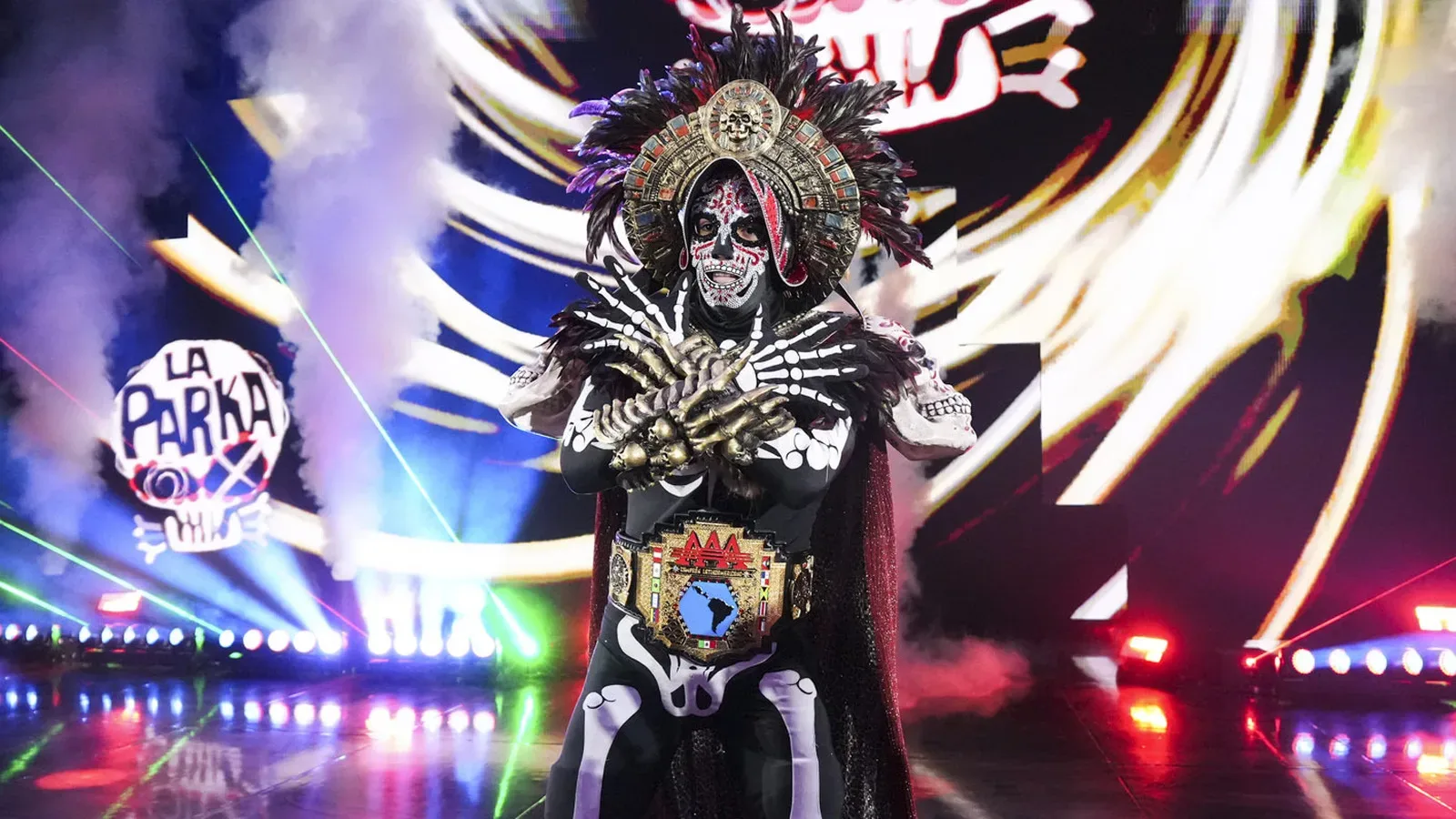
John “Bradshaw” Layfield believes lucha libre is entering a major new period of visibility, and he sees AAA’s recent TripleMania events as a strong indication of where that momentum is heading.
The WWE Hall of Famer, who is currently part of AAA’s broadcast presentation, discussed the promotion’s direction during an appearance on Something to Wrestle. JBL pointed to the increased attention around AAA since WWE’s acquisition of Lucha Libre AAA Worldwide, as well as the crossover opportunities that have placed AAA talent alongside NXT performers at events such as Worlds Collide.
For JBL, the attraction of AAA is not simply that it has reached a wider audience. It is that the distinctive style, pace and emotional investment associated with lucha libre have the capacity to connect far beyond Mexico when presented in the right setting. He has long felt that lucha could become an especially powerful force if it gained broader traction, and he views the current moment as evidence that this is beginning to happen.
TripleMania receives a larger spotlight
This year’s TripleMania drew more mainstream attention than many prior editions, a natural result of AAA’s relationship with WWE and the growing overlap between the companies’ audiences. The shows gave fans an opportunity to see AAA’s roster and its established traditions on a larger platform while also creating room for performers familiar to WWE viewers.
For more background on this topic, read Mason Rook Addresses Missed NXT Title Match After Medical Clearance Issue.
JBL was at ringside for both nights of TripleMania and came away impressed by what he saw. He singled out the Copa Bardahl Battle Royal as one of the elements that stood out across the events, while also praising the work taking place behind the scenes. In his view, AAA has a collection of experienced producers whose understanding of the performers and the style can help maximize the presentation.
That kind of infrastructure matters during a period of increased exposure. AAA is not merely introducing new viewers to individual wrestlers; it is presenting a complete lucha libre environment, from its masks and stables to its fast-moving multi-person bouts and the personalities that shape its biggest cards. The challenge is preserving the identity that made the promotion important while helping new audiences understand why its stars and traditions matter.
TripleMania has always occupied a special place on AAA’s calendar, functioning as one of lucha libre’s most recognizable annual spectacles. With WWE’s involvement now bringing additional attention to the company, the event can serve as a gateway for fans who may be experiencing AAA’s signature presentation for the first time. JBL’s reaction suggests that the shows succeeded in creating that sense of occasion.
Las Vegas turnout exceeds expectations
One of the points JBL emphasized was the reception in Las Vegas. He acknowledged that the audiences in Nevada were good, especially given the scale of the undertaking, and he characterized the Friday-night turnout as a success. The attendance reportedly finished at roughly three times what WWE had expected for that night.
That result is significant because expanding lucha libre beyond its traditional strongest markets requires more than simply placing a show in a new city. It requires convincing fans that the experience is worth seeking out live. A crowd that significantly outperforms expectations is a positive sign for AAA’s ability to build interest in the United States as its profile rises.
At the same time, JBL made clear that even an encouraging Las Vegas crowd does not replicate the atmosphere of a major Mexican event. Mexican lucha crowds have a worldwide reputation for their vocal passion, their familiarity with performers and their willingness to become fully involved in every turn of a match. Their responses are part of the texture of lucha libre, whether the audience is rallying behind a beloved técnico, rejecting a rudo or reacting to a breathtaking dive.
The comparison was not a dismissal of the Las Vegas audience. Instead, it underscored the standard AAA carries with it. Mexican fans bring a depth of history and emotional connection to the product that is difficult to duplicate elsewhere. For new markets, the opportunity is to develop their own relationship with the style while AAA continues to showcase the intensity that has made its home crowds so distinctive.
Omos continues his AAA development
JBL also addressed Omos, whose work in AAA has been a notable point of interest for fans following the company’s evolving relationship with WWE. The former WWE talent has been working under the guidance of The Undertaker, and JBL believes the giant is increasingly finding his footing in AAA.
Omos has always brought an immediate visual advantage to any match due to his size. In lucha libre, however, size alone does not define how a performer fits into the broader match structure. Opponents, producers and the wrestler himself all have to establish the right rhythm, create believable moments of danger and make the contrast in styles work for the crowd.
JBL credited both The Undertaker’s involvement and AAA’s production team for helping Omos progress. He noted that there are highly knowledgeable people in AAA who understand not only what Omos needs to do, but what the wider roster needs from a match and from a television presentation. That insight can be especially valuable for a performer developing a new dimension of his career in a different environment.
The positive assessment also reflects the value of AAA as a setting for talent growth. The promotion’s roster contains performers with varied styles, from high-flying specialists to brawlers, technical wrestlers and larger-than-life characters. Working within that landscape can present fresh challenges for someone like Omos, whose presence naturally changes the strategy and visual tone of every bout in which he appears.
There remains an important distinction between declaring a wrestler fully transformed and recognizing visible progress. JBL’s comments fall firmly into the latter category: he sees Omos improving and coming into his own through the opportunities and guidance available in AAA. That is a meaningful endorsement from someone watching the shows from close range.
Daga earns high praise
Another AAA name who caught JBL’s attention was Daga, the leader of Los Perros del Mal. JBL spoke particularly highly of Daga’s presence and drew a comparison to Eddie Guerrero, one of the most influential and admired wrestlers in modern history.
Comparisons to Guerrero naturally carry weight. Eddie’s legacy spans charisma, timing, ring intelligence and an ability to make every action feel connected to his character. JBL’s observation should not be read as suggesting Daga is a replica of Guerrero; rather, it speaks to the qualities JBL sees in Daga’s work and demeanor as a performer leading one of AAA’s most recognizable groups.
Los Perros del Mal has long carried a reputation for attitude and defiance, making its leadership role central to the group’s identity. Daga’s ability to command attention is therefore crucial. In an era when AAA is reaching viewers who may not know the promotion’s full history, performers with clear personalities and a strong hold over the audience become even more important.
The attention on Daga also illustrates a larger benefit of AAA’s expanded platform. Major events can introduce viewers to wrestlers whose names may not have been as familiar to audiences outside Mexico, while allowing long-time fans to see those same talents receive a wider stage. AAA’s growth will depend not just on crossover appearances, but on fans becoming invested in its core roster.
A pivotal opportunity for AAA
JBL’s overall message was one of optimism about lucha libre’s place in the current wrestling landscape. WWE’s acquisition has created greater visibility, Worlds Collide has provided an obvious bridge between rosters, and TripleMania has benefited from the additional spotlight. Those pieces do not replace the qualities that made AAA compelling in the first place, but they can amplify them.
For AAA, the next phase is about converting curiosity into lasting interest. A strong turnout in Las Vegas, attention around TripleMania and positive reactions to wrestlers such as Omos and Daga all provide reasons for confidence. The promotion now has an opportunity to bring its established identity to an audience that may be learning the rhythms of lucha libre for the first time.
JBL’s perspective carries the enthusiasm of someone who has watched the recent shows closely and believes the audience is responding. Mexican crowds remain the benchmark for their passion, but the expanded interest in AAA suggests lucha libre is finding more room to grow. If that trend continues, TripleMania may be remembered as more than a major annual card—it may be a defining showcase for AAA’s next chapter.
In pictures

Darryl Polo
Darryl Polo is a passionate wrestling fan covering WWE, AEW, TNA and beyond. He loves great rivalries, breakout stars and the moments that keep fans talking long after the bell. How we work.