
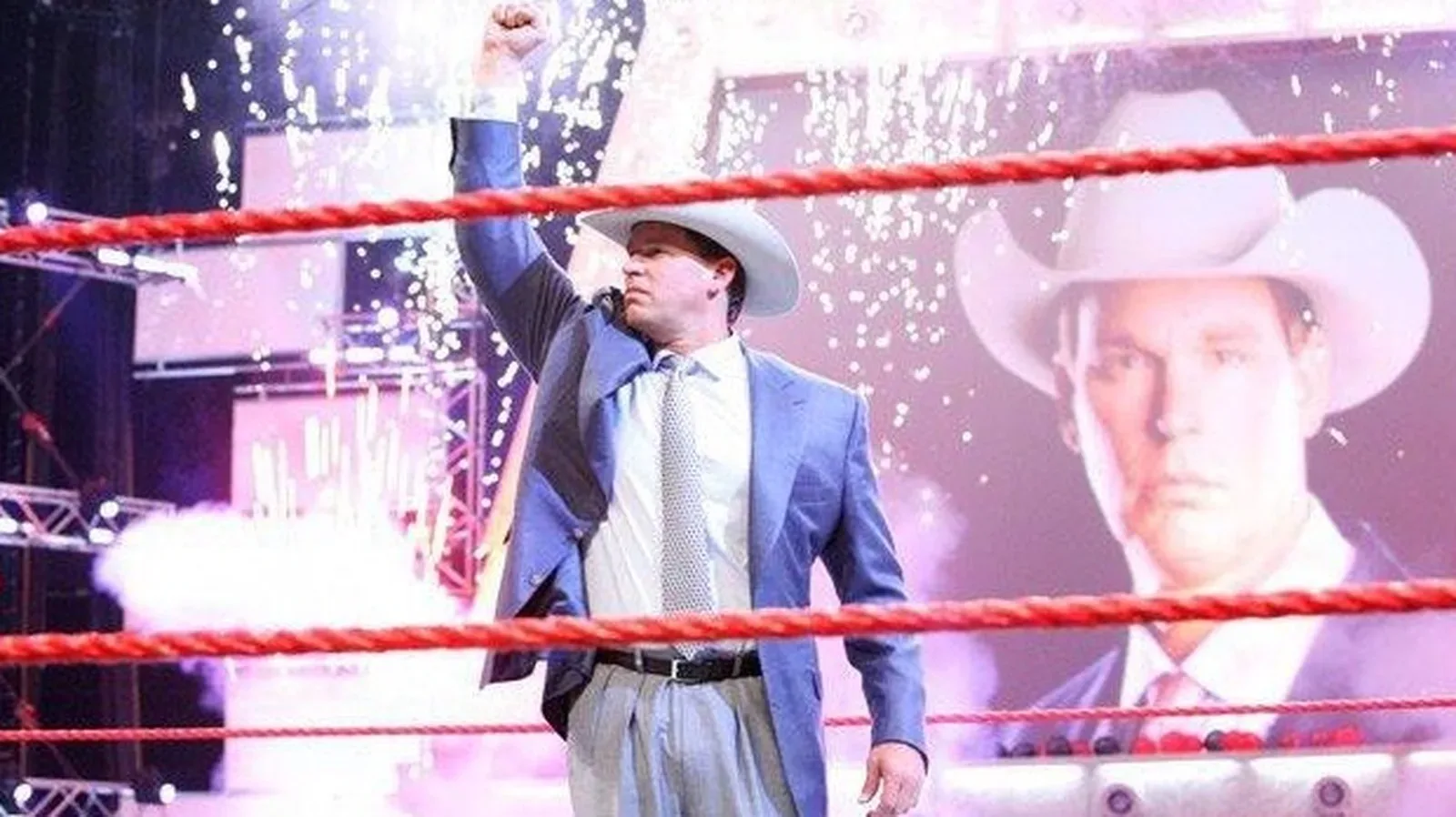
WWE Hall of Famer John “Bradshaw” Layfield believes professional wrestling’s most enduring successes cannot be measured solely by the quality or complexity of a match. For JBL, athletic execution has value, but it becomes meaningful only when an audience cares about the people in the ring and the consequences of what they are watching.
Speaking on Something to Wrestle With Bruce Prichard, Layfield agreed with Paul Heyman’s assessment of the role that landmark moments play in wrestling history. The discussion centered on Brock Lesnar ending The Undertaker’s WrestleMania streak at WrestleMania 30, a result that remains one of WWE’s most shocking and memorable outcomes.
That match is often remembered less for individual sequences than for the visual and emotional aftermath: The Undertaker sitting up in the ring, Lesnar’s victory being processed by a stunned stadium, Heyman’s ringside reaction, and the graphic changing to show 21-1. It was a moment that instantly told the audience that a seemingly permanent piece of WWE history had been altered.
“I agree with what he says about the moment,” JBL said. “There’s so much about people talking about... work rate and all that stuff. I mean, that work rate means absolutely nothing if no one cares.”
For more background on this topic, read Pat Laprade and Kevin Raphael Announced as WWE’s Live French Commentary Team on Netflix in Canada.
Layfield’s point was not that wrestlers should disregard ring ability. Rather, he argued that the most technically polished contest in the world can still struggle to leave a lasting impression if it has no emotional foundation. A match needs fans to understand what is at stake, who the competitors are, and why the outcome should matter to them.
“You go out there and have the best match in the world... But if no one cares, it’s like a tree falls in a forest and no one’s there. Does anybody hear it?”
Why the WrestleMania 30 Finish Still Defines the Conversation
Lesnar’s win over The Undertaker remains an especially fitting example for JBL’s argument because the streak had become much larger than a series of annual WrestleMania victories. It had developed into one of WWE’s central attractions. Fans did not simply tune in to see The Undertaker wrestle; they watched to see whether anyone could do what so many major stars had failed to accomplish.
Over time, the streak helped create an atmosphere in which each Undertaker WrestleMania match arrived with built-in suspense. Even when viewers expected The Undertaker to win, they understood the historic importance of the possibility that he might not. That ongoing story gave every near fall, submission attempt, and dramatic reversal added significance.
When Lesnar scored the decisive victory, the immediate response was disbelief. The shock was not dependent on a viewer recalling every move from the contest. The defining memory was the result itself and the collective realization of what it meant. WWE’s presentation of the new record made that finality impossible to miss.
Heyman, who was at ringside for Lesnar, has emphasized that audiences remember the finish, his reaction, and the scoreboard shift. JBL’s comments reinforce the broader principle behind that viewpoint: wrestling is at its most powerful when it produces an emotional event rather than simply an exhibition of skill.
The outcome did not need a lengthy explanation in the moment. The faces in the crowd, the silence and confusion inside the building, and the 21-1 display communicated the story. That is the kind of clear, shared reaction that wrestling promotions attempt to create when building a major match or angle.
Work Rate and Character Are Not Opponents
JBL did not dismiss the importance of being a reliable, talented performer. Strong in-ring work can establish credibility, help tell a story, protect performers in demanding situations, and provide a foundation for rivalries over the long term. A wrestler who consistently delivers at a high level can earn trust from fans and colleagues alike.
However, Layfield framed the issue as a question of priorities when forced to choose between pure work rate and a compelling dramatic package. In his view, the performer who can make an audience feel something has the greater chance of becoming unforgettable.
“I understand you want to have both. You want to have a great work rate and also great drama and great characters. But if you had one or the other, which do you want? You want the great characters and the great drama,” JBL concluded.
That perspective reflects a longstanding tension in wrestling discussions. Fans regularly debate match ratings, move sets, pacing, endurance, and innovation. Those elements are part of the craft, and they can be essential to a successful bout. Yet the business has also been shaped by performers whose connection with the audience exceeded any discussion about technical precision.
Characters give fans a reason to choose a side. They establish recognizable motivations, flaws, ambitions, and rivalries. Drama then gives those traits consequences. When those pieces are in place, a simple move can feel enormous because it represents a turning point in a larger story. Without them, even an elaborate sequence may register only as an impressive display before fading from memory.
Layfield’s own WWE career offers a familiar illustration of the value he places on presentation and personality. His transition into the JBL character created a distinct identity that audiences could quickly understand: an arrogant, wealthy, self-assured antagonist who used status and bravado as weapons. The character gave his matches and promos a consistent framework, allowing fans to invest in the possibility of seeing him defeated.
That does not mean the in-ring component was irrelevant. Instead, the character helped make the matches matter. The audience’s desire to see JBL lose, or its frustration when he found a way to retain an advantage, created the emotional response that turns individual matches into chapters of a larger run.
The Importance of Making Fans Care
The phrase “making fans care” can sound simple, but it encompasses much of what wrestling promotions seek to accomplish. It involves presenting rivalries with enough clarity that viewers know what each side wants. It means giving performers voices, traits, and histories that distinguish them from the rest of the roster. It also requires follow-through, so that victories, defeats, betrayals, and championships feel like they have consequences.
Wrestling audiences can appreciate athleticism while still asking larger questions. Why is this match happening now? What does a victory change? Can the hero overcome the obstacle? Will the villain finally receive a comeuppance? Is an established record about to fall? The answers create anticipation, and anticipation gives the bell-to-bell action its purpose.
JBL’s comments are particularly relevant whenever work rate is used as the primary shorthand for a wrestler’s value. Ring work is one important part of the equation, but it is not an automatic substitute for charisma, character development, or storytelling. An acclaimed match can earn praise in the short term; a defining moment can become part of a promotion’s identity for years.
The strongest performers are often those who combine both sides. They can execute at a high level while ensuring every major moment has emotional context. Their matches are not just collections of moves, but confrontations that reflect personalities and advance stories. In that setting, work rate supports drama rather than replacing it.
A Reminder of Wrestling’s Core Objective
JBL’s assessment ultimately returns to wrestling’s central objective: create a reaction that lasts. Whether that reaction is shock, joy, anger, fear, heartbreak, or celebration, it is the feeling that makes an audience remember where it was when something happened.
Lesnar defeating The Undertaker at WrestleMania 30 remains an example because the result touched a deeply established piece of WWE history. The streak was the hook, the crowd response was the proof of investment, and the 21-1 graphic became the image that preserved the moment.
For JBL, that kind of connection is the standard against which wrestling should be judged. Great matches and great workers remain valuable, but the biggest prize is an audience that is invested enough to react as though the result truly matters. When wrestling reaches that point, it creates memories that outlive the individual moves used to make them.
In pictures

Darryl Polo
Darryl Polo is a passionate wrestling fan covering WWE, AEW, TNA and beyond. He loves great rivalries, breakout stars and the moments that keep fans talking long after the bell. How we work.