
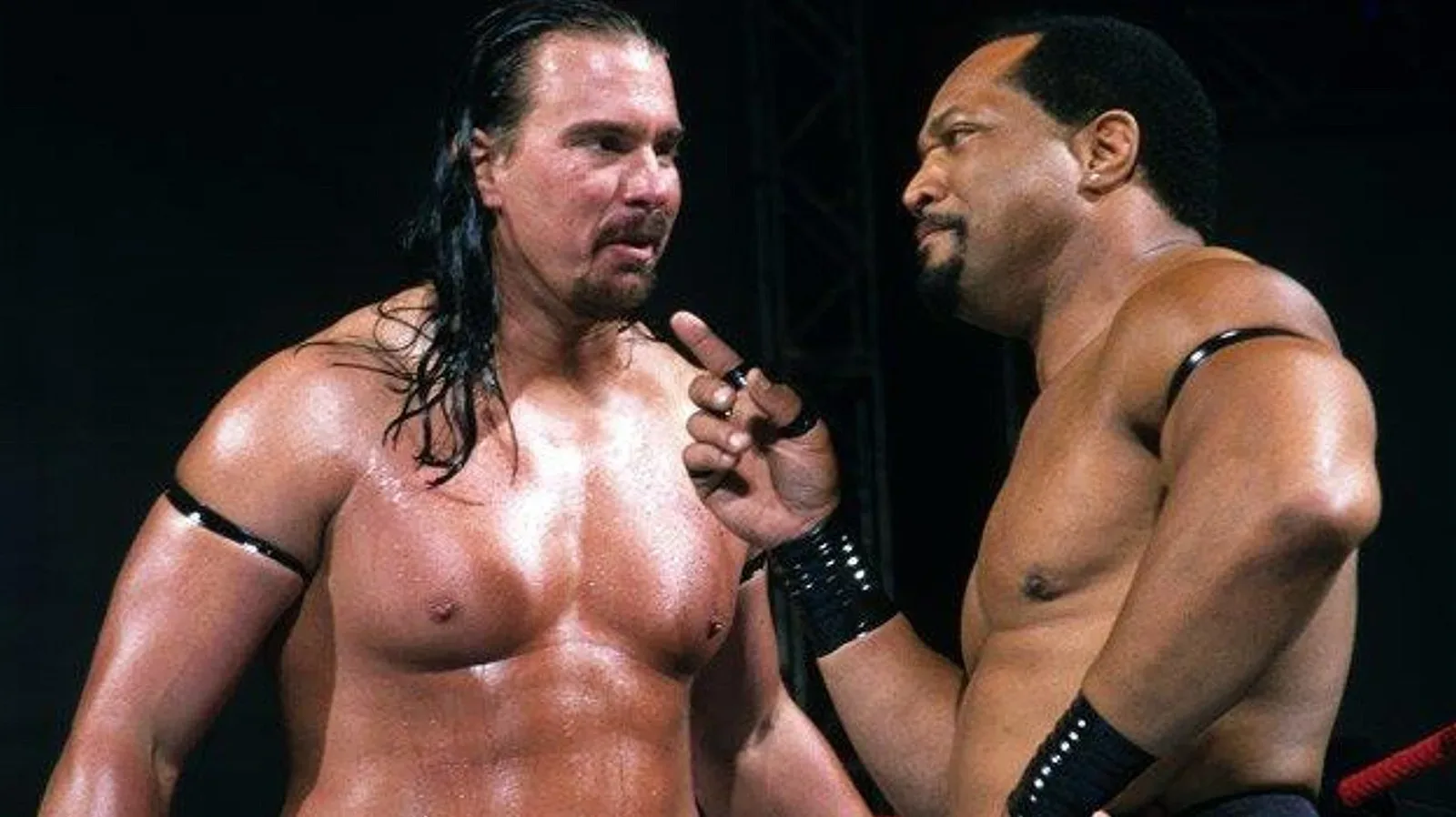
John Bradshaw Layfield believes the APA’s time alongside Jacqueline should have lasted much longer.
During a discussion on Something To Wrestle, Layfield looked back on the period in which he and Ron Simmons, then known as Bradshaw and Farooq, were paired with Jacqueline. The association was brief, but it gave WWE fans a different look at the normally no-nonsense APA act. It also allowed Jacqueline to work within angles and matches involving the team, including programs against Right to Censor and Team Xtreme.
For Layfield, the short duration of the partnership is the part that stands out most in hindsight. He said Jacqueline had all the qualities needed to belong with the APA for the long haul, both on screen and away from it.
“I don't know how we didn't end up with Jackie for years! She was that good! I wish we did,” Layfield said on Something To Wrestle.
For more background on this topic, read Chad Gable vs. Big Cass Announced for WWE Raw on November 30.
The APA had become one of WWE’s most recognizable pairings after The Acolytes evolved into a more fan-friendly act. Simmons and Layfield retained their intimidating presence, but the revised presentation gave the team an unusual amount of personality. Their backstage scenes, centered around a card table, doorways, cigars and their willingness to provide protection for the right price, remain a popular part of the era and continue to circulate among fans online.
That environment made Jacqueline’s involvement feel particularly distinctive. The APA was built around two imposing veterans whose credibility came from their physicality and their chemistry. Jacqueline, however, was never presented as someone who needed to be sheltered by the group. Her reputation as a legitimate, hard-nosed performer made her a believable ally for Simmons and Layfield, while her experience gave the trio room to participate in stories that crossed typical men’s and women’s divisions.
JBL Highlights Jacqueline’s Toughness and Training
Layfield specifically pointed to Jacqueline’s background when explaining why she worked so naturally with the APA. He recalled that she trained in the same Dallas wrestling gym that developed a number of notoriously rugged wrestlers. In his view, that foundation was evident in everything she did in the ring.
“A tough, tough lady, and a great wrestler!” Layfield said on Something To Wrestle.
That assessment reflects the respect Jacqueline has earned throughout her career. She was more than a personality placed into a faction or a division for storyline purposes. Jacqueline was regarded as a capable worker who could adapt to numerous roles, opponents and styles. Her willingness to engage physically in mixed-gender situations made the APA pairing viable in a way that might not have been possible with every performer on the roster.
Layfield also made clear that the appreciation was personal, not merely a retrospective assessment of what could have worked creatively. He and Simmons remain close with Jacqueline and still see her regularly.
“Ron and I loved Jackie, still do. I mean, we see her all the time. She's a terrific person,” Layfield said on Something To Wrestle. “I don't know why she wasn't with us a lot longer, because she certainly fit in with the APA.”
The comments underline how much the APA’s strongest material depended on authenticity. The group’s appeal was not based only on catchphrases or the visual of the backstage poker table. Fans could buy into the act because Simmons and Layfield projected a sense that they were exactly as formidable as they appeared. Jacqueline’s own reputation for toughness meant she added to that presentation rather than changing its identity.
A Brief Run With Plenty of Possibilities
The APA and Jacqueline connection gave WWE a flexible unit during a period when factions, alliances and inter-gender stories frequently overlapped. The trio’s involvement against Right to Censor and Team Xtreme showed how Jacqueline could be used beside the APA without being reduced to a passive supporting role. She was able to participate directly in the conflict, which aligned with the image she had established as a competitor.
Right to Censor was designed as an antagonistic force with a rigid message and a confrontational approach, making the APA’s rugged, anti-authoritarian energy an effective contrast. Team Xtreme, meanwhile, brought a different dynamic into the equation. Jacqueline’s presence helped broaden the APA’s options within those rivalries. Rather than restricting Simmons and Layfield to standard tag-team confrontations, the group could move into scenarios that involved women’s division talent and mixed-gender match structures.
Layfield did not offer a specific explanation for why the arrangement did not continue for years. His remarks were framed as a wish that WWE had recognized the fit for a longer period. That distinction matters: he was not pointing to a confirmed behind-the-scenes reason for the partnership ending, nor was he claiming there had been a particular obstacle. Instead, he was reflecting on a missed opportunity from the perspective of someone who felt Jacqueline belonged with the group.
In wrestling, not every pairing that clicks is given the time to become a defining act. Creative directions change, rosters shift and individual performers move into other programs. The APA’s association with Jacqueline remains memorable precisely because it was short enough to leave fans wondering what a more sustained version of the alliance could have become.
Jacqueline’s Reputation Continues to Earn Respect
Layfield is far from alone in emphasizing Jacqueline’s legitimacy as a performer. Jeff Jarrett spoke highly of her toughness in 2024, recalling her ability to work against male opponents such as Brian Christopher, who competed as Grand Master Sexay. Jarrett’s view was that Jacqueline threw punches with the force and conviction of a male wrestler, an especially notable compliment in an era when many women in WWE were not regularly positioned around athletic in-ring competition.
That history helps explain why Layfield saw Jacqueline as such an obvious APA fit. The group’s identity was rooted in physical credibility. Simmons, a former world champion, and Layfield built their presentation around the idea that crossing them carried consequences. Jacqueline had a career that allowed her to stand in that setting without the audience questioning whether she belonged.
Her work in inter-gender angles was significant for the same reason. Inter-gender wrestling can only succeed when the performers, the presentation and the audience all accept the stakes of the encounter. Jacqueline’s ability and toughness gave WWE a performer who could enter those situations with credibility. She was not simply there to complete a visual lineup; she could actively contribute to the match and the story.
The praise from Layfield and Jarrett also speaks to the broader respect Jacqueline commands among peers. Her toughness is often discussed, but it is inseparable from her technical ability, adaptability and professionalism. Being tough alone does not create a lasting career. Jacqueline’s reputation was built because she combined that toughness with the skill to make her work connect across different opponents and circumstances.
Why the APA Pairing Still Makes Sense in Retrospect
Years later, the idea of Jacqueline as a permanent APA member still feels logical because the roles complemented one another so clearly. Simmons and Layfield had a chemistry that made the APA work as a duo, while Jacqueline could have added another dimension without disrupting that foundation. She brought her own established identity, a willingness to fight and a natural connection with both men.
There was also a thematic fit. The APA were not characters who needed a polished, conventional manager to speak for them or guide them. Their act worked best when the people around them seemed able to stand on their own. Jacqueline met that requirement. Her presence could strengthen the group’s edge while creating fresh matchups and storytelling avenues.
Layfield’s reflection is ultimately a simple but meaningful endorsement of a fellow WWE Hall of Famer. He remembers Jacqueline as a talented wrestler, a tough person and a genuine friend to both himself and Simmons. His regret is not rooted in revisiting a major creative failure or revealing an untold controversy. It is the kind of hindsight that comes from recognizing that a combination had more potential than the time it received.
For fans who remember the APA’s backstage scenes and Jacqueline’s fearless performances, the comments offer a reminder of an alliance that may have been brief but was never out of place. In Layfield’s eyes, Jacqueline did not merely work alongside the APA. She fit the APA—and she could have fit there for years.
In pictures

Darryl Polo
Darryl Polo is a passionate wrestling fan covering WWE, AEW, TNA and beyond. He loves great rivalries, breakout stars and the moments that keep fans talking long after the bell. How we work.