
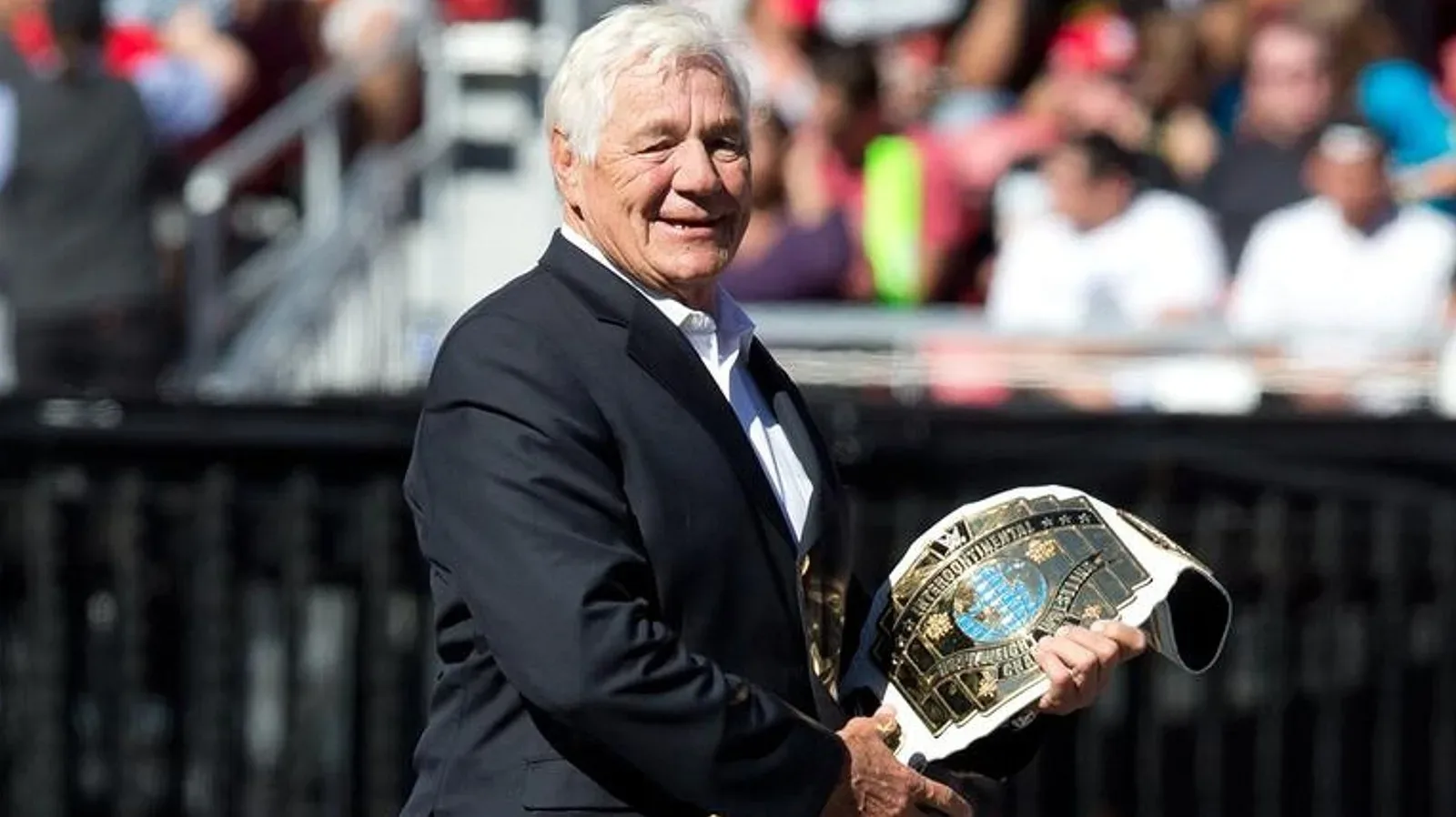
The WWE Intercontinental Championship has carried prestige for generations, serving as a launching point for many of the company’s biggest stars and as a symbol of high-level championship wrestling beneath the WWE Championship picture. Its lineage began in 1979 with Pat Patterson, but the story behind Patterson becoming the inaugural champion has always occupied a distinctive place in WWE history.
Rather than presenting a tournament that fans could watch unfold, WWE established Patterson as champion through an announced tournament victory in Rio de Janeiro, Brazil. The company’s presentation stated that Patterson had defeated Johnny Rodz in the tournament final. In reality, the tournament was fictional, and Patterson was simply awarded the new title.
John “Bradshaw” Layfield has now shared a humorous explanation for why Rio de Janeiro became the chosen setting for that fictional championship tournament. Speaking on Something To Wrestle, JBL said the location was selected as a rib aimed directly at Patterson and his French accent.
“In case you didn’t know, the reason that [Vince McMahon] chose Rio De Janeiro is because Pat couldn’t say it,” JBL said. “That’s a true story. He chose Rio De Janeiro because Pat couldn’t say it, because of his French accent. Yeah, yeah, it was all a rib on Pat.”
For more background on this topic, read Penta Explains Why His Joker Gear Finally Appeared at WWE Money in the Bank.
A Championship Origin Story Unlike Any Other
The Intercontinental Championship’s beginning differs sharply from the way WWE typically introduces a major title. A new championship is often accompanied by an on-screen tournament, an inaugural match, or a formal announcement explaining its competitive structure. Patterson’s crowning instead arrived with a storyline that gave him immediate credibility while avoiding the need to stage a full tournament on television or at live events.
The title’s fictional Rio de Janeiro tournament has become an enduring piece of WWE lore. It also reflects the looser, more territory-driven nature of wrestling storytelling at the time. Promotional histories could be built around events that fans did not see firsthand, especially when a company wanted to establish a wrestler as a major champion quickly.
Patterson had previously held the North American Heavyweight Championship, a belt that had been associated with WWE’s earlier championship landscape. Three months after being handed the Intercontinental Championship, Patterson lost the North American title. The Intercontinental Championship then became the more prominent secondary singles prize and eventually developed into one of the most recognizable championships in the entire industry.
While the tournament itself did not happen, Patterson’s importance as the first Intercontinental Champion was very real. The title gained value over time through the wrestlers who pursued it, the rivalries built around it, and the standard of performance that came to be associated with being champion.
Pat Patterson’s Lasting WWE Influence
Patterson’s legacy reaches far beyond his brief status as the inaugural Intercontinental Champion. He became one of the most influential minds in WWE, contributing in a range of creative and developmental roles across decades. His work remained significant through several different eras of the company, from the territorial period through WWE’s national expansion and into its modern developmental system.
He continued to be an important presence within WWE until his death in December 2020. Patterson’s influence extended to NXT and the Performance Center, where his experience and instincts helped shape performers and the presentation of WWE programming. For a company that has consistently evolved its style, production, and roster structure, Patterson represented a connection to foundational wrestling traditions while also helping younger talent adapt to the demands of modern WWE.
Paul “Triple H” Levesque has spoken highly of Patterson’s standing within WWE, including the extent of his importance during Vince McMahon’s tenure as chairman. Levesque has said Patterson was second only to McMahon in that environment, a description that illustrates the depth of trust Patterson earned over the course of his career.
Levesque has also identified Patterson as a major influence on professional wrestling as a whole, including for his work in the San Francisco territory. That regional experience was a key component of Patterson’s wrestling education. Before becoming synonymous with WWE, he developed his reputation through a wrestling landscape where regional promoters, bookers, and performers each had to understand how to connect with different audiences.
That background helped make Patterson particularly valuable as wrestling changed. He understood the in-ring side of the business, the character side, the importance of match structure, and the detailed planning required to make large-scale events work. Patterson is widely recognized as the creative force behind the Royal Rumble match, one of WWE’s most successful and enduring annual concepts.
The Royal Rumble Connection
The Royal Rumble is perhaps the clearest example of Patterson’s creative influence surviving as a yearly centerpiece of WWE’s calendar. Its format is simple enough for new viewers to understand immediately: competitors enter at timed intervals, eliminations occur when a wrestler is sent over the top rope and both feet touch the floor, and the final remaining wrestler wins.
Yet the strength of the concept lies in its flexibility. The match can introduce surprises, revive old rivalries, create moments for rising talent, and set up championship programs in a single bout. It is a storytelling engine as much as it is a match stipulation. That mix of structure, suspense, and opportunity has made the Royal Rumble a fixture for decades.
Patterson’s connection to the match ensures that his name remains part of WWE history every year. The same is true of the Intercontinental Championship. Even as titleholders and eras change, the championship’s origin traces back to Patterson, his fictional tournament victory, and, as JBL recounted, an inside joke involving the city where that tournament was said to have taken place.
The Intercontinental Championship in 2026
The championship Patterson first held remains central to WWE programming today. Chad Gable is the current Intercontinental Champion after defeating Penta for the title at Night 2 of SummerSlam in August. Gable’s reign places the championship in the hands of one of WWE’s most technically accomplished competitors, giving the title a champion whose style fits its long-standing association with athletic, high-level singles wrestling.
Gable is scheduled to defend the Intercontinental Championship against Rey Fenix on the upcoming edition of Raw. The match will carry an added personal dimension because Rey Fenix is Penta’s brother. With Penta having lost the championship to Gable at SummerSlam, Rey Fenix now has an opportunity to challenge the man who ended his brother’s reign.
That situation provides another example of the many ways the Intercontinental Championship continues to generate meaningful stories. The belt has always been more than a secondary prize. At different points, it has represented a proving ground, a marker of consistency, a spotlight for spectacular in-ring performers, and a platform for rivalries with personal stakes.
Gable versus Rey Fenix also presents a stylistic contrast that could underscore the championship’s range. Gable’s amateur wrestling credentials, technique, and precision have made him one of WWE’s most respected workers. Rey Fenix brings a dynamic high-flying approach and explosive pace. Their meeting gives the Intercontinental title another showcase match while tying its current direction to Penta’s recent loss.
From a Rib to a Cornerstone of WWE
JBL’s recollection adds an unusual footnote to one of WWE’s most important title histories. The choice of Rio de Janeiro may have originated as a playful jab at Patterson, but the championship attached to that fictional destination became a cornerstone of the company.
For decades, the Intercontinental Championship has helped define WWE careers. It has been pursued by established veterans, emerging prospects, technical specialists, power wrestlers, high-flyers, and future world champions. Its identity has shifted with each generation, but its importance has endured.
At the center of that history is Patterson, whose contributions cannot be reduced to a single title reign or a single creative idea. He was an influential performer, a trusted WWE figure, a mentor, and a creative voice whose work still shapes the company’s biggest events. The story of the title’s inaugural tournament may be fictional, but Patterson’s impact on WWE was anything but.
In pictures

Darryl Polo
Darryl Polo is a passionate wrestling fan covering WWE, AEW, TNA and beyond. He loves great rivalries, breakout stars and the moments that keep fans talking long after the bell. How we work.