
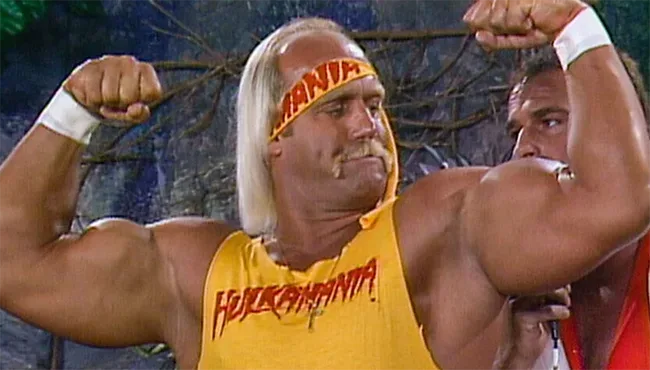
JBL has placed Hulk Hogan at the top of his personal list of the greatest world champions in professional wrestling history, ranking the WWE Hall of Famer ahead of John Cena and Bruno Sammartino.
The former WWE Champion made his choices during a “Stay Silent Game” discussion on Something to Wrestle, a format in which names are presented in sequence and the guest speaks only when a wrestler is ranked higher than the previous selection. Starting from a list that included foundational figures such as Lou Thesz, JBL eventually stopped for Sammartino, then again for Cena, before identifying Hogan as his final choice.
The ranking is notable not simply because of the three names involved, but because of the different standards JBL applied to each man. Sammartino represented unmatched regional drawing consistency and the bedrock of a major wrestling territory. Cena represented the challenge of carrying WWE as its public face during a wholesale transition in presentation. Hogan, in JBL’s view, stood above both because his fame and drawing power helped turn WrestleMania and WWE’s national expansion into a cultural phenomenon.
Bruno Sammartino’s extraordinary Madison Square Garden legacy
JBL’s first major stopping point was Bruno Sammartino, whose reigns as WWWF World Heavyweight Champion remain among the most historic in the industry. Sammartino’s first title reign lasted nearly eight years, while his second reign lasted more than three years. Those numbers alone establish a remarkable legacy, but JBL focused especially on Sammartino’s sustained ability to fill Madison Square Garden.
For more background on this topic, read Joe Hendry Details Penta’s Gesture During WWE’s South America Tour.
“I don’t think anybody could do what Bruno did,” JBL said. “Jerry Lawler in Memphis sold out the arena for 52 straight weeks, the same arena. Bruno sold out the Garden 186, 187 times, whatever it was. I don’t think anybody in the world could have done that. I think Bruno was the foundation of so much of wrestling.”
The comparison to Lawler underscores the scale of what JBL was describing. Lawler was one of wrestling’s defining territorial attractions and became synonymous with the Memphis territory, while Sammartino’s repeated Garden success made him the face of the Northeast’s dominant wrestling operation for generations of fans.
Madison Square Garden was not merely another venue in the territory system. Its importance to the WWWF and later WWE made it a central stage for the company’s biggest cards and most significant champions. Sammartino’s ability to repeatedly headline there reflected the uniquely powerful connection he maintained with the audience, particularly the large Italian-American fan base that embraced him as a heroic figure.
JBL’s assessment did not reduce Sammartino’s place in history to ticket sales. By calling him “the foundation of so much of wrestling,” he framed the champion as a figure whose success helped establish the viability and identity of the promotion that eventually became WWE. Sammartino was the long-term standard-bearer in an era when the world title was presented as an enduring attraction, with a champion expected to anchor a territory over years rather than months.
Why JBL puts John Cena just ahead of Sammartino
Despite his reverence for Sammartino, JBL placed John Cena slightly higher. His explanation was rooted in the very different assignment Cena inherited as WWE’s leading star.
“Because of what he had to do,” JBL said of ranking Cena above Sammartino. “He had the hardest role in the history of world champions. He had to go from a Rated-R era and maybe past that, where you could flip off your boss and drink beer. Where you could drop the F-bomb on TV, which guys did, and say GD. You could do anything you wanted. He had to go from that to a PG-rated era and still carry the company.”
WWE’s move into a more family-oriented PG presentation changed the expectations around its top babyface. The Attitude Era and its immediate aftermath were associated with adult-oriented language, defiant antiheroes and a much edgier on-screen tone. Cena rose to prominence in the closing years of that broader period, initially finding success with a more aggressive rapper-inspired persona before developing into WWE’s central heroic star.
As the company adjusted its content and brand identity, Cena became the main figure asked to connect with younger viewers while retaining enough credibility to work at the top of the card in front of an audience that included long-time fans. JBL viewed that balancing act as uniquely difficult.
“I think Cena had the hardest role in the history of wrestling, and he did it,” JBL continued. “So yes, I think that puts him slightly ahead of the great Bruno Sammartino.”
Cena’s case is supported by the length and visibility of his run at the top. Across a career that made him one of WWE’s most recognizable modern stars, Cena won world championships on numerous occasions, headlined major events and served as the company’s primary ambassador through a period of expanding global reach and increased mainstream crossover. His slogan, “Never Give Up,” became inseparable from WWE’s outreach to younger audiences, while his presence was also central to the company’s television and premium live event identity.
That does not mean Cena’s era was free of division. He was one of the most polarizing top stars in WWE history, with some audiences loudly supporting him and others vocally rejecting his position as the company’s chosen centerpiece. JBL’s point, however, was that Cena carried the role through that resistance and through a changing set of creative restrictions without losing his value as the promotion’s leading champion.
Hulk Hogan’s mainstream impact separates him from the field
For JBL, the final answer was Hulk Hogan. His argument centered on Hogan’s place in the national wrestling boom of the 1980s and his role in making WWE a major entertainment brand beyond the traditional wrestling audience.
“Without him, you don’t have WrestleMania,” JBL said. “Well you have WrestleMania, but you don’t have the success you had. And you had him slam the Giant. Who else could have done that? There were guys that could have done it, but nobody like Hogan.”
JBL was referring to Hogan’s WrestleMania III victory over André the Giant, a match remembered as one of the defining spectacles in WWE history. Hogan lifting and slamming André remains among the most replayed and discussed images of the WrestleMania era. The moment was designed as a dramatic display of the champion overcoming an apparently impossible physical obstacle, and it became emblematic of Hogan’s larger-than-life appeal.
Hogan’s importance to the first WrestleMania goes well beyond a single match. The event relied on the idea that wrestling could be presented as a crossover entertainment attraction featuring celebrity involvement, major media attention and a sense of national occasion. Hogan was its centerpiece. His established visibility from Rocky III, where he appeared as Thunderlips, had already given wrestling a recognizable personality who could be presented to audiences unfamiliar with the territory model.
JBL also pointed to Hogan’s mainstream credentials. “He was on the cover of Sports Illustrated twice,” JBL said. “He was a big star from the Rocky movie. When people look back at the ’80s, all people talked about in wrestling was Hulk Hogan. He was one of the most famous guys in the world. So yes, Hogan.”
That observation gets to the heart of Hogan’s claim in debates of this kind. Great championship reigns can be measured in duration, match quality, attendance, revenue or the strength of the surrounding roster. Hogan’s greatest advantage is the degree to which his name became shorthand for professional wrestling in the 1980s. He was not simply a successful champion within a wrestling promotion; he was a pop-culture figure whose image helped define how the public viewed the industry during that period.
Three different definitions of a great champion
JBL’s rankings also demonstrate why all-time champion discussions rarely have a single definitive answer. Sammartino, Cena and Hogan each represent a different version of greatness.
- Sammartino symbolizes territorial-era stability, trust and extraordinary long-term box-office consistency in one of wrestling’s most important markets.
- Cena symbolizes adaptability, endurance and the pressure of being WWE’s public face during a transition from edgier programming to a more broadly family-friendly product.
- Hogan symbolizes national expansion, mass-media visibility and the ability to make wrestling feel like a major mainstream event.
There are other names with compelling credentials, including champions whose influence extended across the National Wrestling Alliance, Japan, Mexico and subsequent generations of WWE. JBL’s comments were not an attempt to create a statistical formula. They were a judgment about responsibility, drawing power and cultural impact.
His selection of Hogan as No. 1 ultimately rests on a simple conclusion: WrestleMania could have existed without Hogan, but the event and WWE’s expansion would not have achieved the same level of success without the star who stood at the center of that movement. In JBL’s view, that distinction places Hogan above Cena and Sammartino in the debate over wrestling’s greatest world champion.

Darryl Polo
Darryl Polo is a passionate wrestling fan covering WWE, AEW, TNA and beyond. He loves great rivalries, breakout stars and the moments that keep fans talking long after the bell. How we work.