
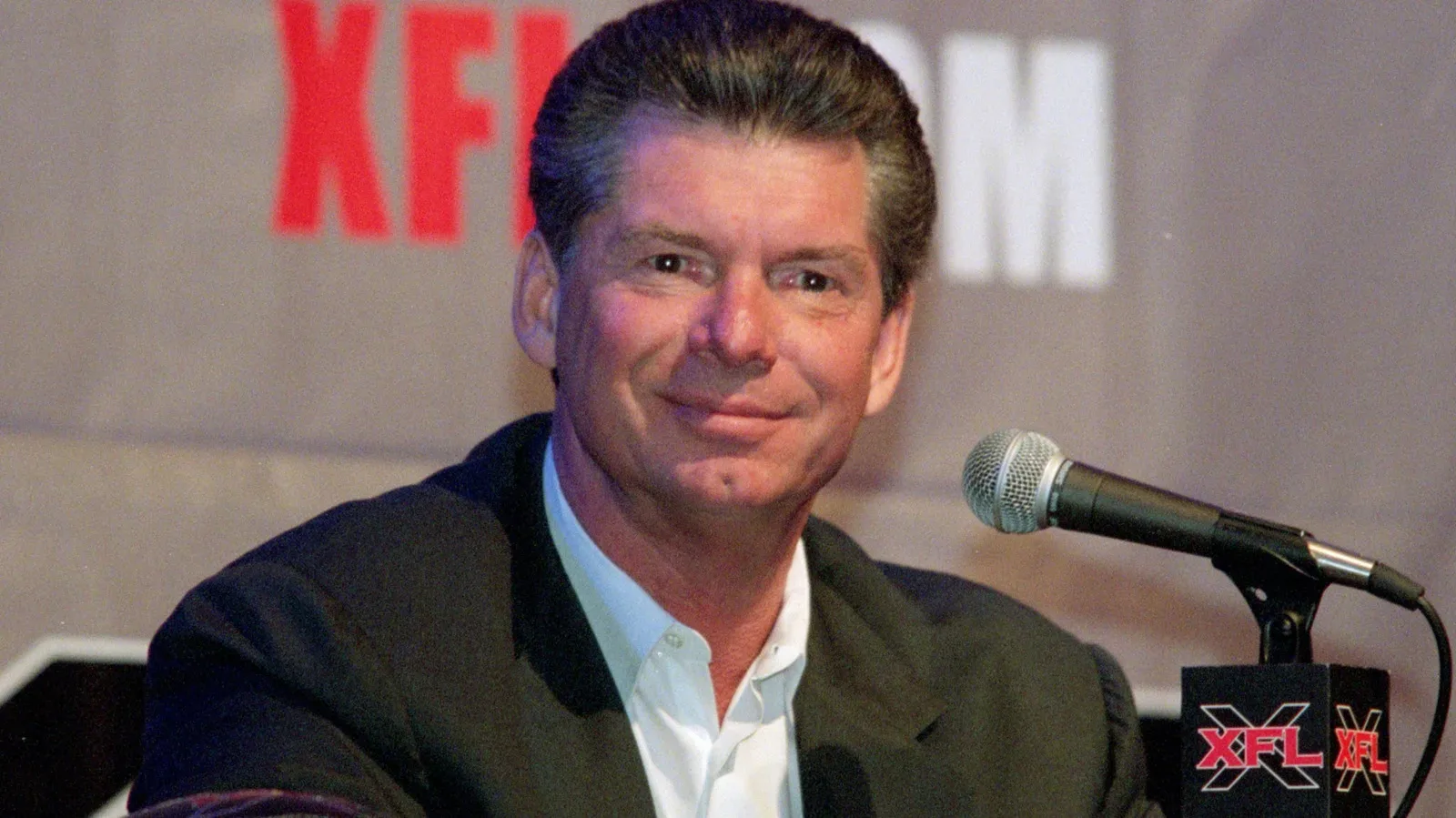
John “Bradshaw” Layfield has offered an emphatic assessment of Vince McMahon’s abilities behind the WWE commentary desk, calling the former WWE chairman the finest producer he worked with during his career in broadcasting.
Speaking on Something To Wrestle, JBL revisited his time as a color commentator and detailed the distinctive way McMahon communicated with him during live television. Layfield’s perspective was not centered on McMahon as an on-screen authority figure, promoter or creative executive. Instead, he focused on the mechanics of producing a wrestling broadcast: anticipating where stories were headed, giving announcers usable information in real time and maintaining control without disrupting the rhythm of a live call.
“Absolutely fantastic,” JBL said of McMahon’s work as a producer. “He’s the best producer I ever worked with by far and it’s not even close.”
The praise is notable because McMahon’s role in WWE television was unusually broad. For years, he was deeply involved in the company’s weekly presentation, including the direction delivered to commentators through headsets during live programming. That style has been discussed by numerous former WWE announcers and performers over the years, with accounts varying significantly depending on the individual and the era. JBL made clear that his own experience was overwhelmingly positive.
For more background on this topic, read WWE NXT Preview: Grayson Waller Defends NXT Title, Dusty Rhodes Classic Matches Set for September 29.
JBL Says McMahon Saw the Bigger Story Picture
One of the central points Layfield made was that McMahon’s commentary direction could occasionally seem disconnected from the segment taking place in the ring. In JBL’s view, that did not mean the direction was random or poorly considered. Rather, it reflected McMahon’s knowledge of creative developments that had not yet been revealed to the audience or, in some cases, to much of the roster.
JBL explained that McMahon would sometimes feed him material that did not immediately appear to fit the current storyline. The value of those comments would become clearer later, when WWE’s planned angle unfolded and viewers could connect the earlier commentary to the subsequent development.
“Vince would have an idea of what creative’s going to do, say, in a couple of weeks, so Vince would feed me some stuff sometimes that didn’t make any sense for the current program/storyline but made sense in hindsight, because Vince knew what we were doing in a couple of weeks,” JBL said on Something To Wrestle.
That advance knowledge created what JBL described as a feeling of camaraderie. Being trusted with information about future creative direction allowed him to shape his commentary around the larger narrative instead of merely reacting to the action immediately in front of him.
For a WWE commentator, that can be a meaningful advantage. Wrestling commentary is expected to perform several tasks at once: explain the stakes of the match, establish the personalities of the wrestlers involved, call the moves and physicality in the ring, promote upcoming programming and guide the audience through story developments. When a broadcaster has a clearer understanding of where a rivalry is going, even a brief line can become groundwork for a payoff that arrives weeks later.
JBL’s comments suggest he regarded McMahon’s production style as especially effective because it served that long-term storytelling process. The direction was not simply about delivering a catchphrase or driving attention to a sponsor read. From Layfield’s perspective, McMahon was helping the announce team position current events within a wider creative plan.
Trust and Timing on Live Commentary
Layfield also contrasted McMahon’s communication with the experience of receiving direction from other producers. He said that some producers would speak over him while he was already talking on air, creating a difficult situation for an announcer who has to listen, process the instruction and continue sounding natural to the viewing audience.
McMahon, JBL said, was more concise. That brevity gave him the confidence to stay close to the instruction without losing his own place in the call. Layfield’s description painted a picture of a producer who understood the pace required in live television and knew how to get a point across with minimal interruption.
“I trusted Vince enough; I would be one word behind him. He was that good with his producing,” JBL said on Something To Wrestle.
The phrase illustrates the level of comfort JBL felt in that environment. Commentary teams are often judged by how spontaneous they sound, but national live wrestling broadcasts also involve an enormous amount of coordination. Producers can direct transitions, clarify story points, remind announcers of upcoming elements or adjust messaging as a show changes on the fly. The more efficiently that direction is delivered, the easier it is for commentators to preserve the illusion of an uninterrupted, organic conversation.
JBL’s account credits McMahon with striking that balance. Rather than feeling as though he was being constantly managed from the production truck, Layfield said he could rely on McMahon’s timing and follow his lead.
A Different Experience Than Other WWE Announcers
At the same time, JBL did not suggest that every broadcaster received the same treatment from McMahon. He specifically acknowledged that Michael Cole and Jim Ross were yelled at by McMahon, while saying he did not personally experience that behavior during his own time on commentary.
“Vince never yelled at us not one time; not one time,” JBL said, referring to himself, Booker T and Jerry “The King” Lawler.
Layfield said McMahon treated that group differently from some other broadcasters. When asked why he believed there was a distinction, JBL’s explanation was tied to their backgrounds as wrestlers. JBL, Booker T and Lawler had all worked extensively in the ring before becoming regular voices on WWE programming. In Layfield’s estimation, that made them “one of the boys” in McMahon’s eyes and gave them a shared understanding of the industry and its language.
That does not diminish the longstanding contributions of broadcasters such as Ross and Cole, each of whom has played a major role in WWE presentation across different generations. It does, however, underline JBL’s view that McMahon’s relationships with members of the announce team could be highly individual. His account was based on his own position as a former WWE Champion and veteran performer who had moved from the ring to the desk.
JBL also recalled a moment when he accidentally said something McMahon had instructed him not to say. He apologized after the slip, and said McMahon responded by telling him it was not a major issue. Layfield contrasted that reaction with how he believed McMahon might have responded had the same mistake come from Cole.
He offered another example involving Booker T, saying McMahon handled an offensive joke by asking Booker to apologize and then moving on from the incident. To JBL, those moments reinforced the sense that McMahon approached him, Booker T and Lawler with more patience than he did certain other members of WWE’s broadcasting staff.
JBL’s Perspective Adds to the Conversation Around McMahon
McMahon remains one of the most consequential and controversial figures in professional wrestling history. His creative instincts, demanding management style and influence over WWE’s global growth have been repeatedly discussed by performers, executives and announcers. Those discussions have produced sharply different recollections, particularly regarding the pressure of working on live television under his direction.
JBL did not attempt to speak for everyone who worked with McMahon. In fact, his acknowledgment of the different treatment received by Ross and Cole made clear that he understood his experience was not universal. His comments instead offered a personal account of why he found McMahon so effective in the production role.
For Layfield, the defining qualities were preparation, foresight, clarity and trust. He appreciated being given information that connected present commentary to future creative plans. He valued a producer who could communicate quickly without speaking over the action. And he felt that McMahon gave him latitude when mistakes occurred, allowing the broadcast to continue rather than turning a small error into a larger disruption.
JBL closed his recollection with a simple conclusion: “Vince was fantastic to work with.”
That assessment is specific to Layfield’s experience, but it provides insight into a side of WWE production that viewers rarely see. Much of a live wrestling broadcast is built on what happens in the ring, yet the announcers’ ability to frame those events can shape how an audience understands a character, rivalry or major turn. JBL’s praise suggests that, in his case, McMahon’s work in the headset was a major part of making that process function.
In pictures

Darryl Polo
Darryl Polo is a passionate wrestling fan covering WWE, AEW, TNA and beyond. He loves great rivalries, breakout stars and the moments that keep fans talking long after the bell. How we work.