
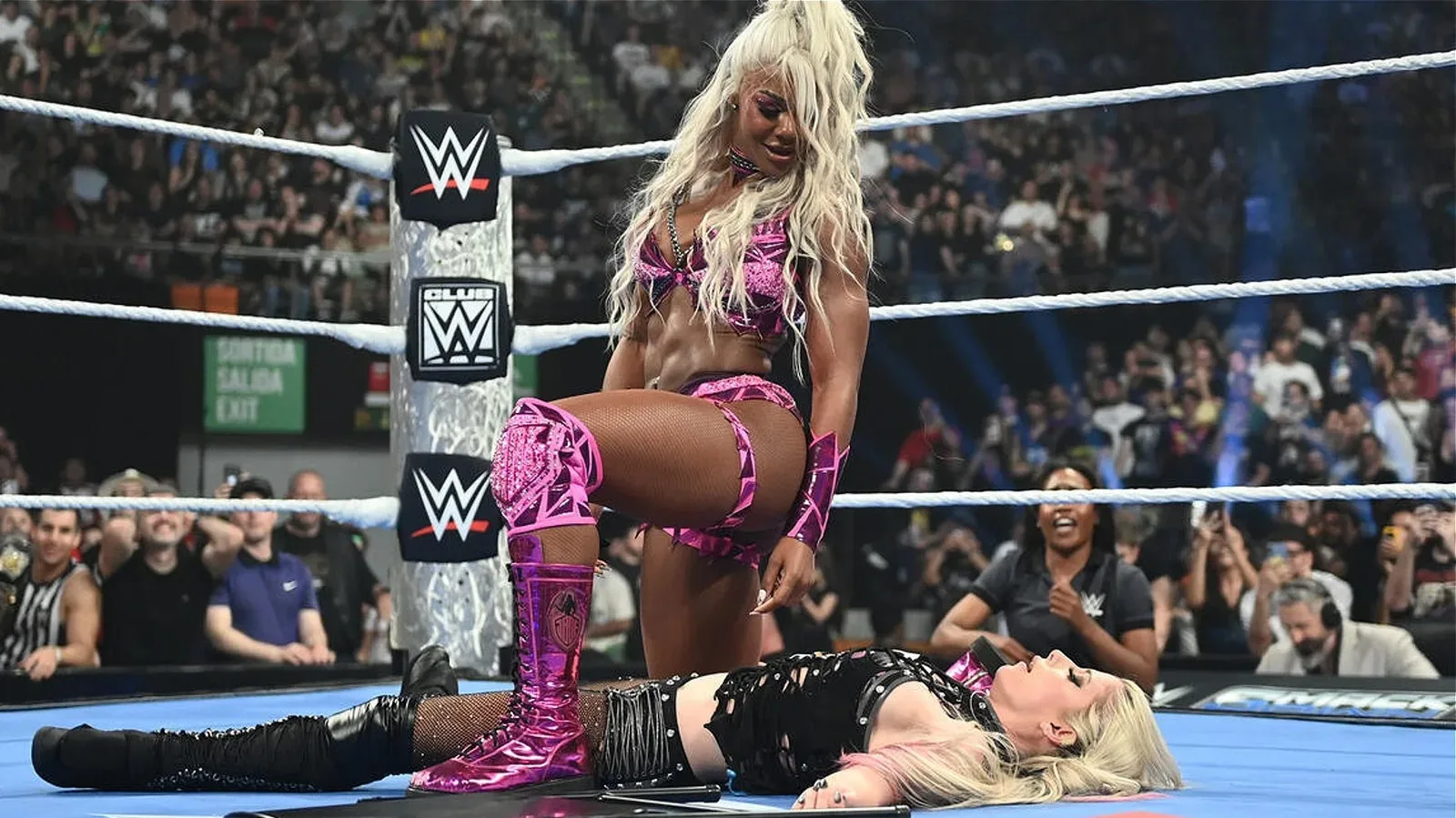
Jade Cargill has built much of her presentation around overwhelming physicality, and the move that closes many of her biggest matches has always fit that identity. The Jaded, the signature finishing maneuver Cargill brought with her from AEW to WWE, is a dramatic display of power designed to leave an opponent exposed before the impact. It is also, as Cargill has made clear, deeply connected to one of WWE’s most respected powerhouse performers: Beth Phoenix.
Speaking on Atlanta United FC’s The Guuuzan Show, Cargill discussed the origins of the Jaded and the uncertainty she felt while attempting to settle on a move that could define her in-ring persona. She explained that the process was not something she figured out alone. Former AEW wrestler Ivelisse helped Cargill brainstorm an approach that would be imposing visually while allowing the audience to see the opponent’s reaction.
“I didn’t know what I was going to do,” Cargill said on Atlanta United FC’s The Guuuzan Show.
That uncertainty is understandable given the importance of a finisher in professional wrestling. A finishing move is more than a hold or a throw. At its best, it becomes an extension of a wrestler’s personality, athletic strengths, visual identity, and standing within a division. For Cargill, whose rise was built on presenting herself as a dominant, elite-level athlete, the move needed to feel decisive from the moment it began.
For more background on this topic, read Trick Williams Details the Biggest Adjustment From Football to WWE Training.
Ivelisse’s guidance focused on the visual storytelling embedded within the maneuver. Rather than simply finding a difficult or painful-looking move, the goal was to create something that gave Cargill’s opponents an opportunity to show fear directly to the camera. That detail is central to why the Jaded works as a television finisher. The opponent is elevated and turned in a way that makes their vulnerability part of the spectacle, while Cargill remains composed and in control.
“Beth Phoenix is an amazing woman. And I’d see when she went out there, she’s a powerhouse. I was like, ‘Oh, I want to be a powerhouse just like that,’” Cargill said on Atlanta United FC’s The Guuuzan Show.
The connection to Phoenix is especially notable because the Glam Slam was one of the defining moves of Phoenix’s WWE career. Phoenix competed with a rare blend of strength, explosiveness, and authority, earning a reputation as one of the standout power wrestlers of her era. Her offense frequently separated her from many contemporaries, and the Glam Slam reflected that difference. It was a move that looked punishing, decisive, and completely appropriate for a performer nicknamed The Glamazon.
Cargill’s Jaded carries that same core influence. While it has become associated specifically with Cargill and her own presentation, its lineage is apparent in both the lift and the opponent’s positioning. Cargill did not hide from the comparison; instead, she embraced Phoenix as the wrestler whose work helped her determine what kind of powerhouse she wanted to become.
That is an important distinction. Homage has long been part of wrestling’s creative language. Wrestlers borrow ideas from the stars they watched, reshape familiar concepts around their own physical gifts, and add details that fit the current style of television production. Cargill has taken inspiration from Phoenix’s celebrated move and made it a cornerstone of an act that is unmistakably her own.
During the conversation, Cargill also spoke about why she wanted an opponent’s face visible during the sequence. The visual was intended to sell the fear and reinforce the inevitability of the result before the move even landed.
“I wanted to do something that was different, and I want to do something that shows fear, and I wanted to put my opponent’s face plastered right on the screen, and everybody can see that I’m about to get this win!” Cargill said on Atlanta United FC’s The Guuuzan Show.
It is a revealing description of how Cargill views the move. The Jaded is not just a finishing hold built for a three-count. It is a moment intended to communicate dominance in stages. First comes the lift, demonstrating Cargill’s control over an opponent. Then comes the suspended visual, giving the crowd and camera a chance to register the opponent’s predicament. Finally, the impact confirms that the match is over.
That structure has served Cargill well from the beginning of her career. She made her in-ring debut with AEW in 2021 and quickly became one of the promotion’s most prominent women’s division acts. Her presentation centered on confidence, star power, and athletic dominance, making a forceful, instantly recognizable finisher particularly valuable. The Jaded became a natural finishing statement for a wrestler positioned as someone opponents had difficulty matching physically.
Cargill later departed AEW and signed with WWE, taking the move into a new environment with a deeper pool of established rivals and a different level of weekly exposure. The Jaded remained a key part of her arsenal as she continued to develop her WWE career. Its clear visual identity made the transition seamless: regardless of promotion, the move immediately conveyed what Cargill was supposed to represent whenever she was in the ring.
Since arriving in WWE, Cargill has added championship accomplishments to her résumé. She has held tag team gold twice alongside Bianca Belair and has also had a run with the WWE Women’s Championship. Her partnership with Belair paired two of the company’s most physically gifted stars, and their title success further established Cargill as a major figure in WWE’s women’s division.
The Belair pairing also underscored the value of Cargill having a finishing maneuver that could stand apart even when she was working beside another athlete known for explosive strength. Belair’s offense is built around speed, power, and the KOD, while Cargill’s Jaded offers a different kind of spectacle: a controlled lift that puts the opponent’s expression at the center of the moment before the finish.
Cargill’s praise for Phoenix additionally highlights the significance of power wrestlers within the history of WWE’s women’s division. Phoenix was a defining presence during her active run because she gave opponents and audiences a different physical problem to confront. Her strength was not merely a feature of her character; it was the foundation of her matches. Cargill has sought to carry that same feeling into her own work, presenting herself as an athlete whose size and power can change the entire tone of a contest.
She even suggested that the Glam Slam’s reputation made it a natural move to adapt into her own version. Cargill recalled viewing Phoenix’s finisher as so formidable that she expected it to have the same impact when used under her own name. While Natalya, Phoenix’s former tag team partner, did kick out of the Glam Slam at one point, the move’s overall aura as a match-ender clearly left a lasting impression on Cargill.
For a wrestler still building the long-term legacy of her in-ring career, that awareness of wrestling history matters. Cargill is not presenting the Jaded as an invention disconnected from what came before. She has acknowledged the performers who helped her find it: Ivelisse in the creative process, and Phoenix as the powerhouse inspiration behind its most recognizable elements.
The result is a finisher that has traveled with Cargill across promotions and through major championship moments. The Jaded remains a reflection of her broader goals as a performer: to look different, to project fear, and to make every victory feel conclusive. With Phoenix’s influence openly recognized, Cargill has given added context to one of the most important moves in her career.
In pictures

Darryl Polo
Darryl Polo is a passionate wrestling fan covering WWE, AEW, TNA and beyond. He loves great rivalries, breakout stars and the moments that keep fans talking long after the bell. How we work.