
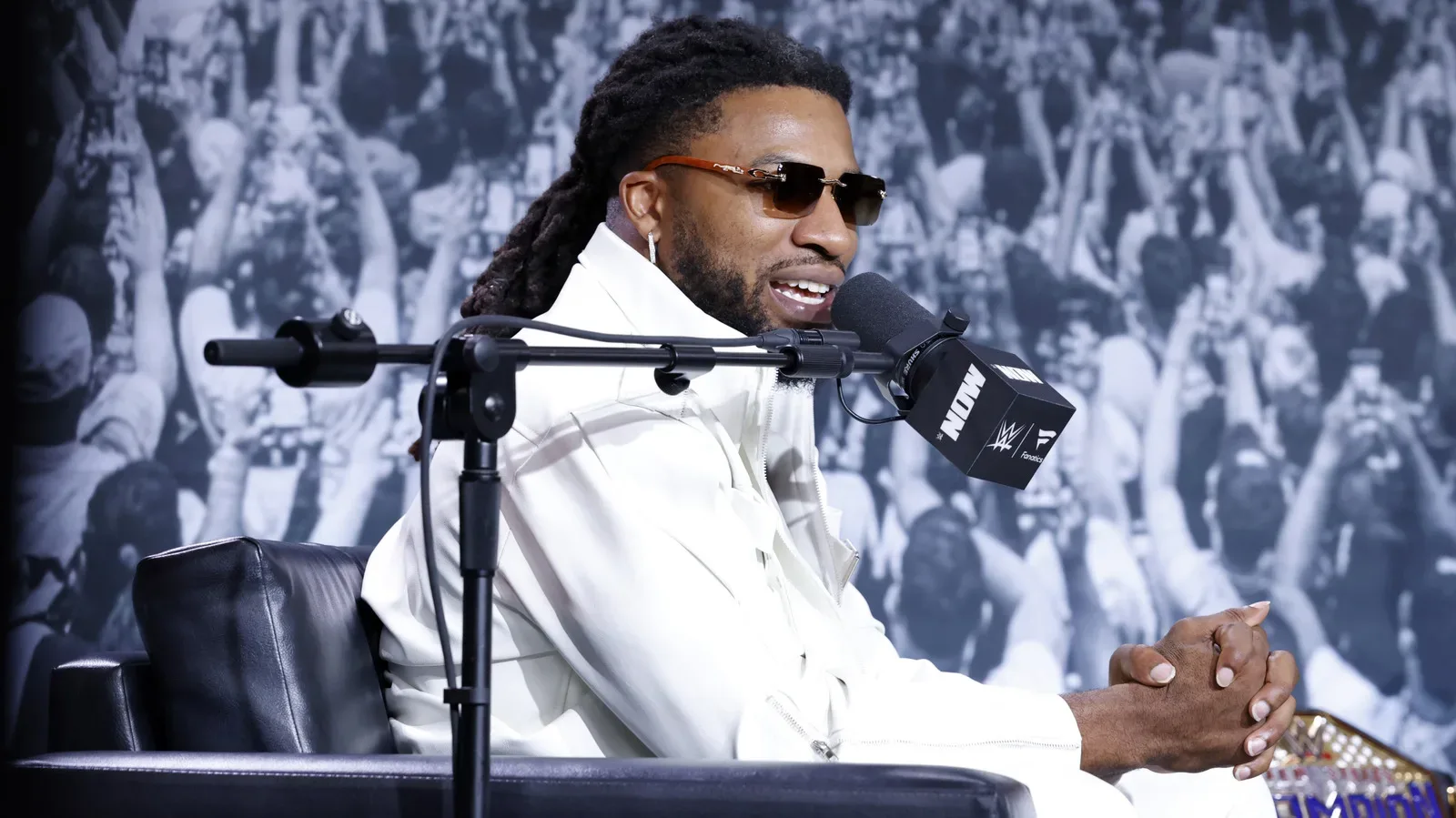
Trick Williams’ athletic background gave him a foundation that has helped shape his WWE career, but the transition from football to professional wrestling required a significant change in mindset.
Williams, who played football through college and continued in the sport briefly beyond that stage, explained that the most difficult early lesson in WWE training was not about strength, conditioning, or performing in front of a crowd. It was learning to do the opposite of what years on the football field had taught him.
During an appearance on Tap Out Tea, Williams discussed the contrast between the two sports. Football rewards an offensive player for avoiding the ground, escaping defenders, catching the ball, and continuing to move forward. In WWE, however, safely going down and returning to one’s feet are essential skills from the beginning of training.
“The funny thing about football is, on the offensive side, they determine how good you are by how many tackles you can break, how well you catch the ball — pretty much how [good] you are at staying on your feet,” Williams said on Tap Out Tea.
For more background on this topic, read Raquel Rodriguez Calls The Judgment Day WWE’s Strongest Faction Ever.
That instinct is especially understandable for someone who spent years playing a sport built around advancing the ball, absorbing contact, and resisting attempts to bring a play to an end. In football, getting tackled means a play is over. A ball carrier is trained to protect himself, maintain balance, keep his legs moving, and fight through contact whenever possible. Falling is often the outcome an offensive player is trying to prevent.
Professional wrestling demands a different kind of body control. While the spectacle can look chaotic or spontaneous, performers must learn how to land, roll, flip, and react in a way that protects themselves and their opponents while still making the action appear impactful. Before a wrestler can master signature offense, character moments, or major-match pacing, the fundamentals of safely taking a fall are central to the process.
“The first thing you learn becoming a WWE Superstar is how to fall, how to hit the ground, how to flip, how to cartwheel,” Williams said.
Unlearning a Football Player’s Natural Instincts
Williams said that shift was the hardest part of his adaptation to WWE. Rather than being praised for staying upright through contact, he had to become comfortable with hitting the mat correctly and recovering from it. The challenge was not simply physical. It was also mental, as he had to move away from habits reinforced throughout his football career.
For an athlete entering WWE from another sport, that distinction can be one of the clearest examples of why crossover success is never automatic. Elite athleticism, explosiveness, speed, and toughness can be valuable tools, but professional wrestling has its own specialized mechanics. An athlete may be accustomed to contact, but that does not necessarily mean they have been trained to take repeated falls or execute the movements required for a wrestling match.
Williams’ comments underline the importance of the early stages of WWE development. The basics are not merely a gateway to more advanced moves. They are the framework that allows a performer to work safely, consistently, and convincingly. Learning how to hit the mat, control momentum, and regain position is part of building the trust necessary to perform with others in a live environment.
That transition can be particularly challenging because football and wrestling both look, at a glance, like physical collision-based pursuits. Both require conditioning, discipline, resilience, and the ability to perform under pressure. Both can demand an understanding of timing and positioning. Yet their movement patterns and core objectives are often very different.
On a football field, players are generally attempting to stay balanced through contact and gain as much ground as possible. In a WWE ring, a performer may need to make an opponent’s offense look effective, react at the right moment, and fall in a manner that creates the desired visual while minimizing risk. The ability to sell an impact is not about failing to remain upright; it is a fundamental part of the performance.
Taking the Process Day by Day
Williams described the next stage of his wrestling education as a gradual process.
“From there, you just [take it] day by day,” Williams continued.
Once the initial challenge of learning how to fall began to settle in, Williams moved toward the broader work of becoming a complete WWE performer. That included developing his character and determining which moves fit that character best. The latter point is a crucial element of wrestling training, because a move set is not simply a collection of athletic maneuvers. It can help communicate who a wrestler is, how they approach a match, and what separates them from the rest of the roster.
For Williams, finding the right in-ring identity was part of a larger development process. A wrestler’s character, presence, verbal delivery, timing, and physical style all need to connect. A move can be impressive on its own, but it has greater value when it feels natural for the person using it. Building that connection is one reason WWE training involves more than adapting to the physical demands of the ring.
The day-by-day approach Williams described also reflects the reality of entering a new performance discipline. There is no single moment in which a recruit simply becomes fully prepared. Repetition, coaching, and experience are all necessary. The challenge is not only to learn individual techniques, but to make them instinctive enough to execute under the pressure of a live match.
That is where Williams’ sporting background can still be an asset. Football players are familiar with structured preparation, practice routines, physical conditioning, and the need to absorb coaching. Those traits can help provide a strong base. But as Williams made clear, the foundation does not erase the need to learn wrestling-specific habits from the ground up.
Football’s Continued Presence in WWE
Williams is far from the only WWE talent with a football background. Roman Reigns, Baron Corbin, and Bron Breakker are among the notable names who also brought extensive experience from the sport into professional wrestling.
The presence of former football players throughout WWE speaks to the overlap in the kinds of athletes the company can develop. Football can cultivate confidence in physical competition, familiarity with team environments, a willingness to train intensely, and comfort with contact. Those are meaningful qualities for anyone pursuing a WWE career.
Still, Williams’ experience shows why a football pedigree should be viewed as a starting point rather than a finished product. The skills that lead to success on the gridiron do not map perfectly onto a wrestling ring. In some instances, they can even create an early obstacle. A player taught for years to avoid being taken down may need time to understand that a controlled fall is not a defeat in wrestling training; it is a skill that makes everything else possible.
That adjustment is also a reminder of the craft involved in professional wrestling. The finished match asks performers to blend athletic ability with timing, character work, cooperation, and physical precision. A wrestler must know when to fight, when to react, when to stay upright, and when to make the fall count. The audience may see only a split second of impact, but getting to that moment safely and effectively depends on extensive preparation.
Williams’ comments offer a straightforward look at the learning curve behind that preparation. He did not present the transition as effortless, even with years of athletic experience behind him. Instead, he identified the need to unlearn a deeply ingrained football instinct and replace it with the movement fundamentals of WWE training.
From there, the work became about steady progress: developing comfort in the ring, refining a persona, and selecting offense that suited the character he wanted to present. It is a process that has helped turn a former football player into a WWE performer, while also demonstrating that the path from one demanding sport to another involves much more than natural athleticism.
In pictures

Darryl Polo
Darryl Polo is a passionate wrestling fan covering WWE, AEW, TNA and beyond. He loves great rivalries, breakout stars and the moments that keep fans talking long after the bell. How we work.