
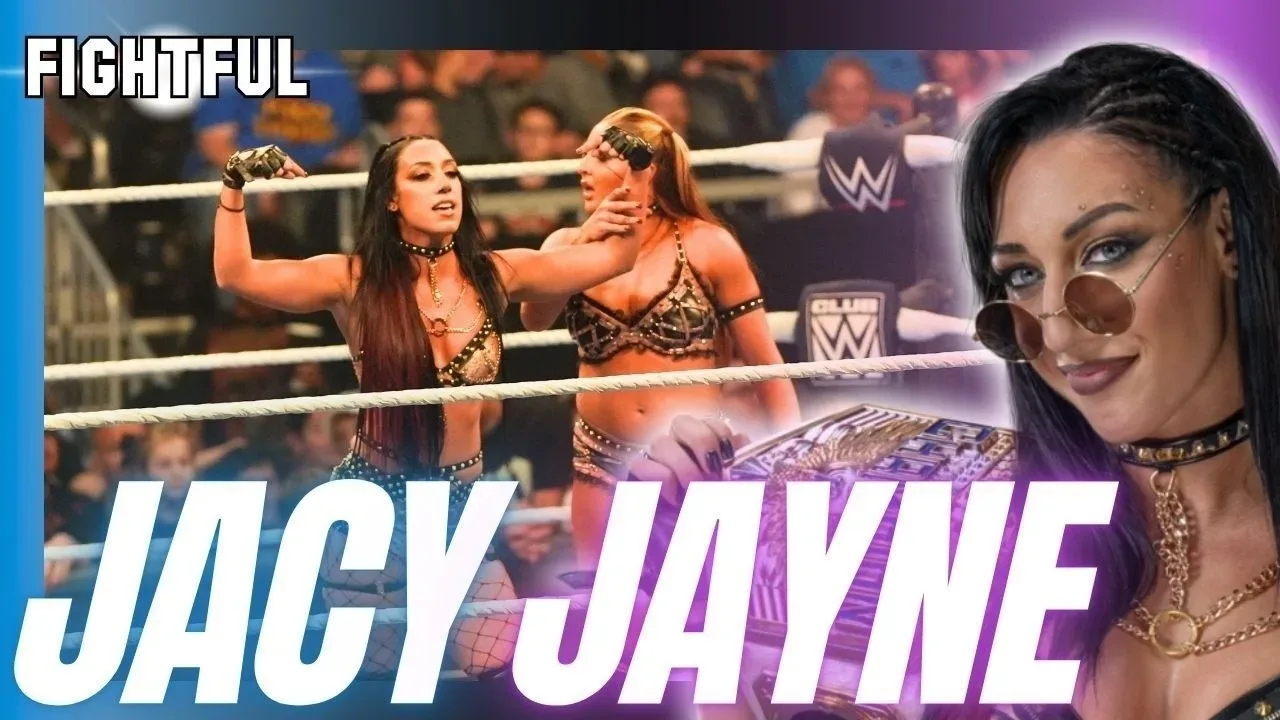
Jacy Jayne did not see her move to WWE SmackDown as a surprise. By the time she got the call in April 2026, she believed she had done enough in NXT to earn a main roster spot. The only question in her mind was when WWE would make the move.
Jayne went up alongside Lainey Reid and Fallon Henley, giving all three a new start on SmackDown at the same time. By August, Jayne had captured the WWE Women’s United States Championship. Looking back in a recent interview, she pointed to her final stretch in NXT as the reason she felt ready for the move and to her first night on SmackDown as the moment she started to show it.
“I was completely ready, I took over on my first night and I haven’t looked back since.”
Jayne says her final stretch in NXT made the case
Jayne called the promotion “a long time coming.” She singled out roughly the last year and a half of her NXT run, describing herself as being “on such a tear” during that period. In her telling, the call did not suddenly make her a main roster wrestler. It gave her a chance to bring the work she had already been doing to a different show.
For more background on this topic, read Rey Mysterio Says Team Mexico’s Survivor Series Win ‘Meant Everything’ After Penta’s Comeback.
“I earned my spot up here on the main roster,” Jayne said. That is a stronger claim than simply saying she was happy to get the opportunity. Jayne credited a sustained run in NXT rather than one breakthrough night, and she did not describe the wait as a period of doubt about whether she belonged on SmackDown. She said it was a matter of finding the right time.
That distinction matters when a wrestler moves from NXT to the main roster. For viewers who follow both shows, an arrival on SmackDown can feel like the next chapter of a story they already know. For viewers who do not watch NXT, the same appearance may be their first chance to find out what makes that wrestler stand out. Jayne’s comments put weight on both sides of that transition: she considered her NXT work the case for calling her up, but she still wanted to make an impression as soon as she got there.
Her claim that she “took over” on night one is Jayne’s assessment of her debut, not a match result. What it does reveal is how she judged the move. She did not talk about needing a few weeks to get accustomed to SmackDown before making her mark. In her view, the point of waiting for the right time was that she could step in and get going immediately.
The April call-up was a group move
Jayne’s account is about her own readiness, but her arrival on SmackDown was not a solo introduction. Reid and Henley made the jump alongside her, and the trio quickly established a presence on the show. That is an important part of the story even with Jayne’s championship win supplying the clearest individual milestone since the move.
A group arrival also gives the audience a different way to get to know a new name. Jayne could be seen in the context of Reid and Henley from the start, rather than having every early appearance carry the burden of introducing her on its own. At the same time, sharing an introduction does not mean each wrestler’s main roster run will be measured the same way. The Women’s United States Championship gave Jayne an accomplishment that was hers, separate from the broader impact of the trio.
There are two distinct milestones in that progression. In April, Jayne, Reid and Henley all made the jump to SmackDown. In August, Jayne became Women’s United States Champion. The group move explains how she arrived, while the title win shows how quickly she reached a significant singles milestone once she was there.
The August title win put her fast start in focus
Four months separated Jayne’s call-up and her capture of the Women’s United States Championship. The title win gives her assessment of that first night some context. She can say she arrived ready, but the more telling detail is that she had won a singles championship before her first summer on SmackDown was over.
The order is worth noting. Jayne did not cite the championship as the moment she finally felt she belonged on the main roster. She traced that confidence back to NXT. Seen that way, the August win was not what persuaded her she was ready in April; it was a result she could point to later when explaining why she never saw the call-up as a gamble.
It also offers a useful distinction between being ready for a new show and getting a result on it. The first is Jayne’s judgment about where she was in her career, shaped by the stretch she had put together in NXT. The second is a measurable part of her WWE record. The championship does not settle every question about what comes next for Jayne on SmackDown, but it does show that her first months there amounted to more than an initial burst of attention around a call-up.
Jayne also discussed preparing for Survivor Series WarGames
The interview was not limited to the move from NXT. Jayne also discussed preparing for her WarGames match at WWE Survivor Series. That subject put the focus on a different part of her main roster experience: getting ready for a team match at a major WWE event, rather than looking back at how she made the jump or talking about a singles title.
Those are different tests for a wrestler. A championship win gives Jayne an individual achievement to point to, while WarGames puts the emphasis on what she does as part of a team. The discussion of her preparation offered another point of reference for how much ground she had covered since April, without changing where she put the emphasis when asked about the call-up itself.
For Jayne, the defining stretch came before the SmackDown debut. She believed she had done enough in NXT to make the decision a question of timing. Once the call came, she and her two running mates had a foothold on SmackDown, and within four months she had a title win of her own. That is the record behind her insistence that WWE was not taking a chance on whether she might be ready someday. As far as Jayne was concerned, she already was.

Darryl Polo
Darryl Polo is a passionate wrestling fan covering WWE, AEW, TNA and beyond. He loves great rivalries, breakout stars and the moments that keep fans talking long after the bell. How we work.