
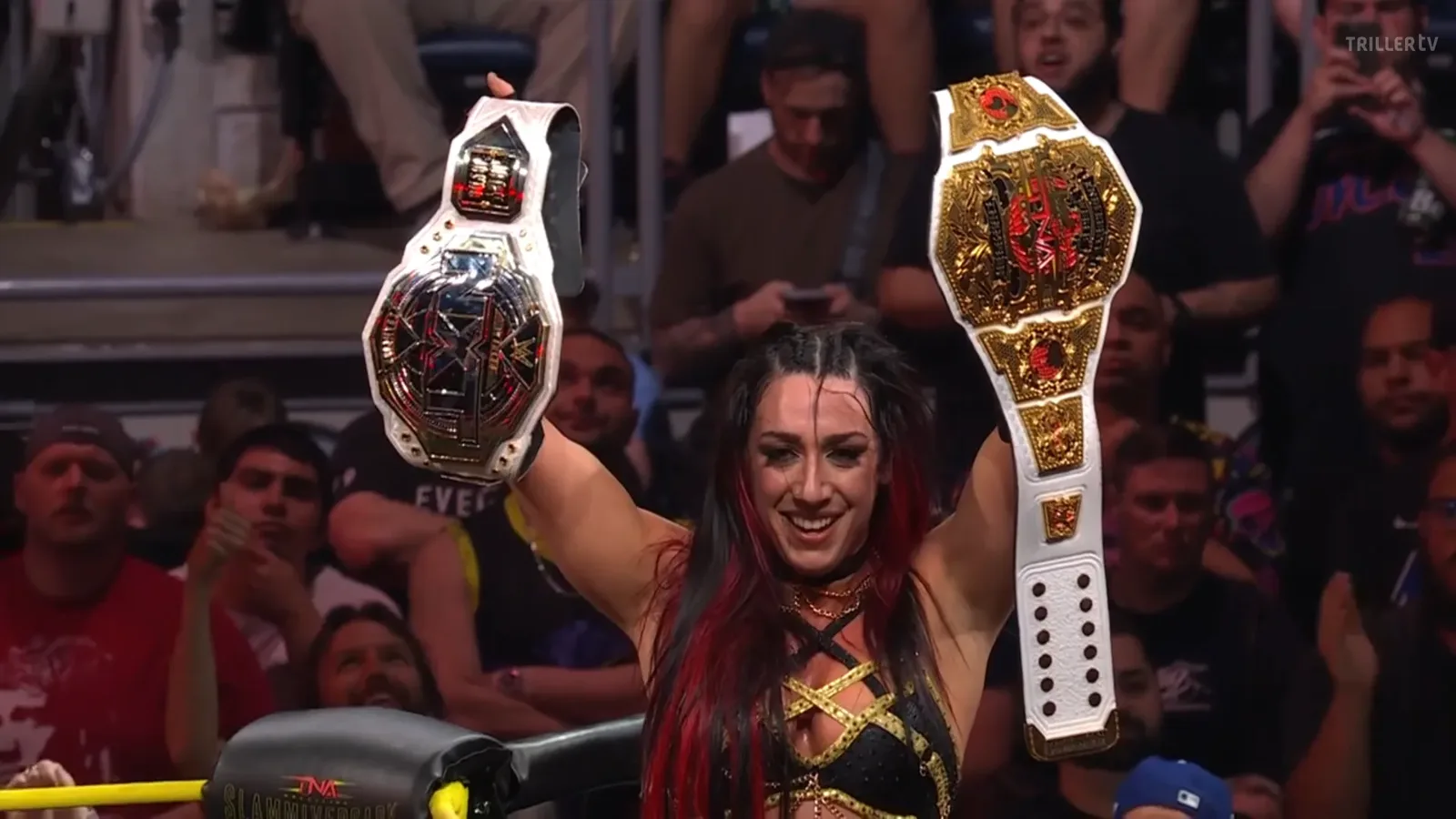
Jacy Jayne’s rise into a prominent singles role in NXT did not happen as quickly as she initially hoped after Toxic Attraction came to an end. The former NXT Women’s Champion has opened up about the difficult transition away from the group, admitting she was frustrated by her place on the card and believed she was ready for a larger opportunity before WWE’s creative leadership felt the same way.
That period ultimately became an important stage in Jayne’s development. Rather than receiving the immediate singles push she was seeking, Jayne says she was told she needed to improve key aspects of her presentation, including her in-ring work and her comfort on the microphone. In her view, the setbacks and the patience required during that stretch helped her find a clearer understanding of how she could succeed as a heel.
The major turning point, Jayne said, came with a non-title singles match against Stephanie Vaquer on an episode of NXT television. It was not a championship program or a match promoted as a major career-defining moment beforehand. But the response to the bout behind the scenes gave Jayne the opening she had repeatedly been asking for, and it helped set in motion the momentum that later carried her through championship success in both NXT and TNA.
Life After Toxic Attraction Presented a New Challenge
Toxic Attraction was one of the defining women’s acts of its NXT era. With Jayne alongside Gigi Dolin and Mandy Rose, the group combined championship accomplishments, a consistent on-screen identity, and a strong presence throughout the brand. When the group ended, however, Jayne was forced to establish herself separately from a unit that had provided a clear platform for her character.
For more background on this topic, read Bully Ray Wants WWE To Revisit Oba Femi’s Defiant Moment With Bronson Reed.
Jayne acknowledged that WWE executives and the NXT creative group had believed in her while she was part of Toxic Attraction. Once the act was no longer together, though, she found herself in an uneasy professional and personal position.
“I don’t want to say I lost myself, but I definitely wasn’t in the best headspace wrestling-wise,” Jayne said. “I felt like I was ready for the next step when in reality I really wasn’t.”
Jayne said she was aggressively seeking an opportunity backstage, repeatedly asking for a chance to prove herself. The response she received was not simply a refusal. Instead, she was told there were still details to refine before she could be given the kind of singles position she wanted.
“They were like, no, you’ve got to work on stuff. You’ve got to get better in the ring, you’ve got to get more comfortable on the mic,” Jayne recalled. “There’s little things that you’re just not getting yet.”
That feedback was difficult to hear at the time. Jayne described herself as frustrated, but she also said she committed herself to putting in the work away from the spotlight. The eventual goal was not only to become a more polished performer, but to develop a stronger grasp of what her role needed to be within NXT’s women’s division.
Shawn Michaels Helped Define Jayne’s Heel Persona
As Jayne continued working to earn a singles opening, she credited Shawn Michaels with helping make her character direction clearer. Michaels has been a central figure in NXT’s creative process, and Jayne said his guidance helped her understand how the brand needed her to function as a heel.
For Jayne, the lesson was not merely about being antagonistic on television. It was about finding the specific presentation that suited her and understanding how that character could serve the stories around her. She said that once the role was better defined, her confidence and her ability to contribute began to change.
“I felt like I finally understood my role in wrestling, being a heel,” Jayne said. “Shawn kind of really made it click for me. He was like, ‘This is how we need you, this is the character you are,’ whatever the case is.”
Even with that increased understanding, Jayne did not want to wait passively for the next step. She eventually went directly to Michaels’ office to ask what was missing and what she needed to do to show she could carry herself as a singles wrestler.
Jayne stressed that she did not walk in demanding a championship. Her request was more basic: one chance in a singles match to demonstrate that she could be trusted in that environment. She asked Michaels to identify what he needed from her, believing that she was still failing to deliver something the creative team wanted.
“You don’t need to make me the champion, you don’t need to do anything like that,” Jayne said she told Michaels. “I just want one singles match to show you that I can be a singles wrestler. What do you need from me, because clearly I’m not doing what you need?”
The response, Jayne said, was to stay consistent. Rather than taking that answer as the end of the discussion, she continued to press for the chance to put that consistency into action in a televised singles bout.
The Stephanie Vaquer Match Opened the Door
That opportunity arrived when Jayne was booked against Stephanie Vaquer. Vaquer has been one of the most acclaimed competitors in the women’s division, and the match gave Jayne a significant in-ring test despite not carrying title stakes.
Jayne emphasized that the bout was simply a Tuesday television match rather than a heavily built championship attraction. Its importance became apparent after it happened. She said the people making decisions were pleased with the performance, and she now views that match as the point where the direction of her career began to shift.
“I finally got a match with Stephanie Vaquer — it was not for the title, it was just a random match on television on a Tuesday,” Jayne said. “They were super happy with it, and I think the ball honestly started rolling from there.”
There is a broader lesson in Jayne’s account of the match. NXT has often relied on individual television performances to determine which developing talent is ready for greater responsibility. Not every pivotal match is announced as a make-or-break encounter. In Jayne’s case, a regular singles assignment became the platform she needed to change perceptions and show that she could deliver outside the structure of a stable.
Jayne’s remarks also underline the value of the Vaquer match specifically. By being placed opposite a highly regarded opponent in a straightforward singles setting, Jayne had the chance to present a more complete version of herself: an in-ring performer capable of keeping pace, a character with a defined purpose, and a wrestler who could be treated as a standalone act.
TNA Work Added More Singles Experience
The next phase of Jayne’s momentum included appearances in TNA. Working across NXT and TNA allowed her to gain more singles-match experience while navigating both schedules. Jayne believes that visibility and repetition were important in helping decision-makers see that she did not need to rely on a partner or faction dynamic to be effective.
“Then, I went to TNA,” Jayne said. “Just me being able to work both schedules and have singles matches and show that I can be my own person and that I don’t need to rely on someone else, I think that’s where the ball really started to roll and they started to believe in me more and more.”
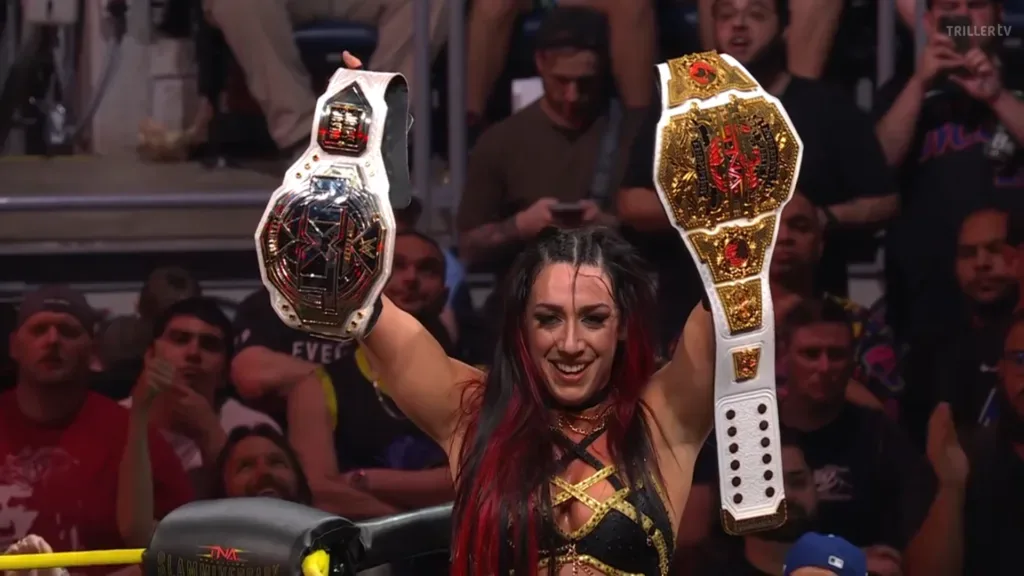
The results of that growing confidence were substantial in 2025. Jayne won both the TNA Knockouts World Championship and the NXT Women’s Championship during the same year, placing her at the center of two major women’s title pictures. The championships served as visible confirmation of the trust she had spent months trying to build.
Jayne also addressed the idea that her championship run may have been expected to be brief. Fans had speculated that she was positioned to be a transitional champion, and Jayne said she does not believe that perception came from nowhere. In her view, there was a real possibility that the initial plan involved a shorter reign.
“I really believe I was actually supposed to be a transitional champion,” Jayne said. “But I just kept having good matches and helping people get over and telling the stories that they wanted.”
Rather than focusing on pushing for more, Jayne said she concentrated on the work in front of her. She described keeping quiet, delivering matches, helping opponents get over, and serving the stories assigned to her. That approach, she believes, changed the outcome of her championship time.
Jayne said the reign eventually became a combined 300-day run, a far different outcome from what she believes may have initially been envisioned. Her journey from post-Toxic Attraction uncertainty to championship success was therefore not built around one dramatic declaration or an immediate rocket push. It was shaped by candid feedback, consistent improvement, a crucial match with Vaquer, and the willingness to keep proving herself every time another opportunity arrived.
For Jayne, the Stephanie Vaquer bout remains the clearest marker of when that work began translating into tangible momentum. A standard Tuesday-night singles match became the performance that showed NXT she was ready to be viewed not just as a former member of Toxic Attraction, but as a major singles presence in her own right.
In pictures

Darryl Polo
Darryl Polo is a passionate wrestling fan covering WWE, AEW, TNA and beyond. He loves great rivalries, breakout stars and the moments that keep fans talking long after the bell. How we work.