
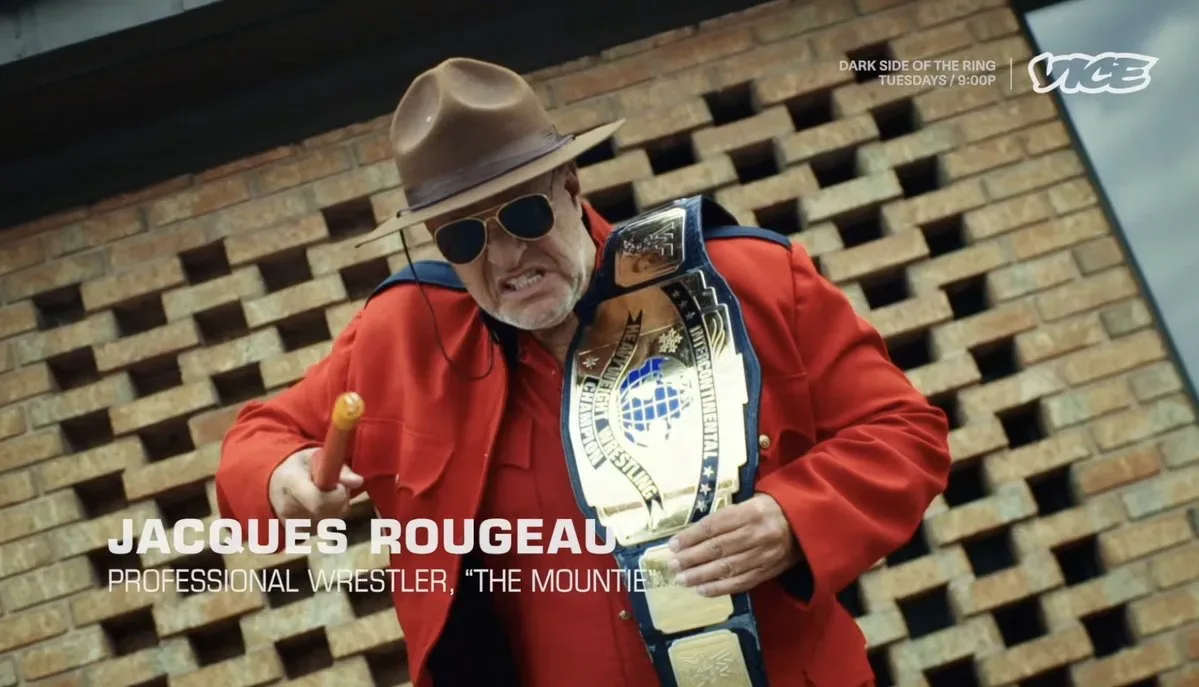
Jacques Rougeau’s appearance at AEW Redemption in Montreal produced exactly the kind of reaction he believes suits his wrestling persona: warmth from much of the building, boos from a smaller section, and an opportunity to fire back on the microphone.
AEW honored the Rougeau Family during the Buy-In portion of Redemption, bringing Jacques and Raymond Rougeau out in Montreal. The brothers have long occupied very different places in the eyes of wrestling audiences, both through their individual personalities and the roles they played during their careers. Raymond was welcomed enthusiastically when he spoke, while Jacques heard boos when he took the microphone.
Rather than taking the response as a negative, Jacques said he enjoyed it. Speaking with Ben Veal on Wrestling Life, Rougeau estimated that only around 10 percent of the audience was booing him, with the larger part of the crowd supporting him. He said the split response gave him a chance to lean into the confrontational edge that has followed him throughout wrestling.
“There is a running gag that there is a good Rougeau and a bad Rougeau, and I roll with it because it’s kind of the truth,” Jacques said. “Raymond has always been an easygoing guy. Whatever is put on his plate, he’ll eat. He’s very diplomatic. He’s always known how to sit between two people and please two people. I’ve never been like that.”
For more background on this topic, read RUSH Says AEW Return Could Come ‘Maybe Next Year’.
The contrast between Jacques and Raymond Rougeau
The different crowd responses were not accidental in Jacques’ view. The Rougeau brothers’ public images have been distinct for decades. Raymond has generally been viewed as the more measured and diplomatic member of the family, while Jacques has often been associated with sharper comments, bigger reactions, and a willingness to publicly state what he thinks.
Jacques said that tendency has created friction during his career. He acknowledged that, looking back, there were times when a more diplomatic approach may have served him better in business. Still, he maintained that being direct is simply part of who he is.
“I’ve always been very prompt and quick on the trigger,” Rougeau said. “That put me in many positions throughout my career where I said my piece of mind where, when I look back, business is business, and you should learn how to be more diplomatic. I guess that’s the autistic side of me, but I can’t; there is no gray zone with me.”
That self-description also framed how Jacques interpreted the Montreal crowd. To him, the boos reflected the baggage of a lengthy career rather than a wholesale rejection from the audience. He said he has accumulated critics in wrestling, including as a result of conflicts and his willingness to stand against Vince McMahon.
At Redemption, however, Jacques saw the response as an extension of the act. Raymond received applause. Jacques heard a pocket of boos. The contrast reinforced the familiar dynamic, and Jacques immediately chose to have fun with the situation instead of attempting to smooth it over.
Rougeau says the crowd reaction grew after his response
Jacques recalled that he began laughing after hearing the boos and mocked the fans responsible for them. He told the hecklers to “kiss my ass,” a retort that he said drew a significant reaction from the audience.
“I made a lot of haters in the business,” Rougeau said. “Raymond starts talking and they are applauding him. When I took the microphone, there were about 10% who were booing me, and I lit up. I started laughing. I made fun of it. I told them to kiss my ass. It felt so good and the reaction is so great.”
Rougeau said the larger portion of the building was behind him and became more vocal in response to the boos. In his telling, even the fans who initially jeered were engaged by the exchange once he responded. The important part for him was not receiving unanimous approval; it was creating a lively, memorable moment that felt authentic to his own history and the Rougeau Family’s connection to Montreal wrestling.
“The 90% that loved me, they were upset that the 10% was booing me,” Jacques added. “When I told them to kiss my ass, they popped big time. The 10% popped too.”
That is a particularly old-school wrestling reading of the situation. A divided reaction can become more valuable than a polite ovation when a performer knows how to use it. Jacques’ career has included prominent villain work, and he has never been someone whose identity depended on being universally cheered. The Redemption segment allowed him to tap into that history while appearing alongside a family member whose demeanor remains markedly different.
Rocky Romero interrupted the Rougeau Family tribute
The Buy-In segment did not remain solely a celebratory presentation. Rocky Romero interrupted the Rougeaus during the appearance and was subsequently taken out. Jacques described the interruption as part of a segment that gave the family a chance to interact with the live crowd beyond a simple ceremonial entrance.
The angle mattered because it turned the tribute into an active wrestling moment. Instead of merely acknowledging the Rougeau Family’s importance in Montreal, AEW gave Jacques and Raymond material to respond to, a crowd reaction to play against, and a physical conclusion involving Romero. For Jacques, the combination of the cheers, boos, insult exchange, and Romero’s interruption created a setting where his instincts could take over.
Jacques said he initially questioned whether he had handled the live moment correctly. He described spending roughly 10 to 15 minutes wondering whether his decision to confront the booing fans had been the right choice. That uncertainty was soon alleviated by the feedback he received afterward.
“Tony Khan came to see me, and he gave me three or four hugs. ‘That was amazing. That was amazing,’” Rougeau said. “All the pressure fell off whether I did the right thing. I questioned myself for ten or 15 minutes: ‘Did I do the right thing?’ With all the great messages I got, wow, what a comeback on the haters. That was fulfilling.”
A Montreal homecoming with a familiar edge
For a wrestling family so deeply associated with Quebec, an AEW event in Montreal provided a natural place for a tribute. The Rougeau name carries substantial local and historical weight, and the appearance placed both brothers before an audience that knew the family’s legacy as well as Jacques’ more polarizing public persona.
Jacques’ comments make clear that he did not expect or require the building to react to him in exactly the same manner as it did Raymond. In fact, he viewed the difference as an advantage. The crowd’s response offered a compressed version of the dynamic he described: Raymond as the agreeable, diplomatic brother and Jacques as the man more likely to provoke a reaction and answer it immediately.
That distinction has been part of their presentation for so long that it remains recognizable even in a one-night AEW appearance. Jacques heard boos, answered in kind, and left satisfied that the response had become a meaningful part of the segment rather than a distraction from it.
Elsewhere in the interview, Jacques also denied that he threw a tantrum over AEW not airing a video package. His principal takeaway from Redemption, though, was the response he received in Montreal and the confidence he felt after seeing the segment land with the crowd and with AEW President Tony Khan.
For Jacques Rougeau, the small group of boos did not spoil a family tribute. They gave it edge, gave him something to work with, and helped produce a return to the kind of confrontational crowd interaction that has long been central to his identity in professional wrestling.

Darryl Polo
Darryl Polo is a passionate wrestling fan covering WWE, AEW, TNA and beyond. He loves great rivalries, breakout stars and the moments that keep fans talking long after the bell. How we work.