
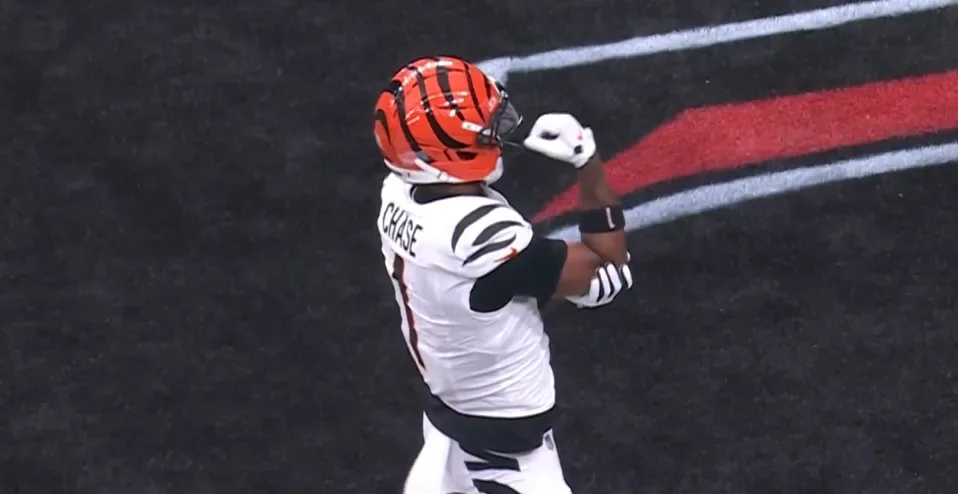
Ja’Marr Chase has won his appeal over fines issued for a touchdown celebration that he described as the “People’s Elbow,” providing an unexpected professional wrestling connection in the middle of the NFL season.
The Cincinnati Bengals wide receiver scored two touchdowns against the Houston Texans on Sunday, September 20. In the days following that game, Chase was fined in relation to the celebrations. The move drew particular attention because Chase later explained that he was performing the “People’s Elbow,” a name immediately familiar to generations of wrestling fans.
On October 13, it was revealed that Chase had successfully appealed both fines. The appeals decision is significant not simply because the penalties were overturned, but because it followed Chase’s explanation that he had not received any warning that the celebration was prohibited.
View the referenced post on X
Chase stated in the appeals office letter that he received no warning that the celebration was not allowed.
For more background on this topic, read Drew McIntyre Reflects On PAC’s Legacy, Friendship And The Importance Of Perspective.
For wrestling audiences, the story is an easy one to recognize. The People’s Elbow is one of the most famous celebration-driven moves in modern pro wrestling. Its appeal has never been limited to the impact of the elbow itself. The spectacle around it—the crowd recognition, the personality behind it, and the unmistakable visual setup—made it an enduring part of wrestling pop culture. That visibility has helped the move become a reference point far beyond the ring.
Chase’s use of the tribute during a football game is another example of wrestling’s vocabulary continuing to travel into mainstream sports. Athletes have regularly borrowed from wrestling over the years, whether through entrance-inspired gestures, championship-style poses, catchphrase references, or in-game celebrations. The People’s Elbow is especially suited to that kind of crossover because it is instantly identifiable even to many casual viewers.
A Celebration That Became a Disciplinary Issue
The immediate football issue was not whether Chase knew the cultural origin of the move, but whether the celebration violated rules governing what players may do after scoring. Chase’s eventual appeal centered on a straightforward point: he said he had not been warned that the celebration was not permitted.
That detail ultimately mattered. Both fines have now been successfully appealed, ending the matter in Chase’s favor. The decision does not change the fact that the celebration initially attracted discipline, but it does establish that Chase’s challenge to the penalties was accepted.
There is a distinction worth making between a wrestler-inspired gesture being performed on a football field and an athlete claiming the presentation, character, or full theatrical context behind it. Chase referred to his celebration as the People’s Elbow, and that reference is what brought the wrestling world into the conversation. It was a nod to an iconic piece of wrestling performance, used in a completely different competitive environment after a touchdown.
In professional wrestling, a signature move can become as recognizable as a performer’s name. That is particularly true of moves whose execution is built around audience participation and anticipation. The People’s Elbow became a cultural shorthand precisely because fans knew what was coming as soon as the sequence began. A football player borrowing that visual language after scoring is therefore likely to be understood immediately, even outside a wrestling broadcast.
Why Wrestling References Continue to Cross Over
Professional wrestling has long had a unique influence on sports celebrations. Its gestures are designed to communicate quickly and clearly to a large audience. A pose, a taunt, a point toward the crowd, or a familiar motion can tell viewers exactly what the athlete is trying to project: confidence, defiance, excitement, humor, or dominance.
That makes wrestling an especially natural place for athletes to draw inspiration. The strongest wrestling moments often rely on big, readable movement and a relationship with the crowd. Those same qualities translate well to stadium settings, where players are celebrating in front of tens of thousands of people and television cameras.
The People’s Elbow also occupies a particular place in that conversation. It is not merely remembered as a technical wrestling maneuver. It is remembered as an event within a match, complete with a recognizable rhythm and an expectation of crowd reaction. A brief version of that performance can be adapted into a celebration without requiring a lengthy explanation.
Chase’s case shows that those references can sometimes bring unintended consequences. In this instance, a celebration that had a clear wrestling inspiration became the subject of fines before the appeals process reversed them. The outcome is a reminder that mainstream visibility does not necessarily mean every gesture will be viewed the same way in every sporting context.
Chase and the Bengals’ Position
While the appeal has supplied an entertaining wrestling-adjacent headline, Chase and the Bengals remain focused on the season ahead. Cincinnati holds a 3-2 record and currently sits at the bottom of the AFC North.
The Bengals’ upcoming schedule includes games against the Baltimore Ravens, Tennessee Titans, and Atlanta Falcons. Those matchups will carry more immediate competitive importance than the fine appeal, particularly as Cincinnati attempts to improve its position within the division.
Still, the resolution of the matter removes a distraction for one of the team’s most prominent players. Chase’s two-touchdown performance against Houston was the on-field foundation for the story, while the celebration and ensuing appeal turned it into something that reached well outside the NFL’s usual discussion points.
For Chase, the practical result is clear: the two fines connected to the celebration have been overturned. For wrestling fans, it is another instance in which a familiar piece of ring tradition has surfaced in a major sporting arena.
The Lasting Recognition of the People’s Elbow
The enduring relevance of the People’s Elbow speaks to the wider cultural footprint of professional wrestling. Wrestling moves and catchphrases can remain part of public consciousness long after a particular match, feud, or era has passed. The best-known examples become references that athletes, entertainers, and fans can use without needing to explain every layer of their origin.
That does not happen by accident. Wrestling’s biggest stars build their identities through repetition, presentation, and crowd connection. A move becomes iconic when viewers can recognize it from its earliest motion, and when its appearance produces a reaction before the final moment has even happened. The People’s Elbow achieved that status.
Chase invoking it after a touchdown underlines how broadly that recognition still extends. His appeal did not turn on wrestling history, nor did it need to. But the fact that the celebration could be identified by that name made the connection unmistakable. The term carried enough meaning on its own to frame the entire dispute.
There is also a lighter side to the story. Sports are often at their most memorable when athletes find ways to express personality after a major play. Wrestling, built around character and audience response, has always offered a deep catalogue of gestures and moments that fit that purpose. The line between homage and celebration can be a fun one for fans to spot.
In Chase’s case, the celebration briefly became expensive before the appeals process provided a favorable conclusion. He said that he had not been warned the move was not allowed, and the reversal of both fines means that argument succeeded.
The Bengals now move forward with their upcoming games against Baltimore, Tennessee, and Atlanta, while Chase can put the disciplinary issue behind him. The wider takeaway, however, will be familiar to wrestling fans: even on an NFL field, the People’s Elbow remains recognizable enough to make headlines.

Darryl Polo
Darryl Polo is a passionate wrestling fan covering WWE, AEW, TNA and beyond. He loves great rivalries, breakout stars and the moments that keep fans talking long after the bell. How we work.