
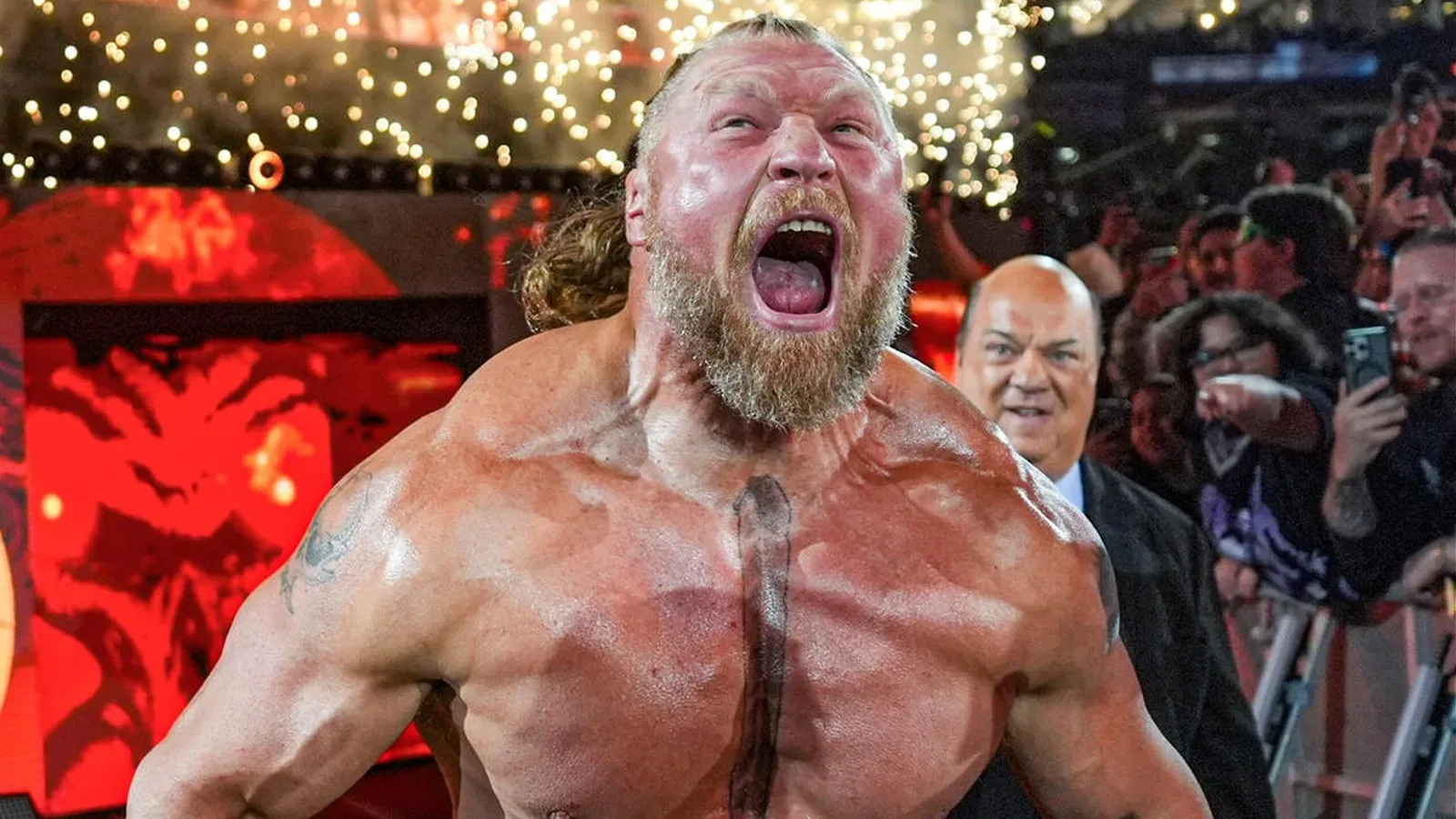
Ilja Dragunov has addressed one of the more debated moments from this year’s men’s Royal Rumble match: his brief confrontation with Brock Lesnar and the rapid elimination that followed it.
Now established as AEW’s latest acquisition, Dragunov looked back on the exchange during an appearance on The Ariel Helwani Show. The sequence saw Dragunov bring his usual intense, hard-hitting approach to Lesnar, only for “The Beast Incarnate” to absorb the offense without visibly selling it before sending Dragunov out of the match moments later.
For some fans, the spot was frustrating. Dragunov has long built his reputation around his ability to make every strike, every recovery, and every show of endurance feel meaningful. Seeing his attack fail to move Lesnar prompted criticism from viewers who believed the Rumble appearance did not give Dragunov a sufficient opportunity to showcase what makes him distinctive.
Dragunov, however, said he views the moment through the lens of the character he has portrayed throughout his career. In his eyes, being placed opposite an imposing force such as Lesnar does not erase the story. It creates the kind of challenge his character is designed to confront.
For more background on this topic, read Jeff Cobb Explains Why WWE Face Paint Was More Difficult Than Wrestling in a Mask.
“If you really understand the persona that I have been in the ring most of the time, like, I’ve been facing monsters,” Dragunov said on The Ariel Helwani Show. “At the end of the day, you can’t change certain things. You have a person like Brock Lesnar standing in front [of you]; most people would run away as soon as that happens, you know?”
The comments speak to an important distinction in how Dragunov sees himself as a performer. He is not presenting his in-ring identity as an untouchable athlete who overwhelms every opponent in front of him. Instead, the appeal of Dragunov’s character has often come from the willingness to keep fighting when an opponent appears bigger, stronger, fresher, or simply more dangerous.
That perspective naturally applies to Lesnar. For years, Lesnar was framed as one of WWE’s most physically dominant attractions, a wrestler capable of running through opponents with suplexes, overwhelming power, and bursts of frightening speed. His presence in a Royal Rumble match changes the dynamic around nearly everyone else in the ring. A direct confrontation with him is not necessarily an equal exchange, particularly within the established presentation of his character.
Dragunov acknowledged that he could not dictate how Lesnar reacted during the moment. What he could do, he said, was remain committed to the mentality that has made his performances resonate with his supporters: refusing to retreat from the fight even when the odds are plainly against him.
That is why Dragunov does not classify the brief Rumble sequence as a defeat in a broader creative sense. An elimination is, of course, a loss within the structure of the match. But Dragunov’s point is that losing a physical battle is different from losing the emotional story of a confrontation. His character has frequently been defined by the response after punishment, rather than by the ability to avoid punishment in the first place.
“It’s always the way how I fought back and how I recovered after those moments, because these moments make great stories,” Dragunov explained on The Ariel Helwani Show. “So I don’t see it as a defeat.”
Why the Lesnar Moment Created Such a Strong Reaction
The reaction from fans was understandable given the investment many have in Dragunov’s style and presentation. He is a wrestler whose strongest matches tend to revolve around escalation. He absorbs punishment, shows visible exhaustion and pain, then finds another level of urgency. The audience is invited to believe that he can be hurt, knocked down, and placed in serious jeopardy, while also believing that he will continue searching for a way back into the contest.
A brief exchange in a multi-person battle royal does not offer the same time or space as a singles match to tell that kind of story. There is no lengthy period of adversity, no extended sequence of selling, and no eventual comeback to reshape the momentum. In the Rumble, Lesnar’s elimination ended the interaction before Dragunov could show the recovery that he considers central to his identity.
That limitation does not mean Dragunov rejects the spot itself. Rather, he appears to regard it as one beat in a much larger career, and not as a definitive statement about his worth or credibility. Dragunov recognized that some of his fans were unhappy with what they saw, but he made clear that it was not a moment he chose to dwell on.
That approach is consistent with the theme of resilience he described. A wrestler who defines himself entirely through victories can be damaged by any setback. A wrestler whose character is built around repeatedly standing back up can incorporate setbacks into the foundation of the act. Dragunov’s view is that vulnerability is not a weakness in that formula. It is part of what gives a comeback weight.
Dragunov Says He Has No WWE Regrets
Beyond the Lesnar interaction, Dragunov also reflected on his WWE career and said he has no regrets about that period. It is a notable sentiment considering the wide range of reactions a wrestler can receive during a major-company run. Every performer faces moments that connect immediately, moments that divide the audience, and moments that generate debate long after the show ends.
Dragunov did not attempt to present himself as universally accepted. He acknowledged that his character can be polarizing. Yet he sees that response as a positive rather than an indictment. Professional wrestling thrives on emotional investment, and a performer who inspires a firm reaction—whether admiration, concern, disagreement, or passionate defense—has created something that viewers are actively engaging with.
Indifference is often more damaging than division. Dragunov’s presentation is not designed to fade into the background. His intensity is deliberately extreme, his physicality is uncompromising, and his performances invite the audience to react to the risk and emotion of what they are seeing. For fans who connect with it, that style makes him compelling. For those who do not, it can still produce a strong opinion. Dragunov appears comfortable with that divide.
His response to the Royal Rumble criticism also illustrates a measured understanding of wrestling’s collaborative nature. A performer can control his own movement, expressions, urgency, and commitment to the character. He cannot independently control the entire meaning an audience attaches to a single exchange, especially one involving an opponent with the established aura of Brock Lesnar.
Rather than framing the situation as a personal grievance, Dragunov placed the emphasis on context. Lesnar was Lesnar: a looming, dominant opponent whose presence would intimidate most competitors. Dragunov was Dragunov: a fighter who does not run away, even when retreat would seem rational. That contrast was the story he took from the segment.
A New Chapter in AEW
With Dragunov now in AEW, the comments offer a useful insight into what viewers can expect from him moving forward. His appeal is unlikely to rest solely on a claim that he is the strongest man in any room. It will rest on his willingness to engage with danger, absorb hardship, and make the audience believe that he will continue fighting through adversity.
That can be a valuable foundation in any promotion, particularly one filled with contrasting styles and personalities. Dragunov’s ability to portray both defiance and vulnerability gives him multiple paths into rivalries. He can be the underdog facing a larger threat, the relentless challenger refusing to concede, or the intense competitor whose willingness to suffer becomes a weapon in its own right.
The Lesnar moment remains a point of discussion because it involved two performers at dramatically different ends of the physical-presentation spectrum. But Dragunov’s own assessment is clear: he does not see the exchange as something that diminished him. He sees it as another instance of a character confronting a monster and refusing to abandon the fight.
For Dragunov, the important part was never whether Brock Lesnar immediately sold the offense. The important part was that he stayed true to the fighter he believes fans have come to know—one who can be knocked down, overwhelmed, or eliminated, but whose defining trait is the determination to rise again.
In pictures

Darryl Polo
Darryl Polo is a passionate wrestling fan covering WWE, AEW, TNA and beyond. He loves great rivalries, breakout stars and the moments that keep fans talking long after the bell. How we work.