
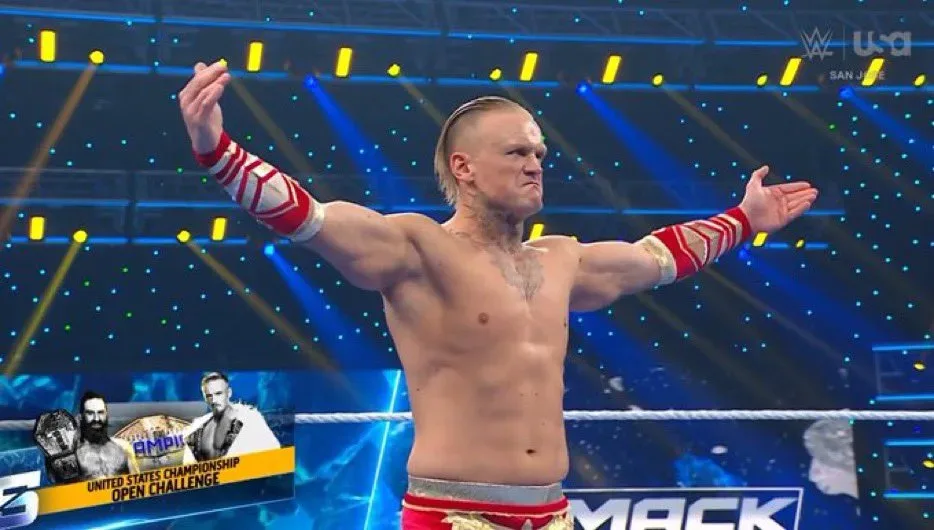
Ilja Dragunov has built his reputation on intensity. Whether he is throwing strikes, absorbing punishment or staring across the ring at an opponent, the WWE star’s performances are defined by a level of urgency that makes every exchange feel meaningful. For Dragunov, though, the spectacular moves are not necessarily the most draining part of the job.
Speaking on the Battleground podcast, Dragunov explained that the expressive side of professional wrestling—the vocal reactions, facial expressions, body language and constant awareness of the audience—is often harder than executing the physical maneuvers themselves. In his view, portraying the consequences of a match and allowing the crowd to understand the emotional stakes requires sustained effort from bell to bell.
“It is definitely the part of expressing yourself. It is the vocality. It is the expressions. This part of portraying what you’re doing is at times much harder than any move that you can do,” Dragunov said.
That answer speaks directly to a major part of what separates a wrestling match from an exhibition of athletic ability. Physical skill remains essential, especially at WWE’s level, where performers are expected to execute demanding offense safely under bright lights. But a move by itself does not automatically create drama. The reaction before, during and after it can determine whether the audience sees it as a routine sequence or as a pivotal moment in a fight.
For more background on this topic, read Michael Cole Sees The Miz, Seth Rollins and Wade Barrett as WWE Commentary Standouts.
Dragunov’s approach has consistently leaned into that second element. His matches are commonly marked by audible exertion, visible pain, defiance and rapid shifts in emotion. Rather than presenting damage as something that disappears after the next transition, he emphasizes the feeling that each strike and each setback has changed the situation. That style makes his bouts feel less like a collection of isolated spots and more like contests in which the performers are trying to survive escalating conditions.
Every Reaction Is Part of the Work
Dragunov described the pressure involved in maintaining that level of communication throughout a match. He pointed to the physical energy required to shout while delivering or receiving offense, while also ensuring that the performance remains connected to the people watching.
“Like this pressure that your body handles. You’re screaming out when you punch, when you get hit. You constantly focus to include the audience, to have this roundabout vision at all times, it is extremely exhausting,” Dragunov said.
The idea of “roundabout vision” is particularly revealing. A wrestler cannot operate only within the narrow space immediately in front of them. They must be aware of an opponent, positioning, timing, the referee, cameras and the live audience at the same time. For a performer as expressive as Dragunov, that awareness also involves reading the building and deciding how strongly to convey a moment so that it reaches viewers in the arena and at home.
It is a balancing act. A wrestler must make emotion clear enough for the back rows to understand it, without losing the authenticity of the moment. They have to project exhaustion while retaining enough awareness to continue the match safely. They must react to offense in a way that gives their opponent’s work weight, while also keeping the larger story moving forward.
Dragunov’s comments underline why the phrase “ring psychology” encompasses much more than deciding the order of moves. It includes pacing, selling, escalation, crowd engagement and the ability to make every action appear to matter. A performer can be physically capable of executing an elaborate sequence, but the sequence needs emotional context if it is going to stay with an audience after the show ends.
The Story Changes With Every Exchange
For Dragunov, the central question during a match is not simply what impressive thing comes next. He said the more demanding task is understanding how the events that have already happened should affect the character and the fight itself.
“It’s not just comes down to what’s the next cool looking thing that I can do. It’s like, how do I handle what happened right now to me? How does it change me as a person during this beautiful fight that I’m expressing, during this play with my opponent?” Dragunov said.
That philosophy is evident in the way Dragunov frames a wrestling bout as a conflict between two people rather than a series of planned physical accomplishments. Each moment has a consequence. A damaging strike can create anger, desperation or doubt. A failed attempt at a big move can alter a competitor’s strategy. A near-fall can raise the urgency of everything that follows. The audience is more likely to invest when performers visibly process those developments instead of moving immediately to the next highlight.
Dragunov also referred to the match as a “play” with his opponent, a description that captures the cooperative but competitive-looking nature of professional wrestling. Two wrestlers are working together to create a believable struggle, but each must stay true to their own character within that shared performance. The emotional exchange is not an accessory to the moves. It is the mechanism that makes the moves feel consequential.
In that sense, vocality is not merely noise, and facial expressions are not merely gestures for the camera. They are storytelling tools. A yell after a punch can communicate aggression. A gasp after taking a blow can tell viewers that the impact landed differently from what came before. A delayed attempt to rise can show accumulated damage and create an opening for the crowd to rally behind a comeback.
Why the Demands Are Physical, Not Just Mental
While expression is often discussed as an artistic component of wrestling, Dragunov stressed that it carries its own physical cost. Projecting emotion while wrestling at a high pace can put added strain on breathing, energy levels and concentration. The performer is not only running, falling, striking and lifting; they are also making sure their body language remains readable during all of it.
“That’s the real exhausting part, and it’s physically exhausting,” Dragunov said.
The statement helps explain why matches that feel especially intense can demand so much from the wrestlers involved. A performer may be able to complete a move, but completing it while selling a previous injury, communicating struggle, hearing the crowd and preparing for the next moment requires another level of endurance. In wrestling, fatigue can also become part of the presentation. The challenge is making that fatigue serve the story without allowing it to compromise the match.
Dragunov’s style has made him particularly suited to discussing that challenge. His work is often fueled by urgency and vulnerability at the same time. He can portray a competitor who is willing to absorb punishment and continue fighting, but that resilience has meaning because the punishment is presented as painful and draining. The audience is asked to believe that the effort matters, not that the wrestler is untouched by it.
That is also why expressive wrestling can be so effective in drawing viewers into a match. Fans do not need to know every technical detail of an offensive sequence to recognize frustration, pain, determination or momentum. Those emotions create an accessible language between the ring and the crowd. When done well, the audience reacts not just to what happened, but to what it seemed to do to the people involved.
Dragunov’s View of the Complete Wrestling Performance
Dragunov’s comments offer a clear view of how he defines a complete professional wrestling performance. Athleticism is important. Conditioning is important. Timing and execution are important. Yet none of those elements stand alone. The emotional presentation ties them together and turns physical action into a story that viewers can follow.
His focus on the changing emotional state of a match also reflects an approach built on responsiveness. Wrestling requires preparation, but it also requires performers to react in the moment. The atmosphere in the building, the audience response and the rhythm of an exchange can all influence how a match is presented. Staying alert to those shifts while continuing to perform at a demanding physical level is the kind of challenge Dragunov considers the truly exhausting part of the craft.
Elsewhere in the same conversation, Dragunov addressed the possibility of a rematch with Kyle Fletcher. But his thoughts on expression provided the broader takeaway: the most difficult work in a wrestling ring is not always the move that earns the loudest immediate reaction. It can be the sustained effort required to make the audience feel every blow, every decision and every change in the fight.
For Dragunov, that is the standard. A match is not just about finding the next cool-looking moment. It is about showing why that moment matters, how it affects the competitors and why the crowd should remain invested until the final bell.

Darryl Polo
Darryl Polo is a passionate wrestling fan covering WWE, AEW, TNA and beyond. He loves great rivalries, breakout stars and the moments that keep fans talking long after the bell. How we work.