
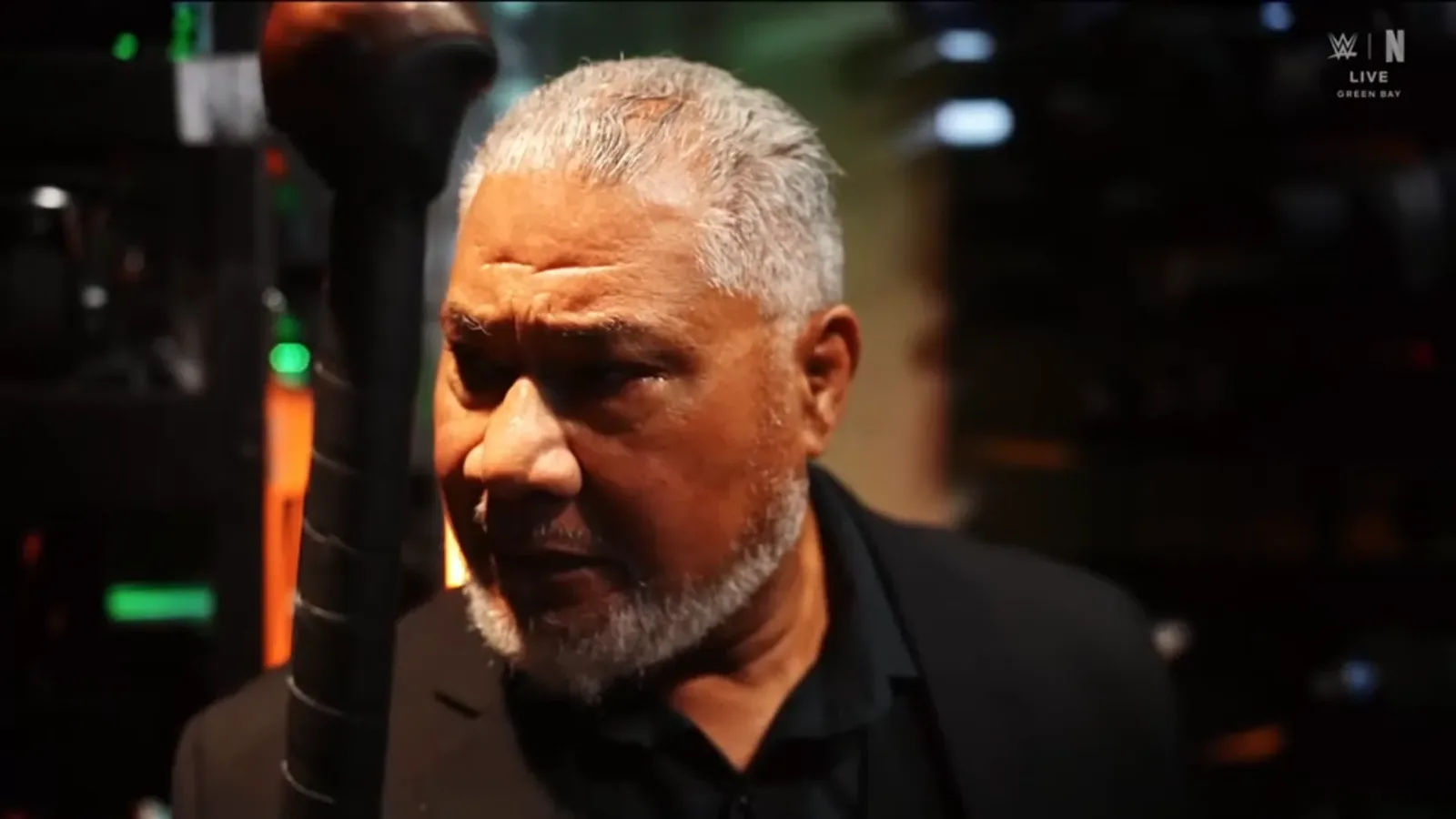
Cody Rhodes has offered a characteristically candid assessment of Haku, describing the WWE legend as both one of the most feared men in professional wrestling history and one of the kindest people a wrestler could meet.
Haku, who has returned to WWE television this year as part of The MFT’s presentation, has long held a singular place in wrestling lore. Across generations and promotions, stories of his toughness have followed him. Rhodes acknowledged that reputation directly during a recent interview, but his strongest point was that the intimidating image does not tell the full story of the man behind it.
“Haku is notoriously the toughest wrestler of all time,” Rhodes said. “Any wrestler will tell you, Haku is the toughest. He’s also the sweetest human being you’ve ever met.”
For Rhodes, the observation came while looking back on his own early relationship with the wrestling business. Growing up around WWE Hall of Famer Dusty Rhodes gave Cody unusual access to the industry from a young age. Yet he explained that, despite being backstage around his father, he was not initially driven to absorb every behind-the-scenes detail or learn the secrets of the trade as quickly as possible.
For more background on this topic, read Ilja Dragunov Explains Why Wrestling’s Emotional Performance Is More Exhausting Than the Moves.
Instead, Rhodes said he wanted to watch wrestling and experience its presentation. That perspective is an important part of the story he told about Haku: it was framed through the eyes of someone who had access to the environment but still felt drawn most strongly to the spectacle taking place in front of the crowd.
Rhodes recalls being a slow learner about wrestling’s inner world
Rhodes said he was “such a slow learner” when it came to the behind-the-curtain side of professional wrestling. While many second-generation performers are assumed to have been immersed in the business from childhood, Rhodes described a more selective interest. He was around the backstage environment because of Dusty Rhodes, but his focus was on watching the action rather than trying to uncover how everything worked.
“I didn’t want to know about the secrets of it,” Rhodes said. “I liked being out there. I didn’t want to be backstage, even though I was backstage with my dad all the time. I wanted to watch it.”
That distinction helps explain why Rhodes’ memory of Haku stands out. Rather than presenting the former King of the Ring as merely an imposing figure from wrestling history, Rhodes recalled him as a real person who made an impression beyond the stories attached to his name.
Rhodes referenced a memory he believes took place in Macon, Georgia, identifying Haku as someone whose reputation was impossible to ignore. He also repeated a notorious story associated with Haku’s legend, saying that Haku had “gouged a cop’s eye out.” Rhodes did not provide further details about the incident, and the comment was made in the context of explaining the extraordinary reputation Haku has carried among wrestlers for decades.
The broader point from Rhodes was not simply to amplify the mythology. It was to contrast that mythology with his own experience of Haku’s personality. In an industry filled with larger-than-life characters, Haku has remained one of the rare names whose toughness is discussed with virtually universal reverence. Rhodes’ comments add another layer to that legacy: the person widely portrayed as wrestling’s ultimate hard man has also left a warm impression on those around him.
Haku’s reputation remains a defining part of his legacy
Haku built his name in WWE and across the wider wrestling world under multiple identities, including Meng. His career made him a familiar figure to fans of several eras, and his presence has endured because of both his in-ring history and the remarkable accounts that fellow wrestlers have shared over the years.
Within wrestling culture, Haku’s name is often invoked when performers are asked who was genuinely the toughest person in a locker room. The details of individual stories can vary depending on who is recounting them, but the overall sentiment has been unusually consistent: Haku was not someone people wanted to test.
Rhodes leaned into that consensus when he said that any wrestler would identify Haku as the toughest. Importantly, though, he did not present Haku solely as an intimidating figure. His description of Haku as “the sweetest human being you’ve ever met” was the centerpiece of the reflection, turning a familiar wrestling conversation into a tribute to the veteran’s character.
That contrast has often made Haku especially fascinating to wrestling audiences. The most enduring tales surrounding him emphasize physical toughness, but those who have worked with him frequently speak about respect, professionalism, and the personal relationships he has formed. Rhodes’ comments fit that longstanding perception without reducing Haku to a single legend or anecdote.
Haku is back on WWE programming with The MFT
The timing of Rhodes’ remarks is notable because Haku has been visible again on WWE television this year through The MFT. His return has connected a revered veteran to WWE’s current programming, allowing a new audience to see a performer whose name has remained influential long after the peak of his full-time in-ring career.
For longtime viewers, Haku’s involvement carries immediate significance. His history in WWE is well established, and his reputation needs little introduction among fans familiar with previous generations. For newer viewers, his presence alongside The MFT gives WWE television an added sense of lineage, with an established name from the past contributing to a current act.
Rhodes did not specifically discuss The MFT’s direction in his comments, but he identified Haku as someone who is presently appearing on WWE television. That acknowledgment reflects the unique position Haku occupies. Even in a supporting or presentation-based role, he brings decades of credibility and an aura built from a career’s worth of memories and stories.
Wrestling is an industry where reputations often outlive individual storylines. Haku’s is among the most durable. His current WWE appearances offer a visible reminder of that status, while Rhodes’ remarks show how strongly Haku is regarded by a leading performer of the present generation.
A revealing perspective from WWE’s top star
Rhodes’ recollection is also revealing because it comes from someone whose life has been intertwined with wrestling for as long as he can remember. As Dusty Rhodes’ son, Cody was exposed to the business in ways few aspiring wrestlers ever are. Still, he described himself as someone who preferred the fan-like wonder of watching over the urge to immediately understand every backstage element.
That approach may be why Haku’s dual reputation resonated so clearly with him. From a distance, Haku can seem almost mythic because of the countless stories about his toughness. Up close, Rhodes emphasized the human side of the veteran—the kindness that exists alongside the fearsome reputation.
It is a reminder that locker-room legends are often more complicated than the stories that make them famous. In Haku’s case, the mystique remains powerful precisely because both sides of the description have endured. He is remembered as exceptionally tough, but he is also remembered fondly by people who have encountered him personally.
Rhodes summed up that balance in simple terms. Haku may be known throughout wrestling as the toughest of them all, but to Rhodes, that status exists alongside another defining quality: he is, in Rhodes’ words, “the sweetest human being you’ve ever met.”

Darryl Polo
Darryl Polo is a passionate wrestling fan covering WWE, AEW, TNA and beyond. He loves great rivalries, breakout stars and the moments that keep fans talking long after the bell. How we work.