
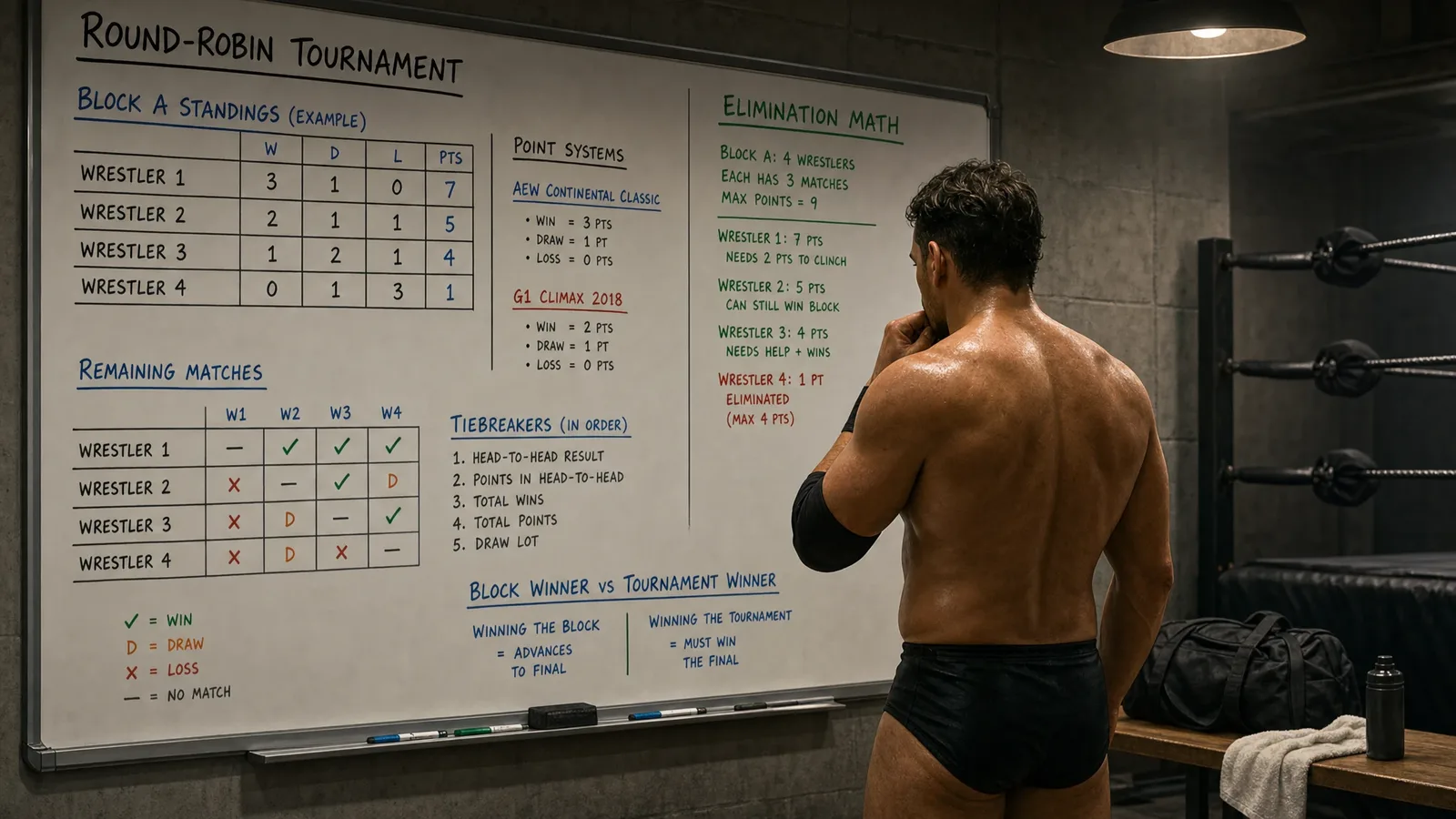
Start with the format, not the ranking
A round-robin tournament is built around scheduled league or block matches rather than a one-loss-and-out bracket. Competitors are placed in a group, meet scheduled opponents within that group, and accumulate results over the course of the league phase. That changes what a standings table means. A position is a snapshot of completed matches and points, not necessarily a final order. Before deciding who is leading, identify the blocks, how many matches each participant is expected to wrestle, the scoring chart and the stated route from league play to the next stage.
AEW’s Continental Classic offers a compact example: its format uses two six-person groups, the Blue League and Gold League. Because each entrant faces the other five people in the same league once, every wrestler has five league matches. That fixed schedule gives viewers a useful first check when reading the table. A wrestler shown at 3-1 has completed four of five matches and has one opportunity left; a wrestler at 2-0 has played only two and has three remaining. Their point totals are not the entire comparison.
Translate records into the published points system
A record such as 3-2 is not a points total by itself. In AEW’s published Continental Classic system, a win earns three points, a draw gives one point to each wrestler and a loss earns zero. So 3-2 equals nine points: three wins multiplied by three. The calculation is simple only after the scoring system is known. A clean way to read any table is to separate its columns mentally: wins, losses and draws describe the results; points determine the ranking subject to the tournament’s tiebreak procedures.
Draws are where a casual glance at wins can mislead. Under the Continental Classic scale, a 2-2-1 record is seven points, not six: two wins create six points and the draw adds one. AEW’s displayed 2025 standings included wrestlers on nine points with 3-2 records and wrestlers on seven with 2-2-1 records. The practical lesson is not that one record is universally better than another, but that the draw column must be included in the arithmetic. Counting wins alone leaves out points that the table recognizes.
The way draws enter a table is tied to the rules of that particular event. Continental Classic league matches have a 20-minute time limit, and a draw is worth one point rather than the zero from a loss or the three from a win. AEW’s Continental Rules also bar ringside companions and impose a strict ban on outside interference. Those restrictions help define that event’s league matches, but they should not be treated as requirements for every round-robin tournament. The scoring chart and match rules must be read as a package specific to the promotion and tournament.
Use matches played to judge the race
Points matter most when they are paired with matches played and matches remaining. In a six-person, one-match-against-each-opponent league, the total schedule is five matches per wrestler. Someone with six points after two matches is not in the same situation as someone with six points after four, even though the standings may place both on the same number. The first wrestler has three chances to add points; the second has one. A useful reading habit is to count completed results in the record, subtract from the scheduled total and write down the remaining number before projecting the table.
Consider an illustrative table using the Continental Classic’s three-points-for-a-win scale. Wrestler A has six points at 2-0, while Wrestler B has six points at 2-2. Their current point totals match, but A has three matches remaining and B has one. This does not predict either wrestler’s finish; it simply shows why a points tie is not a complete description of the race. The standings become more informative when they show record, points and matches remaining together, rather than presenting an unexplained numbered list.
Calculate a maximum, then recognize its limit
The basic elimination calculation starts with a ceiling, not a prediction. Take the number of remaining matches, multiply it by the points available for a win, then add the result to the wrestler’s current score. In the illustrative three-point system, a competitor on four points with two matches left can reach 10: four current points plus six more from two possible wins. This number answers a narrow but valuable question: can that wrestler still catch a particular points total? It does not say that the wrestler will reach it.
If that maximum possible total is already lower than the score held by every qualifying position, the wrestler is mathematically eliminated from those positions. For example, in a three-points-for-a-win illustration, a wrestler on three points with one match left can reach only six. If every advancement position is already occupied by a wrestler with at least seven points, the six-point ceiling cannot catch any of them. No future match result can change that arithmetic. This is the clearest kind of elimination: the gap cannot be closed even in the most favorable remaining scenario.
A reachable tie is more complicated than a reachable lead. Suppose an illustrative wrestler can rise to nine points, matching rather than passing a rival already on nine. That player is not automatically through, because the applicable tiebreaker and the other competitors’ remaining matches still matter. Maximum-point math establishes whether a target can be caught; it does not award a position when the final comparison may be level on points. Fans should treat the ceiling as the first step in an elimination check, then turn to the event’s published tie rules and the unfinished schedule.
Find the tiebreaker before declaring a leader
AEW explicitly identifies head-to-head record as the Continental Classic tiebreaker for equal point totals. In plain terms, the prior league match between the relevant tied wrestlers can decide their order. That is why a basic standings table may be incomplete: two wrestlers can be tied in points and have identical-looking records, yet their direct meeting supplies information the table does not show. When a race reaches a tie, look for the results grid, match history or a clear tiebreak notation before announcing which wrestler is ahead.
The historical 2018 G1 Climax B Block provides a concrete reminder that equal points do not require co-winners or a separate playoff. Kota Ibushi, Kenny Omega and Tetsuya Naito all ended the block with 12 points. Ibushi received the block through the tiebreaker because he had defeated both Omega and Naito during the round-robin phase. The important viewer lesson is limited but useful: a three-way tie cannot be decoded by totals alone. Direct results and the tournament’s stated tiebreak procedure can identify a single block winner.
Do not carry one promotion’s math into another
The 2018 G1 Climax used a different points scale from AEW’s Continental Classic: two points for a win, one for a draw and zero for a loss. It was also a larger structure, with 20 wrestlers divided into two blocks, rather than AEW’s two six-person leagues. The larger field and the two-point win change the context for reading its standings and making projections. These differences are precisely why terms such as round robin and block do not tell a viewer enough on their own. The rules page or event coverage remains the starting point.
The same record can produce different totals under those two systems. Three wins and two losses equal six points on the 2018 G1 scale but nine in the Continental Classic’s three-point-win format. Draws differ in importance as well. Both cited systems award one point for a draw, but a draw sits one point below a win in the 2018 G1 and two points below a win in the Continental Classic. The record is therefore only raw material. Convert it using the tournament’s scoring chart before comparing positions or trying elimination math.
Time limits can be important to that conversion. The reported 2018 G1 format awarded a draw when a block match reached its 30-minute limit without a winner, while the final had no time limit. AEW’s league matches instead use a 20-minute limit. Neither detail establishes a universal round-robin rule; together, they show why viewers should verify the specific event’s treatment of time-limit results. A draw affects the standings, so the conditions that create one can be part of understanding what remains possible in a block.
Winning a block is not winning the tournament
League success and tournament victory are separate achievements when a round-robin phase feeds an elimination stage. In AEW’s stated Continental Classic arrangement, the league phase determines semifinalists. Each league winner meets the runner-up from the opposite league: the Blue League winner faces the Gold League runner-up, while the Gold League winner faces the Blue League runner-up. Finishing first can therefore shape a semifinal opponent, but it does not itself make that wrestler the overall champion. Read the standings for qualification first, then follow the elimination matches for the tournament result.
The 2018 G1 B Block illustrates the same distinction in a different tournament setting. Winning the block advanced Ibushi to face A Block winner Hiroshi Tanahashi in the final; the block result was the route into the championship match, not the G1 championship by itself. When fans encounter a headline saying someone captured a block or league, the helpful follow-up questions are: Does that finish end the event, qualify the wrestler for a final, or place them in a semifinal? The answer lies in the tournament format, not in the phrase block winner alone.
A repeatable checklist for every standings graphic
A strong fan-facing standings graphic should name the scoring system, show every wrestler’s record and points, identify matches remaining, and flag relevant head-to-head information. From there, work in order. First, establish how many league matches each entrant is scheduled to have. Second, translate the record into points using the published scale. Third, calculate each contender’s maximum possible total from remaining matches. Fourth, check whether a tie is meaningful under the stated tiebreaker. Finally, confirm whether the top block position wins the tournament or merely earns advancement. This sequence keeps the visible table connected to the rules that give it meaning.
Explore more

Darryl Polo
Darryl Polo is a passionate wrestling fan covering WWE, AEW, TNA and beyond. He loves great rivalries, breakout stars and the moments that keep fans talking long after the bell. How we work.