
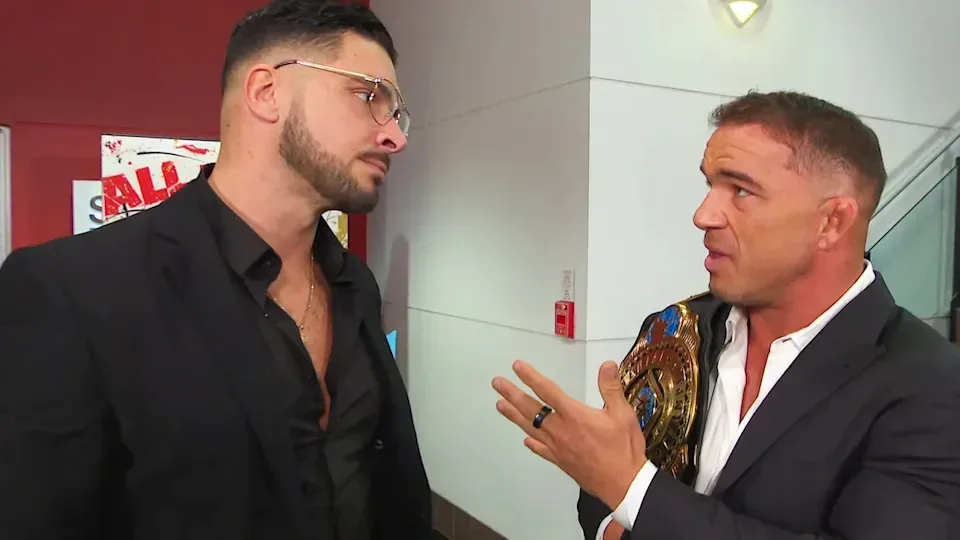
Ethan Page knows Chad Gable’s game better than most at this point, and the reigning Intercontinental Champion has delivered a striking comparison for his current rival.
Page and Gable have competed in 19 matches against one another since June, creating the kind of repeated in-ring exposure that can reveal every strength, habit, adjustment, and vulnerability an opponent possesses. That extensive history has clearly shaped Page’s view of Gable, whom he described as an unusual blend of two of WWE’s most celebrated technical wrestlers: Kurt Angle and Bret Hart.
“All Ego” was complimentary of Gable’s abilities, but his assessment also carried the competitive edge expected from a champion preparing to remain ahead of the field. Page suggested that Gable’s wrestling reflects visible influences from the past, even if Page believes his own approach to preparation is broader.
“People absorb things a lot differently and you can see the influences in his wrestling. Maybe he’s studying matches of, I don’t know, he reminds me of a lot of like a Kurt Angle or Bret Hart, or maybe both wrestlers mixed together in the weirdest way possible. He does very well at it, but maybe he’s only watching the maneuvers. Maybe he’s only studying the attacks.”
For more background on this topic, read Ethan Page Says Intercontinental Title Fulfilled His Wrestling Dream: ‘I’m Just Here for Money’.
A comparison built on technical excellence
The Angle and Hart comparison is significant because the two Hall of Fame-level performers represent distinct, though occasionally overlapping, approaches to technical wrestling. Hart was famed for precise fundamentals, intelligent limb targeting, and a patient ability to make every hold feel like part of a larger plan. Angle combined amateur credibility with explosive intensity, rapid transitions, suplex-based offense, and an uncanny comfort in nearly any style of match.
Gable has long been regarded as one of WWE’s most naturally gifted mat wrestlers. His amateur background, speed, suplexes, ankle-lock variations, and ability to flow smoothly from one counter into another all make the Angle portion of Page’s observation easy to understand. Meanwhile, Gable’s tendency to work with a clear tactical structure and build his offense around controlling an opponent’s body aligns with qualities frequently associated with Hart.
Page’s wording matters, however. He did not simply call Gable a copy of either man. He framed Gable as a unique mixture, calling it “the weirdest way possible,” while still stressing that his rival performs at a very high level. It is equal parts praise and challenge: Page recognizes the quality in Gable’s work, but he is not presenting him as an impossible puzzle.
After 19 matches since June, Page has had more than enough opportunities to test that puzzle. A single major match can offer a wrestler a snapshot of an opponent. Nearly 20 matches can provide a far more complete picture. Repetition forces both sides to evolve, because familiar strategies become easier to anticipate. In that environment, the wrestlers who continue winning are often those able to find fresh adjustments before their opponents do.
Page says preparation means studying everyone
While discussing Gable’s influences, Page drew a distinction between studying a particular wrestler’s moves and evaluating the entire landscape around him. The Intercontinental Champion positioned himself as someone who is constantly considering future opponents, rather than limiting his attention to the person directly in front of him.
“I am not watching one wrestler, I am watching all wrestlers. Not to emulate, but to find out how do I prepare for this, because one day it’s going to happen.”
That philosophy is especially relevant for an Intercontinental Champion. The title has historically carried a demanding expectation: its holder must be ready for challengers with radically different strengths. Some threats arrive through power, others through speed, technical mastery, veteran awareness, aerial ability, or sheer resilience. A champion cannot afford to build a strategy around one rival when the next contender may require an entirely different response.
Page’s comments also fit the persona he has cultivated as “All Ego.” Confidence is a central part of his presentation, but his remarks were rooted in preparation rather than empty bravado. He argued that watching widely is not about imitation. It is about anticipating eventual competition and ensuring that no potential challenger appears without Page having considered the matchup.
In Page’s view, there is a difference between borrowing attacks and building a complete game plan. His criticism of Gable was not that Gable lacks talent; Page explicitly said that Gable does what he does very well. Instead, Page raised the possibility that Gable may be too focused on the mechanics of offense, while Page is seeking to understand the wider strategic problem posed by every wrestler around him.
That is an inherently provocative claim from a champion to a rival. It suggests that Gable may have the technique, the conditioning, and the match-to-match execution, but that Page believes he possesses the more comprehensive perspective.
Roman Reigns remains on Page’s radar
Page made it clear that his scouting does not stop with the contenders immediately circling the Intercontinental Championship. When asked previously about the greatest threat to his reign, he named Roman Reigns.
“I was recently asked in an interview what I believe is the biggest threat is to my Intercontinental Championship. My answer was Roman Reigns. I’m not an idiot, I’m watching the entire landscape of the show so that when I’m playing chess against everybody, I’m trying to win the game.”
By naming Reigns, Page emphasized the scale of his thinking. Reigns is not presented as a narrow, convenient answer based only on Page’s current issues with Gable. He represents the kind of elite, proven danger that any champion would need to take seriously. Page’s point was that a titleholder cannot afford tunnel vision, regardless of how often he has shared the ring with one particular opponent.
The “playing chess” line is perhaps the clearest explanation of Page’s approach. Wrestling is physical, but Page is portraying championship competition as a game of timing, foresight, and positioning. Every match is not only a test of who can execute better in the moment; it is also a chance to gather information, identify tendencies, and make sure the next move is in the champion’s favor.
That mindset is likely even more important against someone such as Gable. Technical wrestlers thrive on patterns. They create openings through reactions, turn small positional errors into takedowns or submissions, and make an opponent pay for repeating a mistake. Page’s stated answer is to study broadly enough that he can avoid becoming predictable in the first place.
The rivalry’s repeated meetings raise the stakes
The 19-match total between Page and Gable since June is the central fact behind Page’s commentary. Their issue is not based on distant observation or a single encounter. It has been forged through repeated competition, meaning both men have accumulated considerable knowledge of one another.
For Gable, that familiarity can be an advantage. He has seen Page react under pressure and has had numerous opportunities to learn how the champion responds to mat exchanges, attacks to specific areas, and late-match momentum shifts. Gable’s reputation as a detail-oriented technician makes that volume of information especially valuable.
For Page, the same applies in reverse. His remarks indicate that he believes he has identified the foundations of Gable’s approach, from the wrestlers who may have influenced him to the emphasis he places on particular attacks. Page is attempting to turn that recognition into a competitive edge.
There is also an element of psychological warfare in Page’s framing. Comparing Gable to Angle and Hart places him in impressive company, but suggesting that he may be studying only maneuvers is a deliberate attempt to question the completeness of Gable’s process. It challenges Gable to prove that he is not merely an exceptional executor of technique, but a wrestler who can outthink Page in the larger battle for championship control.
Page, meanwhile, has placed a high standard on himself. If he says he is studying everyone from Gable to Roman Reigns, he has declared that he intends to be prepared for any challenger WWE can put in front of him. That confidence will invite opponents to test whether his chessboard philosophy can withstand the unpredictable nature of championship competition.
Respect, rivalry and the Intercontinental Championship
Page’s words ultimately combine respect with unmistakable self-belief. He sees Gable as a highly capable performer whose offense evokes two of the most accomplished technical wrestlers of all time. At the same time, Page believes he is operating with a wider lens, one focused not just on surviving an immediate rival but on staying ahead of the entire WWE roster.
That makes the Intercontinental Championship more than a prize at the center of one rivalry. In Page’s telling, it is the piece on the board that demands constant vigilance. Gable remains a major threat because of his skill and the extensive history between the two men. But Page is refusing to let that history limit his focus.
With 19 matches already in the books since June, Page and Gable have every reason to believe they know what the other will bring. The next chapter will be determined by whether Gable can introduce something Page has not accounted for, or whether Page’s promise to prepare for every possibility gives him the answer before the bell even rings.

Darryl Polo
Darryl Polo is a passionate wrestling fan covering WWE, AEW, TNA and beyond. He loves great rivalries, breakout stars and the moments that keep fans talking long after the bell. How we work.