
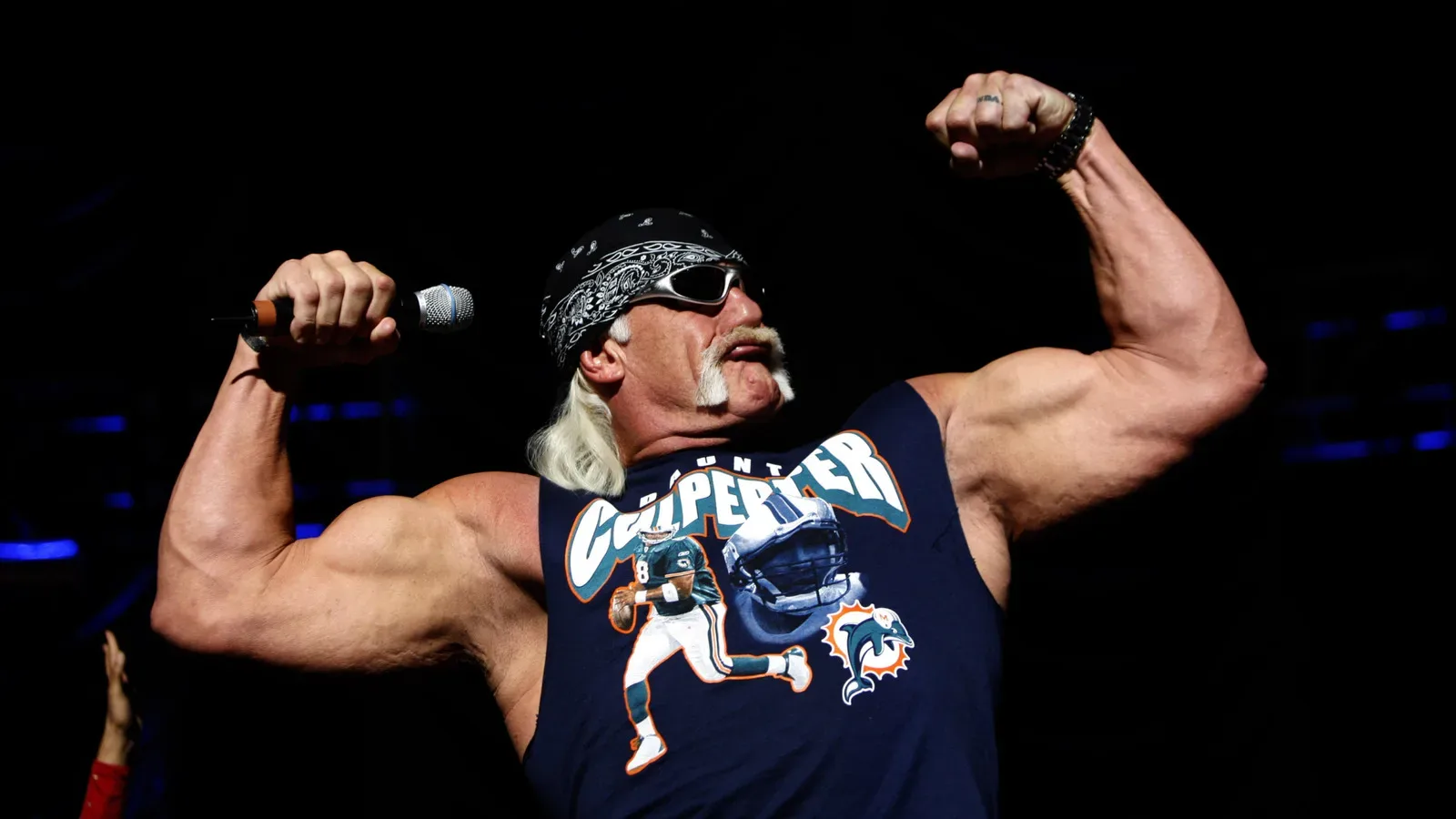
Hulk Hogan’s rise to the top of WWE turned him into one of professional wrestling’s most recognizable figures, but the public image that made him an international star also created a difficult divide between the character and the man behind it. Eric Bischoff has reflected on that tension while discussing Hogan’s life following the WWE Hall of Famer’s passing.
Speaking on Planet Tyrus, Bischoff described Hogan as somebody who carried the Hulkster identity far beyond the arena. For generations of fans, Hogan was not simply a wrestler playing a role on television. He was the red-and-yellow-clad superhero who urged audiences to say their prayers, take their vitamins and believe in Hulkamania. That connection was central to his extraordinary popularity, but Bischoff believes it also made it harder at times for Hogan to remain grounded as Terry Bollea.
“He was in character all the time,” Bischoff said on Planet Tyrus.
Bischoff explained that public appearances came with a built-in expectation. When people approached Hogan, they were looking for the larger-than-life performer they had watched headline WWE events, not a private individual named Terry Bollea. Hogan understood the assignment and gave fans what they came to see, often presenting himself as the Hulkster whenever he was in public.
For more background on this topic, read Chad Gable Reflects on Rare WWE Raw Moment With Kurt Angle and the Ticket That Followed.
“He lived it. And, over time, I think he lost sight sometimes of who Terry was and who Hulk was,” Bischoff said.
The observation speaks to an era in wrestling in which protecting a character was often treated as an essential part of the job. Long before social media made talent more accessible and blurred the line between performers and their real lives in a different way, many stars were expected to maintain their personas wherever fans might see them. For a wrestler whose character was as enormous as Hogan’s, that demand carried a unique weight.
Hogan was a defining face of WWE during the company’s national expansion and remained a fixture in the industry across multiple decades. His appeal was built on an outsized presentation: the entrance music, the poses, the catchphrases, the colors and the ability to make a packed arena react to every gesture. The Hulkster became a cultural figure who reached far beyond wrestling, and the expectations attached to that image did not disappear once the cameras were off.
Bischoff Says Fans Can See Terry Bollea In Documentary Footage
Bischoff also addressed the documentary made about Hogan after his death, saying viewers can see moments that reveal more of Bollea beneath the famous character. That distinction was important to Bischoff, whose comments focused on the human being behind the wrestling phenomenon rather than only the carefully constructed image fans knew for decades.
For a figure as famous as Hogan, public memory inevitably includes both the historic accomplishments and the personal failings that became part of his story. His career featured landmark moments, immense commercial success and a lasting influence on how wrestling stars were marketed. It also included controversies that changed how many fans viewed him and led to significant consequences in his relationship with WWE.
Tyrus, who joined the discussion on Planet Tyrus, spoke candidly about Hogan’s faults while arguing that Hogan did not attempt to escape responsibility for the worst moments of his life. Tyrus praised Hogan for addressing mistakes directly rather than placing blame elsewhere.
“He didn't blame every mistake [on someone else], he told it like it was. He wasn't perfect; he didn't always say the right thing,” Tyrus said. “Who the f*** does?”
Tyrus’s perspective centered on the difference between acknowledging wrongdoing and trying to avoid accountability. He noted that a celebrity of Hogan’s stature lived with the constant possibility that private remarks or actions could become public, while also emphasizing that fame does not remove a person’s humanity. In Tyrus’s view, Hogan had opportunities to make excuses or shift responsibility, but chose instead to acknowledge what he had done.
The Racial Controversy That Changed Hogan’s WWE Standing
The most damaging controversy of Hogan’s career involved a leaked recording in which he used racist language while discussing his daughter dating a Black man. The recording prompted WWE to distance itself from Hogan, and the company removed references to him from its media platforms for three years.
The fallout was substantial because Hogan had long been presented as one of WWE’s most important historical names. The decision to separate from him underscored the seriousness of the situation and the impact of his remarks. Hogan later apologized publicly, but the controversy remained an unavoidable part of any honest discussion about his legacy.
Tyrus, who is Black, addressed the matter without minimizing the seriousness of the recording. He instead argued that people should consider the circumstances of anger, pain and flawed human behavior while still recognizing the importance of accepting responsibility. Tyrus said he believed Hogan’s apology was sincere.
“The difference is: he owned it. He sincerely apologized and he owned it. And that to me was the greatest strength of any man!” Tyrus said on Planet Tyrus.
That assessment is Tyrus’s own view of Hogan’s response, and it does not erase the consequences of the controversy or the hurt caused by the language in the recording. Rather, it reflects the balance Tyrus sought to draw during the conversation: a person can commit serious mistakes, face deserved criticism and still be judged in part by whether they confront those mistakes honestly.
The conversation also turned to Hogan’s final years, which included greater political involvement and a public baptism. Tyrus said he believed Hogan’s faith was genuine and viewed the late wrestling star as someone who had reached a place of greater personal clarity by the end of his life.
“Everyone falls. No one can be Jesus,” Tyrus said. “But I just felt like, although he was gone way too soon, after watching that [documentary], I felt like he had everything in order.”
Legacy Beyond A Single Label
Tyrus also expanded the discussion beyond Hogan, addressing how wrestlers are often categorized and remembered through race rather than being evaluated simply as performers. He said he would prefer wrestlers to be judged on the quality of their work, citing Booker T as an example of an all-time great wrestler rather than limiting that praise with a racial qualifier.
That thought aligns with the wider complexity of examining Hogan’s legacy. He was undeniably one of the most consequential wrestlers in WWE history, a performer whose popularity helped bring the company and the broader industry to a mainstream level few could have envisioned. The scale of Hulkamania, the reach of his persona and his influence on the template for a modern wrestling superstar are impossible to separate from wrestling history.
At the same time, Hogan’s legacy cannot be assessed only through championship reigns, iconic WrestleMania appearances or the familiar image of the Hulkster standing tall before a roaring crowd. The personal controversies, the public apologies and the questions surrounding the man behind the character all belong in that history as well.
Bischoff’s comments offer one framework for understanding that duality. The Hulkster was a character so successful that it could overwhelm the identity of Terry Bollea. The public saw the hero, the pitchman and the wrestler who seemed permanently locked into an amplified version of himself. Yet the documentary footage referenced by Bischoff apparently gives viewers opportunities to see a more personal side of Bollea, including the imperfections that the superhero persona could never fully contain.
For fans who grew up with Hogan as wrestling’s most visible ambassador, that contrast may be the most revealing part of the conversation. The character was designed to feel invincible and uncomplicated. The man was neither. Bischoff and Tyrus approached that difference from separate angles, but both pointed toward the same reality: Hulk Hogan’s story was bigger, messier and more human than Hulkamania alone.
In pictures

Darryl Polo
Darryl Polo is a passionate wrestling fan covering WWE, AEW, TNA and beyond. He loves great rivalries, breakout stars and the moments that keep fans talking long after the bell. How we work.