
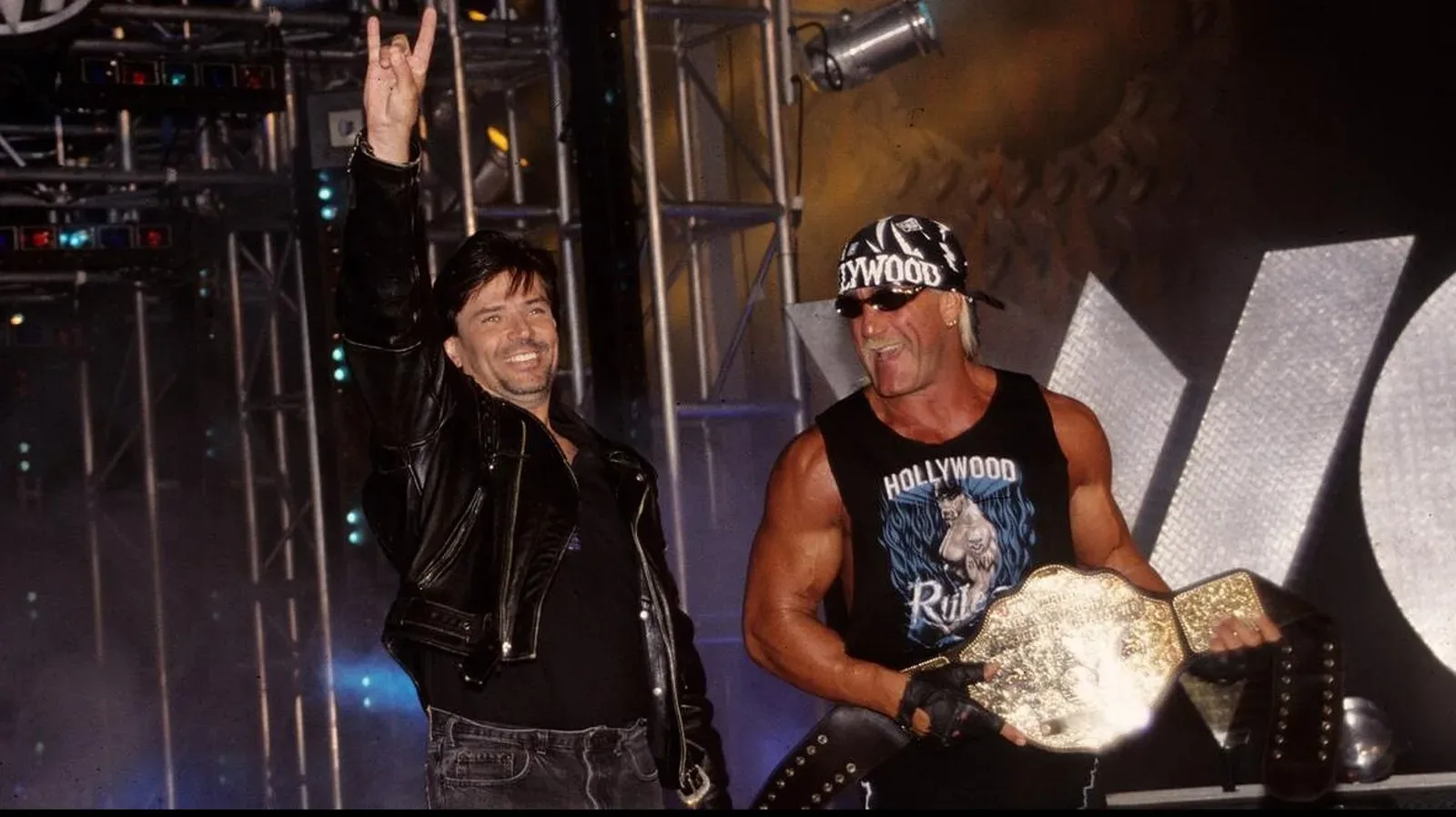
Eric Bischoff has explained the creative thinking that led to his on-screen alignment with the New World Order during one of the most consequential storylines in WCW history.
The nWo’s arrival transformed WCW’s presentation in the mid-1990s, with the group quickly becoming central to the company’s programming. As its presence grew, so did the questions within the storyline. The faction was able to exert influence in ways that required an explanation, and Bischoff said the creative direction eventually pushed him toward a reveal that someone inside WCW had been enabling the group.
Speaking on 83 Weeks, Bischoff said the decision was rooted in the need to make sense of how the angle had developed rather than being a spontaneous choice to place himself in a featured television role.
“At some point, creatively, we’ve painted ourselves into a corner because now we can’t explain s***,” Bischoff said on 83 Weeks. “That’s when I went: ‘Well, what if it was an inside job? Who’s the only person that could have looked the other way? Who’s the other person that could’ve forged the document?’”
For more background on this topic, read Jake Hager Retains Some Sight Following Two Emergency Eye Surgeries.
That line of thought gave Bischoff’s television character a major place within the nWo narrative. Rather than simply presenting the group as an outside force causing chaos within the promotion, the reveal positioned the WCW president as someone who could have helped facilitate its rise. It addressed the question of how the faction could obtain the access and authority it appeared to possess while adding another layer to the conflict.
A Storyline Solution, Not an Overnight Call
Bischoff emphasized that he did not make the choice immediately. He said he spent months considering whether inserting himself into the storyline was the right creative move. The decision came with obvious complications because he was not merely an on-air personality. He also held a major behind-the-scenes role in WCW.
That dual responsibility made the direction more difficult than simply playing a villain on television. Bischoff had to oversee business and creative matters while also appearing as a prominent character tied to the company’s biggest angle. The nWo story was already drawing enormous attention, and his decision to become part of it placed even more focus on the real-life executive behind the scenes.
Still, Bischoff ultimately concluded that the story required his involvement. In his view, the angle had reached a point where the “inside job” concept was the most logical answer to the questions WCW had created. His real position within the company also gave the reveal an added element of credibility, since the character had the power and access necessary to plausibly play a role in helping the nWo.
Bischoff said he felt confident in one particular aspect of the plan: his ability to portray the arrogant executive character the storyline needed.
“I knew I could do a very believable job in being the smarmy, arrogant boss, because I was really, really comfortable on character; I knew what that character needed to be,” Bischoff said on 83 Weeks.
The distinction mattered. A wrestling authority figure has to serve a function beyond simply appearing in segments, especially when that figure is intertwined with the promotion’s leading antagonists. Bischoff believed he understood how to play the role as an extension of the nWo’s attitude and influence, rather than as a detached executive occasionally interacting with the group.
The Risks of Becoming Part of the Angle
Bischoff also acknowledged that the decision made him uneasy. His concerns were not limited to the challenge of acting while holding an executive job. He was aware that people looking at the situation from outside WCW could interpret his involvement in a much different way.
There was a risk that his on-screen role would be viewed as self-serving, particularly because he was a central decision-maker in the company. Bischoff admitted that he was insecure about that perception and worried people would believe he had placed himself in the nWo storyline for his own benefit.
That concern reflects the unusual balance involved whenever a real executive becomes an important television character. The creative argument can be straightforward: an authority figure may be the best person to make an angle believable or to resolve a major storyline question. But the audience and industry observers can also question whether the executive’s power behind the scenes influenced the decision.
For Bischoff, the choice appears to have remained a point of internal debate precisely because both realities existed. He saw a story need that his character could fill, but he also understood that the move could invite criticism. Ultimately, he chose to follow the creative logic as he understood it.
Why the Reveal Fit the nWo’s Expanding Reach
The nWo’s influence across WCW was a major part of what made the storyline so prominent. The group was not treated as an isolated collection of wrestlers in a conventional rivalry. Its impact spread through the company’s programming, and that broad reach created the need for an explanation as the angle evolved.
Bischoff’s comments frame his involvement as an attempt to answer that problem. If the faction could seemingly operate with unusual freedom, disrupt WCW, and gain advantages that others could not, an insider helping them offered a narrative explanation. The company president was, in Bischoff’s view, the most natural person to fill that role.
The result also blurred the line between Bischoff’s actual job and his on-screen persona. That kind of overlap can make a wrestling storyline feel more immediate because the character carries real-world authority. At the same time, it creates the pressure Bischoff described: the more convincing the role becomes, the more likely viewers are to question the real motives behind it.
Bischoff’s retrospective makes clear that he did not see the decision as a simple performance opportunity. He describes it as a response to a creative corner WCW had reached. The nWo story needed a person who could plausibly have looked the other way, helped make arrangements, or enabled the faction from within. In his mind, the answer was the executive already at the center of WCW.
Bischoff’s View of the Character
His confidence in playing the role did not eliminate the discomfort surrounding the decision, but it did help persuade him to proceed. Bischoff said he was comfortable with the character and understood the kind of “smarmy, arrogant boss” that the angle called for. That confidence was important because the nWo storyline demanded a character who could stand alongside the group without diminishing its menace or making the explanation feel incidental.
Rather than portraying himself as a reluctant figure pulled into events, Bischoff’s on-screen role fit the idea of an executive whose authority could be used to advance the faction’s interests. His comments suggest that he believed the character had to be unapologetic and recognizable, not watered down by the fact that he also had genuine corporate responsibilities.
In looking back at the decision, Bischoff has presented it as one of necessity as much as opportunity. Months of hesitation preceded the move, and he remained concerned that it would be interpreted as an executive spotlighting himself. But the story’s growing need for an internal explanation won out.
For Bischoff, joining the nWo was ultimately the answer to a creative question WCW had to resolve: if the group’s influence was everywhere, who inside the company had made that possible? His conclusion was that the person with the authority to enable it had to be the president himself.
In pictures

Darryl Polo
Darryl Polo is a passionate wrestling fan covering WWE, AEW, TNA and beyond. He loves great rivalries, breakout stars and the moments that keep fans talking long after the bell. How we work.