
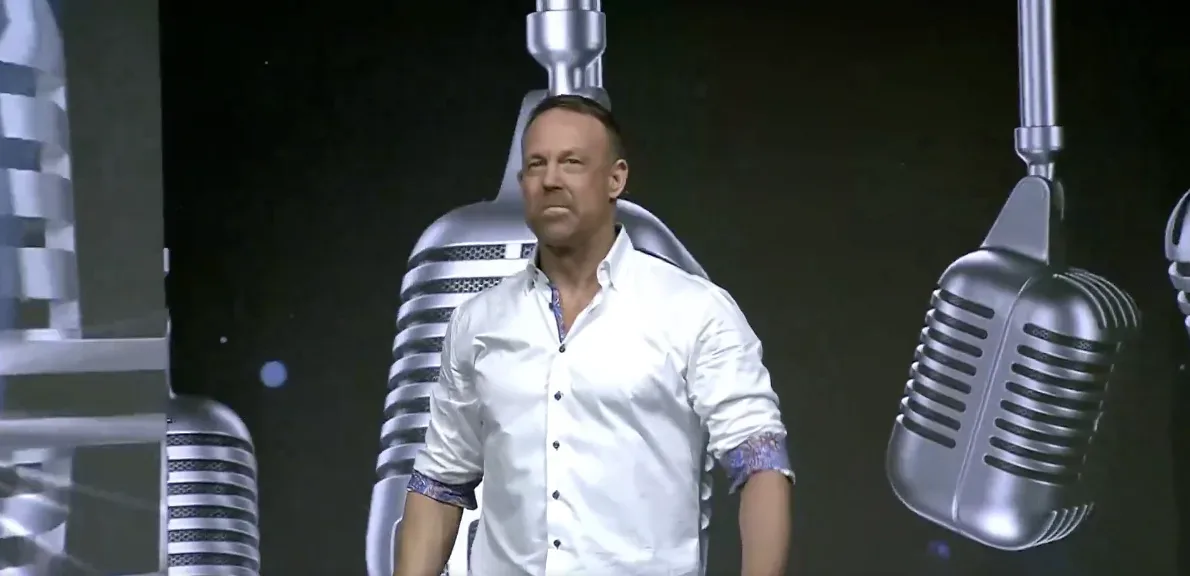
Ken Anderson has spent much of his professional wrestling career playing a character built to provoke a reaction. Whether he was demanding an introduction as Mr. Anderson, delivering a pointed promo, or working a live crowd from inside the ring, antagonizing fans was part of the job. In one memorable case, however, an in-character insult aimed toward a woman at ringside had a very different long-term result.
Anderson recently recalled meeting his wife at a wrestling event in Australia. Unlike many wrestling couples whose relationships began after both people entered the industry as performers, Anderson said his future wife attended the show as a fan after receiving an invitation from a friend who had an extra ticket.
The detail that stood out to Anderson was her reaction during the event. He remembered taking part in the kind of crowd interaction common to a wrestling show, insulting her appearance in what he described as a roundabout way. While other people were upset by the comment, she saw the humor in it.
“I was wrestling in Australia on a show, and one of her friends was like, ‘I have an extra ticket, will you come with me?’ She was like, ‘okay, whatever,’” Anderson said during an appearance on Rewind, Recap, Relive. “She was sitting in the—they were sitting front row or near front row, and I called her ugly in a roundabout way, and she was like, everybody else was mad about it, and she was like, ‘he’s funny.’”
For more background on this topic, read Sherilyn Guerrero Says ‘Latina Heat’ Is the Right Identity for Her Wrestling Career.
The exchange is a fitting example of the unusual environment surrounding professional wrestling. A performer’s relationship with the audience is rarely straightforward. Fans are expected to react emotionally, particularly when a villainous character insults the crowd, bends the rules, or makes an effort to generate hostility. At the same time, many audience members understand the performance behind those moments and enjoy being part of the interaction.
For Anderson’s future wife, the insult did not become an unpleasant memory from a night at the matches. Instead, her ability to laugh at the situation became part of the story Anderson now tells about how they first crossed paths. Her reaction apparently separated her from the rest of the people around her, who had responded to his comment with more conventional anger toward the heel in the ring.
A Moment From Their First Meeting Still Exists
Anderson added that there is a photograph from the night they met, giving the memory another layer of significance. He compared the situation to something he had heard the late Steve Irwin say about having a picture with his own wife from the moment they first met.
“The funny thing is, I heard Steve Irwin say this, that he had a picture of him and his wife the moment they met, and I have that,” Anderson said.
In an industry where wrestlers can spend long stretches traveling between towns, promotions, and countries, the personal stories that emerge from live events can be as unexpected as anything that happens in the ring. Anderson’s account began with a friend’s spare ticket and a near-front-row seat. It then moved through the familiar language of wrestling crowd work: a performer says something intended to draw heat, the audience reacts, and the show continues.
But the woman who would become Anderson’s wife interpreted the moment differently. Rather than treating the insult as a personal slight, she recognized the entertainment value in the performance. That response created a connection that ultimately outlasted the event itself.
The Art of Working a Live Crowd
Anderson’s recollection also highlights why front-row spectators often become part of a wrestler’s performance. People seated close to the ring are highly visible to cameras, fellow fans, and the wrestlers themselves. For a heel, engaging directly with those fans can add energy to a match or promo. A sharp remark can intensify the atmosphere, reinforce a character’s arrogance, and give the crowd a clear reason to cheer against that wrestler.
Those moments require a certain level of awareness from everyone involved. Wrestlers aim to stay true to their characters while reading the room and maintaining the boundary between performance and real hostility. Fans, meanwhile, can respond in countless ways. Some shout back. Some boo. Some laugh. Some take the exchange seriously. The range of reactions is part of what makes a live wrestling crowd different from an audience watching from home.
Anderson’s wife laughing at his comment did not mean the heel work had failed. If anything, it demonstrated an understanding of what he was trying to do as a performer. A crowd response does not have to be identical from every person in the building for a wrestler’s character work to connect. In this instance, the response was memorable precisely because it was unexpected.
The story is also a reminder that wrestling personas are designed to create moments. Anderson was not recounting an elaborate planned angle or a televised storyline. He was remembering a spontaneous interaction during a show in Australia, one that became important to his personal life well beyond the original context of the event.
Anderson's Career Was Built on Character Work
Anderson is best known to many fans for his time in WWE as Mr. Kennedy and later Mr. Anderson in TNA. Across those runs, he developed a presentation centered on confidence, verbal swagger, and a willingness to make himself the center of attention. His microphone work was a defining part of his act, and his delivery often encouraged audiences to react loudly whether they supported him or wanted to see him lose.
That kind of character naturally lends itself to direct crowd engagement. Anderson’s on-screen identity was not one built around quietly entering the ring and letting only the match speak for him. The persona demanded a reaction, and he regularly used words, timing, and attitude to get one.
His recollection of meeting his wife offers a more personal perspective on the same instincts that shaped his wrestling work. What may have registered to everyone else as a standard heel insult became a funny story to the person sitting near the front row. Years later, Anderson can look back at that moment not simply as a successful attempt to get heat, but as the beginning of an important relationship.
Wrestling's Unpredictable Personal Connections
Professional wrestling has long created unusual meeting places for performers and fans. Live events bring together people from different backgrounds around a shared interest, and the atmosphere can make even a brief encounter memorable. While many well-known relationships in wrestling involve wrestlers, managers, broadcasters, or other people working in the business, Anderson’s story is different because it began with someone who was simply brought to a show by a friend.
There is an easy charm to the simplicity of it. His future wife was not necessarily seeking out a wrestling event; she agreed to use an extra ticket. Anderson was doing what wrestlers do in front of a live audience, trying to make the crowd react. One person in the audience laughed instead of getting angry. A photograph from that night remains as a record of their first meeting.
That chain of events speaks to the unpredictable nature of live wrestling. Matches and promos may have planned destinations, but the reactions around them are never fully scripted. Every crowd brings a different energy, and every direct interaction carries the possibility of becoming a standout memory. In Anderson’s case, one exchange from an Australian show became far more meaningful than a typical night of heel work.
For fans, the story provides a lighthearted look at the person behind the character. Anderson’s wrestling career gave him a platform to entertain audiences through bravado and confrontation. His account of meeting his wife shows that the same world of exaggerated insults and crowd reactions also delivered a real-life moment he still clearly values.
Sometimes a wrestling show is just a wrestling show. Sometimes a fan goes home talking about a favorite match or a wrestler who got under their skin. And sometimes, as Anderson’s story demonstrates, a spare ticket, a front-row seat, and a joke delivered in character can lead to the beginning of a marriage.

Darryl Polo
Darryl Polo is a passionate wrestling fan covering WWE, AEW, TNA and beyond. He loves great rivalries, breakout stars and the moments that keep fans talking long after the bell. How we work.