
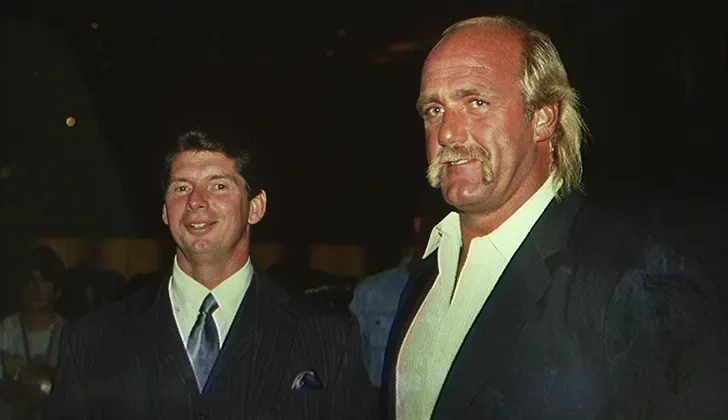
Eric Bischoff believes the discussion of professional wrestling’s most important historical figures ultimately comes back to one partnership: Vince McMahon and Hulk Hogan.
During a recent edition of 83 Weeks, Bischoff took part in a game with Conrad Thompson in which he was asked to remain silent until a name was mentioned that he considered to be as historically important to wrestling as Hogan. Thompson named several major figures from different eras, including Tony Khan, Brock Lesnar, Roman Reigns, Dave Meltzer and Ric Flair.
Bischoff’s answer was not another individual performer, promoter or media figure. Instead, he pointed to the relationship between McMahon and Hogan, arguing that their careers and the expansion of the World Wrestling Federation were fundamentally tied together.
“It’s Vince and Hogan,” Bischoff said on 83 Weeks. “I don’t care what anybody says. WWF would have never reached the level of success they did, when they were at so much risk, if it would not have been for Hulk Hogan. Conversely, Hulk Hogan would have never become Hulk Hogan were it not for the risks and the support and the partnership with Vince McMahon.”
For more background on this topic, read Chris Jericho Revisits James Ellsworth’s ‘List’ Moment a Decade Later Ahead of AEW Dynamite Grand Slam France.
Bischoff characterized their connection as a “two-man team,” pushing back against what he called revisionist interpretations of how the company’s most consequential boom period came together. His point was not that other wrestlers, executives, promoters, television partners or members of the McMahon family did not matter. Rather, he presented McMahon and Hogan as the central pairing at the heart of a business gamble that reshaped the industry.
The WWF’s rise during the 1980s required a national vision and a star capable of serving as the public face of that vision. McMahon’s strategy moved the company beyond the traditional regional model that had long defined North American wrestling. Hogan, meanwhile, possessed the charisma, visual presence and broad mainstream appeal needed to make that expansion legible to audiences far beyond wrestling’s established fan base.
In Bischoff’s view, separating those accomplishments misses the nature of the story. McMahon created the platform, assumed enormous risk and positioned the WWF for wider exposure. Hogan became the leading attraction who could fill the role McMahon needed: a champion who felt larger than the company itself while also giving the company a clear identity.
“That was a two-man team,” Bischoff said. “And I don’t care about all the family revisionist history. You tell yourself whatever you need to tell yourself to feel good about your last name. If you can’t admit that that was a symbiotic success story, you’re not being real.”
Bischoff’s Case for the McMahon-Hogan Connection
Bischoff has extensive experience assessing the value of major wrestling stars and the impact of executive decision-making. As the public face of WCW during the Monday Night War era, he worked directly with Hogan after the former WWF champion joined the promotion in 1994. Their later association included the creation of the nWo, one of wrestling’s most influential acts and one of the defining storylines of the 1990s.
That history gives Bischoff a particular perspective on Hogan’s value as an attraction. He has seen firsthand what Hogan could mean to a promotion, both as a recognizable celebrity and as a wrestler whose presence could change the perceived scale of a product. But Bischoff’s comments also place substantial emphasis on the machine that helped turn Terry Bollea into Hulk Hogan on a global level.
Hogan had established himself as a notable figure before his defining WWF run, including through his work in the American Wrestling Association. His momentum, look and connection with fans were already evident. McMahon’s WWF, however, provided the setting in which the Hogan character became a phenomenon associated with a national wrestling boom, mainstream visibility and a new commercial ceiling for the business.
The relationship produced a formula that was easy for the public to understand. Hogan was presented as an unmistakable heroic figure, delivering a message centered on training, saying prayers and taking vitamins. McMahon’s rapidly expanding company built major events and programming around that image. The result was a champion who did not merely headline wrestling shows but became synonymous with the WWF itself for a generation of viewers.
Bischoff’s argument is especially centered on timing and risk. He said the WWF was taking significant chances as it pursued a higher level of success, and that Hogan was essential to making those chances pay off. National expansion was not simply a matter of running more shows; it required an audience-facing centerpiece who could sell the scale and ambition of the new enterprise.
A Debate About Historical Importance
Thompson’s list of names underscored the different ways a person can be important to professional wrestling. Lesnar and Reigns have each been defining WWE attractions of their respective eras. Flair’s influence stretches across multiple decades and promotions. Meltzer has been a prominent voice in wrestling media, while Khan’s arrival as an executive has had a major effect on the modern competitive landscape.
Bischoff did not dismiss those names individually in the discussion described. His silence through the game instead communicated his belief that none met the specific standard set by Hogan’s historical significance. When he did respond, he expanded the premise: the comparable force was not a single name but McMahon’s partnership with Hogan.
That distinction matters. Hogan’s importance can be evaluated through his accomplishments as a wrestler and crossover celebrity. McMahon’s can be evaluated through his role in transforming the WWF’s business model and building a national powerhouse. Bischoff contends that the scale of their combined impact is what makes the pairing uniquely difficult to match.
There are, naturally, many ways to tell the history of the WWF’s expansion. The period involved numerous critical performers, creative contributors, business partners and employees. WrestleMania, cable television, syndicated programming, licensing, merchandise and celebrity involvement all played roles in the company’s ascent. Yet Bischoff’s position is that the foundation of the public-facing success was the McMahon-Hogan alliance.
His comments also reflect a recurring issue in wrestling history: whether a promotion creates its top star, whether the star makes the promotion, or whether the truth lies in the interaction between both. Bischoff firmly chose the third option in this case. He sees Hogan as someone with extraordinary value who still needed McMahon’s investment and vision to become the version of Hulk Hogan known worldwide. At the same time, he sees McMahon’s grandest ambitions as dependent on having Hogan at the center of the presentation.
“Neither One of Them Would Have Survived Without the Other”
Bischoff made his position even clearer while reflecting on his personal regard for Hogan. He said he has continued to speak with Hogan regularly and acknowledged the affection he still has for him. However, he maintained that appreciating Hogan does not mean overlooking McMahon’s role in building the character’s unprecedented stature.
“As much as I loved Hulk, and still do in many ways, and talked to him on a regular basis, he would not have been Hulk Hogan without Vince McMahon,” Bischoff said. “But I guarantee Vince McMahon would have never become what Vince McMahon became in terms of WWF without Hulk Hogan. Neither one of them would have survived without the other.”
The use of the word “survived” is central to Bischoff’s framing. He was not merely arguing that McMahon and Hogan made each other more successful. He argued that the level of success each eventually reached was unattainable without the other’s involvement during the critical formative period of the WWF’s national expansion.
For Hogan, McMahon’s backing provided the platform to lead the company through its defining early WrestleMania years and become an attraction recognized outside traditional wrestling circles. For McMahon, Hogan provided a singular centerpiece for the product at the moment the company needed one most. Bischoff sees those paths as impossible to disentangle.
The comments will likely continue a longstanding discussion among fans about the people most responsible for professional wrestling’s modern evolution. Individual eras have produced transformative champions, business leaders and creative forces. Bischoff’s answer, though, was direct: when measuring historical importance against Hulk Hogan, the only appropriate response is Vince McMahon—and the partnership they formed together.

Darryl Polo
Darryl Polo is a passionate wrestling fan covering WWE, AEW, TNA and beyond. He loves great rivalries, breakout stars and the moments that keep fans talking long after the bell. How we work.