
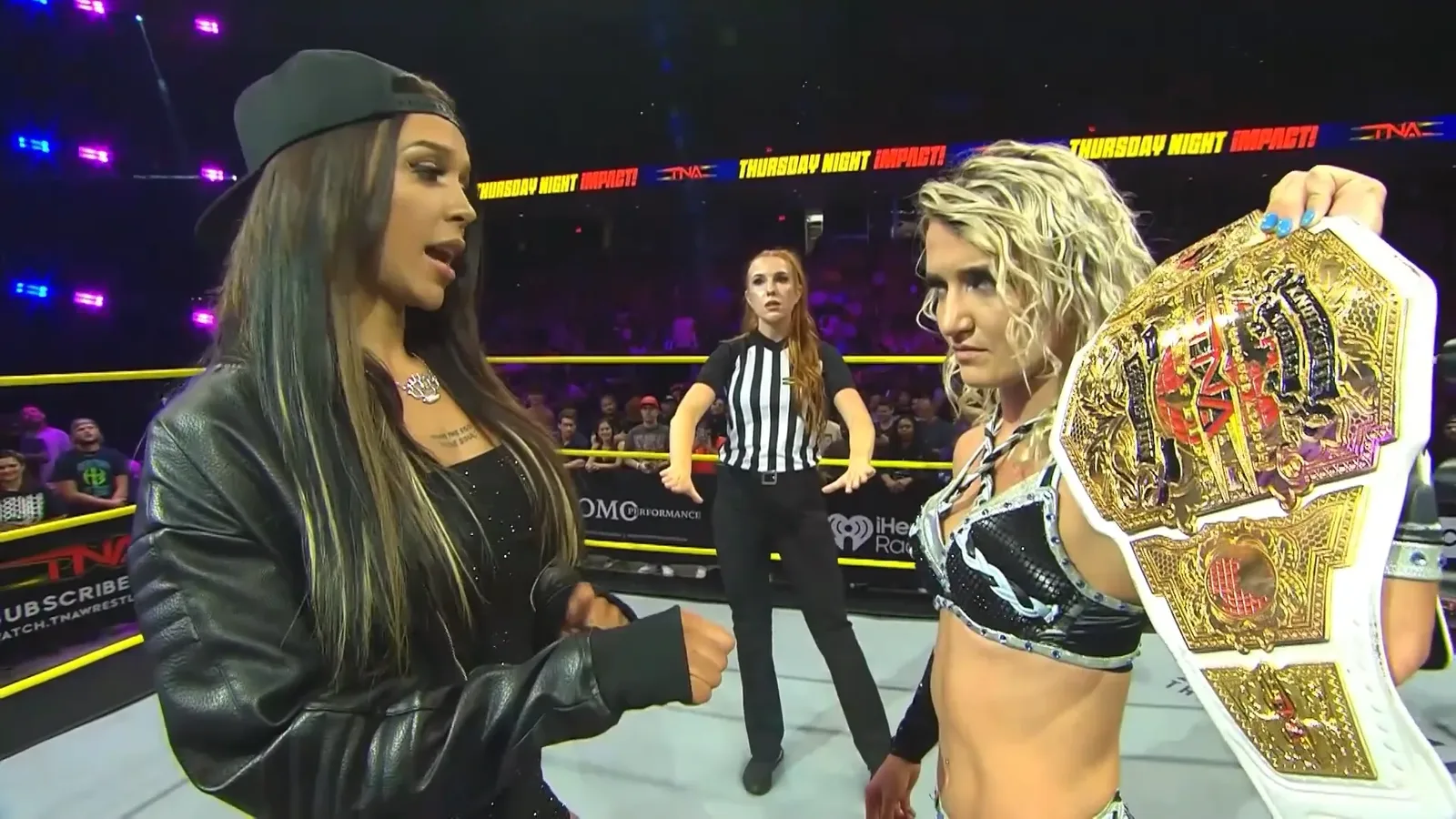
Elayna Black has offered a candid assessment of the physical price she paid following TNA Lockdown, revealing that the steel cage match for the TNA Knockouts Championship left her feeling as though she had “got hit by a truck” for two weeks.
Black challenged Xia Brookside for the Knockouts title at Lockdown in Chicago late last month. The bout carried significant personal stakes for Black, who was competing in her hometown with friends and family in attendance, as well as professional stakes as she pursued the championship that has been her stated objective since joining TNA.
Brookside retained the title after a bloody contest inside the cage, denying Black the hometown championship victory. While Black did not leave Chicago with the title, she remains encouraged by the performance and believes the match showed viewers a side of her they may not previously have expected.
Two weeks of recovery after Lockdown
Speaking about her condition in the aftermath of the event, Black said she is now doing well but needed considerable time to recover from the encounter.
For more background on this topic, read Dani Luna Reportedly Expected To Join AEW Following TNA Departure.
“I’m feeling good now. You know, it was like two weeks of feeling like I got hit by a truck. But we’re finally finally on the ups. I had a spa day, a little massage. Obviously had to wash my hair excessively and get rid of all the blood. But, you know, we’re here. We’re moving on and moving up.”
The comments underline the toll that can come with a championship match held inside a steel cage. The structure is designed to contain a rivalry and remove easy escape routes, but it also changes the nature of the action. Every collision, attempted climb, and struggle against the cage can escalate the punishment endured by the wrestlers involved.
For Black, the visual aftermath was especially apparent given the bloodshed during the match. Her reference to repeatedly washing blood from her hair offers a blunt reminder that the event was not simply another routine night in the ring. Even after the show had ended and the Chicago crowd had gone home, the physical effects stayed with her.
Still, Black’s outlook is not one of resignation. Her focus has shifted from recovery toward the next opportunity, and her “moving on and moving up” message makes clear that the loss to Brookside has not changed her larger ambitions in TNA.
A title opportunity with hometown significance
Black acknowledged that a victory at Lockdown would have meant a great deal. Winning the TNA Knockouts Championship is a central goal for her, and the chance to potentially achieve it in Chicago added another layer to the occasion.
“Yeah, you know, obviously I would have loved to come back out of Lockdown with the title, you know, number one, being in my hometown in front of all my friends and family, and number two, that’s been my goal from day one in TNA to win the Knockouts title.”
A hometown title challenge can bring added emotion as well as added pressure. Black was not only competing against the reigning champion in a cage; she was doing it in front of people who have watched her journey before this stage of her career. That combination made the defeat harder to accept, but it also made the night meaningful beyond the result.
Rather than presenting the match as a missed final chance, Black framed it as part of a longer path. She noted that she is in her first year with TNA and is still only 25 years old, giving her confidence that another championship moment will come.
“So obviously that would have been great, but I’ve said it before. It’s my first year in TNA, I’m 25 years old. I have no doubt that that title will be mine.”
That conviction is important following a high-profile loss. Brookside remains champion, and Black’s immediate title pursuit did not end with the result she wanted. However, Black has made it clear that she does not see Lockdown as the conclusion of her pursuit of the Knockouts division’s top prize.
Respect for the performance despite rivalry
Black was also emphatic in her praise for the match itself, even while making it clear that her feelings toward Brookside remain complicated. Championship rivalries do not require friendship, and Black did not attempt to minimize the tension between them. But she believes they were united by an intention to make the cage match matter.
“I think Xia and I — despite my feelings about her — I think we really put it all out there and I think we put on a great show. I think we both were extremely passionate going into that match and we wanted it to be great, and we did whatever we could to make sure that it was great.”
That assessment speaks to the stakes surrounding the bout. Lockdown is built around cage competition, so a Knockouts Championship match in that environment arrives with expectations. Black and Brookside had an opportunity to deliver a defining match within that format, and Black believes they met that challenge.
Her praise does not erase the central competitive issue: Brookside left Chicago with the championship, while Black did not. Yet Black’s comments suggest she can separate disappointment with the decision from pride in the work that led to it. In a division where performances can shape future opportunities, that distinction could prove meaningful.
Showing a different side of Elayna Black
Perhaps the most revealing part of Black’s reflection was her belief that Lockdown allowed her to demonstrate something new. She stopped short of saying she needed to prove herself, but she acknowledged that there may have been people who doubted whether she had this type of performance in her.
“It’s something I’m proud of because I feel like it was something that I don’t want to say that I needed to prove myself, but I think it was maybe a different side of me that people haven’t seen or, you know, kind of have doubted me and haven’t maybe think I had it in me.”
The steel cage setting naturally demands a different kind of presentation from a wrestler. It places a premium on intensity, resilience, and the willingness to absorb punishment while continuing to fight for an objective. Black’s description of her physical condition in the two weeks after the match reinforces how much of herself she put into the title challenge.
For a wrestler still in her first year in TNA, that exposure matters. A title opportunity does not guarantee a championship reign, but it can establish how a challenger performs when the pressure is at its highest. Black came away without the belt, but she came away believing she and Brookside gave the audience a memorable and passionate fight.
“I think we did,” Black said when reflecting on whether they succeeded. “I think we did a great job and I’m very proud of that.”
What comes next for Black and Brookside
Black’s words leave little doubt that her long-term destination remains the TNA Knockouts Championship. She has already had a major challenge in an emotionally charged setting, and she views her age and early stage in the company as reasons to remain optimistic rather than discouraged.
Brookside, meanwhile, retains the championship after surviving a demanding cage defense in Chicago. Any champion who emerges from a Lockdown match with the title intact has overcome a distinctive test, particularly against an opponent as motivated as Black was in her hometown.
For Black, the immediate chapter has been recovery. The longer chapter is unfinished. She has moved past the painful aftermath of Lockdown, but she has not moved past the goal that brought her into the cage in the first place. The title did not change hands in Chicago, yet Black’s confidence has not wavered: she intends for the TNA Knockouts Championship to be hers eventually.
In pictures

Darryl Polo
Darryl Polo is a passionate wrestling fan covering WWE, AEW, TNA and beyond. He loves great rivalries, breakout stars and the moments that keep fans talking long after the bell. How we work.