
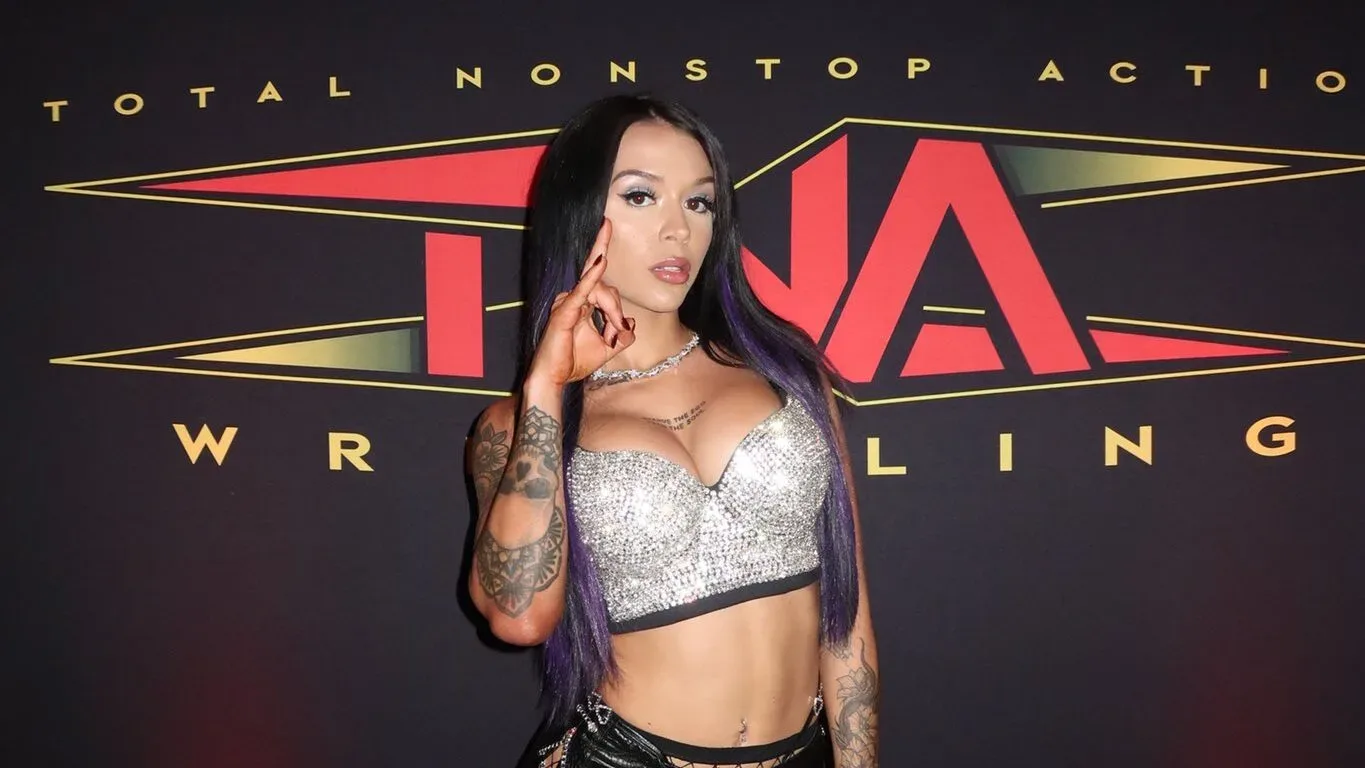
Elayna Black has described the creative freedom she has found in TNA Wrestling as both rewarding and demanding, explaining that the opportunity to shape her own character comes with a responsibility she had not experienced to the same degree earlier in her career.
Black joined TNA in January 2026 and debuted on the premiere episode of TNA iMPACT! on AMC. Her arrival marked her return to wrestling after a significant break from the industry. She had been released by WWE in May 2025 and stepped away shortly afterward, before resurfacing under the Elayna Black name in TNA.
During an appearance on Casual Conversations, Black discussed the difference between contributing ideas within WWE’s system and being trusted with a more substantial role in defining her character in TNA. While she stressed that TNA still has its own plans for storylines and television, she said the promotion has given her room to make Elayna Black feel like her own creation.
“It’s been great. It has been a little bit challenging,” Black said. “Being at WWE and the PC, you do have some input and ideas, but you don’t get the final say. You can give your input, but it doesn’t necessarily mean you’re getting the final say or vision of what you think your character is because they might have a different vision, and ultimately it’s up to their vision.”
For more background on this topic, read Amazing Red Calls Full-Time TNA Return a Surreal Full-Circle Moment.
That distinction is important for any performer, but particularly for someone returning to the ring after time away. A wrestling character is not limited to a name, entrance, or gear. It is reflected in the way a wrestler speaks, reacts, competes, carries themselves in backstage segments, and chooses what elements to emphasize when the cameras are on. The more personal the work becomes, the more preparation it can demand.
Black said TNA’s environment has allowed her to approach those details from a different perspective. Rather than simply fitting into an established vision, she has been able to spend more time determining what Elayna Black should represent and how that identity should be presented to the audience.
“In TNA, it’s kind of up to me and who I want Elayna Black to be,” she said. “Obviously, they have their vision for their storylines and the show, but they are more giving in that I can take Elayna Black and make it who I want her to be and just create. I haven’t been able to do that in a long time.”
More Control Means More Responsibility
Creative freedom is often framed as an uncomplicated positive in professional wrestling. For performers, the chance to have a stronger voice in their own presentation can lead to characters that feel distinct and believable. Black’s comments, however, also underline the less glamorous part of that freedom: the performer must be prepared to make the decisions.
Having someone else establish the broad direction of a character can simplify the process, even when a wrestler would prefer more input. When the responsibility shifts toward the talent, there are more questions to answer. What is the character’s point of view? What should change from week to week? Which traits are essential, and which are temporary responses to a particular feud? How can a performer make their own work recognizable while still serving the needs of a larger television story?
Black acknowledged that the adjustment has pushed her to put additional thought into the role. She initially welcomed the chance to take ownership, only to realize that ownership requires work beyond performing in the ring.
“It’s been challenging in that I’m like, ‘Oh yay, I get to do what I want and make Elayna Black who I want,’ but then I’m like, ‘Oh shit, I have to think about it and put more effort into the character,’” Black said.
That candid assessment speaks to the practical side of character development. A wrestler with greater creative control has to consider the full package, not just the immediate assignment for a given show. Black is not describing unrestricted independence from the promotion’s creative structure; she made clear that TNA maintains a vision for its programming and angles. Instead, she is describing a collaborative arrangement in which she can contribute more directly to the identity of Elayna Black.
For TNA, that kind of collaboration can be valuable when it helps performers present material with confidence and clarity. Wrestlers are the people tasked with bringing stories to life in front of the audience. When they understand the character at a deeper level and have a hand in its development, that can help create a more natural connection between their personality, their performance, and the material being featured on television.
An Authentic Return as Elayna Black
Black said the extra effort has ultimately made the process more fulfilling because it allows the character to better reflect her own creative instincts. After being away from wrestling following her WWE release, the ability to return and build something that feels personal has carried added significance.
“I’m having fun with it and I’m grateful for it because it makes it even more me,” Black said. “I get to put more time, effort, and thought into everything, and it makes it more authentic.”
Authenticity can mean different things in wrestling, where performers often balance real traits with heightened storytelling. It does not necessarily mean every part of a character is a literal representation of the person behind it. More often, it means the performer has identified an approach they can commit to fully. That commitment can affect everything from promo delivery and body language to the tone of a rivalry and the emotional stakes of a match.
Black’s remarks suggest that TNA’s trust has provided her with the room to find that balance herself. The process is still new enough that she is continuing to adapt. She noted that she has only been with TNA for a year, making the different workflow and level of responsibility an ongoing adjustment rather than something she has already mastered.
“It is a little more challenging getting used to it since I’ve only been in TNA for a year, so it’s definitely different, but it’s very rewarding, and I’m having fun,” Black said. “I’m grateful that I have their trust to be able to do that.”
TNA’s Platform for a New Chapter
Black’s TNA run began at a notable moment for the company, as she debuted on the AMC premiere episode of TNA iMPACT!. The debut gave her a fresh platform after her time away from the ring, and her comments indicate that the new chapter is not simply about returning to regular competition. It is also about rebuilding and refining the Elayna Black identity on her own terms within TNA’s broader creative plans.
The transition from one major wrestling environment to another always involves an adjustment in expectations. Different promotions have different production methods, storytelling priorities, and approaches to talent involvement. Black did not portray either environment as lacking value. She recognized that she was able to offer input and ideas while in WWE and at the Performance Center. Her point was that the ultimate direction there did not rest with her.
In TNA, she feels that balance has changed. The promotion still guides the show and its stories, but Black has been given greater latitude in deciding how Elayna Black is defined within those stories. For a wrestler looking to establish a lasting identity, that degree of trust can become as important as the matches and segments themselves.
As Black continues her second year with TNA, the challenge she identified may remain part of the appeal. Greater freedom means the need for constant evaluation, refinement, and effort. But it also gives her the chance to make each creative choice more deliberate. By her own account, that work has made her return more enjoyable and made Elayna Black a more authentic expression of the performer audiences see on TNA television.

Darryl Polo
Darryl Polo is a passionate wrestling fan covering WWE, AEW, TNA and beyond. He loves great rivalries, breakout stars and the moments that keep fans talking long after the bell. How we work.