

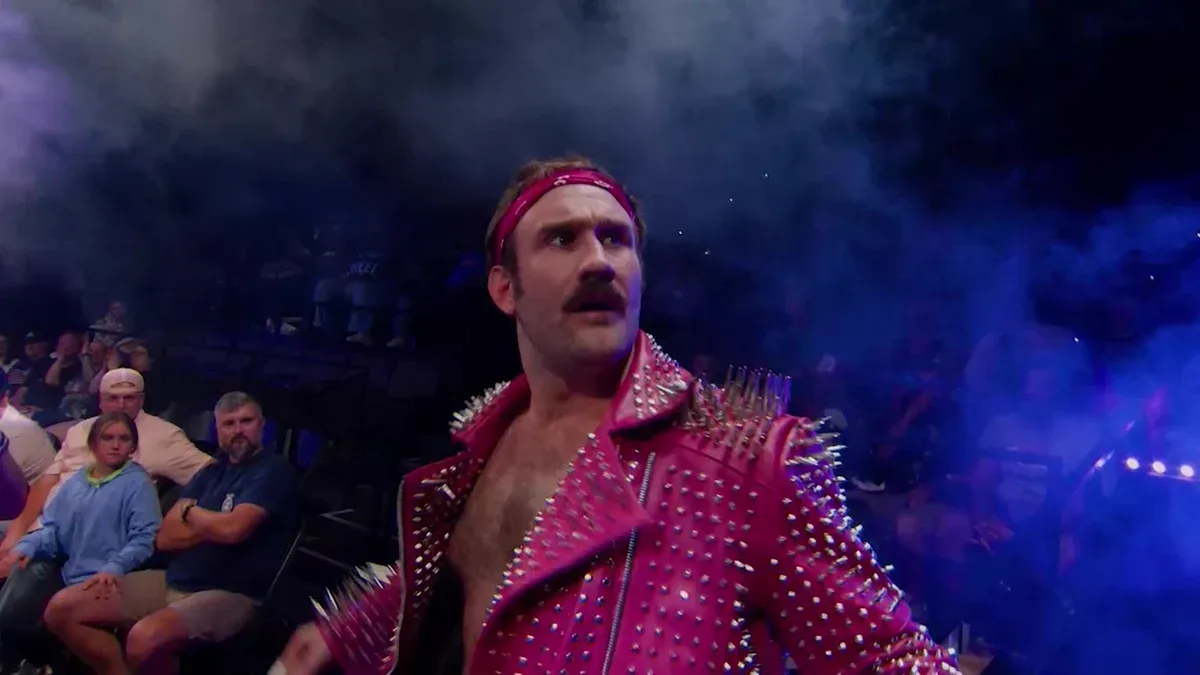
EFFY has built his career around movement, variety and a willingness to work outside the boundaries that define much of modern professional wrestling. The former GCW Champion believes that approach has given him a perspective that differs sharply from wrestlers whose careers are centered around a single contracted promotion.
Speaking about his place in the industry after more than 13 years as a paid wrestler, EFFY argued that the label of “wrestler” is often viewed too narrowly by people who immediately associate the profession with WWE or AEW. While he acknowledged the benefits of guaranteed money and a contract, he stressed that his own career has been shaped by sheer volume: matches, opponents, towns and audiences accumulated through a constant independent schedule.
His central point was not that a contracted wrestler is less valid, but that the experience of regularly going out to find work, perform for new crowds and adapt to different environments remains fundamental to what he wants from wrestling. EFFY said that, despite the financial security available in major companies, he would be jealous of the freedom he has created if he were “stuck somewhere,” even if that position came with more money.
For EFFY, the distinction comes down to the difference between being active in the profession and waiting for a company’s creative structure to assign a wrestler a role. He contrasted his own schedule with performers who may appear infrequently on television tapings or wait in catering for word on whether they will have a segment. In his view, a wrestler proves the craft through repetition, availability and a responsibility to deliver for people who paid to see a match.
For more background on this topic, read Tommaso Ciampa Reflects On AEW Battles With Mark Briscoe And Their Instant Chemistry.
“Every dollar, I have to go get. Every match, I have to go have,” EFFY said.
That mentality is especially fitting for a performer whose profile has grown through independent wrestling’s unconventional spaces. EFFY has long embraced wrestling as something that can meet an audience where it is rather than demanding that an audience first enter a conventional wrestling building. That philosophy was at the heart of an example he shared from a recent Sunday in Atlanta.
A Day That Captured EFFY’s Independent Wrestling Philosophy
EFFY described working two events in the Atlanta area that day. After appearing at a show in Alpharetta, he headed to a Black Gay Pride event at the Marquette Club, identified as one of Atlanta’s oldest drag clubs. The match took place in the venue’s parking lot at 12:30 a.m., where EFFY wrestled Edward Draven in front of the Black Pride audience.
There is an easy temptation to frame a parking-lot match after midnight as a lower rung on the ladder for someone who has wrestled for 13 years. EFFY rejected that idea completely. To him, deciding that such a booking should be “behind” him would mean losing sight of what makes the independent scene valuable in the first place: the chance to bring wrestling into a setting that normally would not host it, connect with people who may not be regular wrestling viewers, and make a distinct event out of the collision of two live-performance worlds.
He said he was proud to still be having what he described as a “sick match” in such a unique setting. Rather than viewing unusual bookings as a compromise, EFFY sees them as the work. The ability to travel from one show to another, perform in drastically different environments and win over a crowd on the spot is what continues to motivate him.
EFFY connected that experience to Andy Williams, the Every Time I Die guitarist and professional wrestler better known in the ring as The Butcher. Reflecting on Williams’ many gigs throughout his own career, EFFY said the thought of him pushed him to stay busy. The anecdote also highlighted the deep freelance reality of independent wrestling, where wrestlers frequently piece together a living through multiple bookings, long drives and a schedule that bears little resemblance to the structure of a national television promotion.
There is no automatic direct deposit in that model, no assumption that a match is waiting next week and no guarantee that any given crowd knows who is walking through the curtain. EFFY presented those facts not as complaints, but as the defining challenge that keeps the job meaningful. He has not had the backing of a company paycheck and said he has not entered a building for a long time without that building actively asking for him to be there.
Comfort, Conformity and the Meaning of the Job
EFFY’s critique extended beyond employment arrangements. He argued that wrestling has historically not been a “sport of comfort” or conformity. In his assessment, the business is at its strongest when performers are willing to leave the safe zone, take risks in front of audiences and find their own ways to create opportunities.
That is not necessarily a condemnation of wrestlers who choose the stability of a national contract. Guaranteed income, access to larger platforms and the chance to work within a major promotion are obvious goals for many performers. EFFY explicitly recognized that guaranteed money is a good thing. But he questioned whether comfort can also narrow a wrestler’s range of experiences, particularly when a performer wrestles less often or primarily works inside an established system.
He pointed to the physical and emotional demand of reaching the fourth show in a week while sore, then still knowing that the next opponent and the next set of fans deserve a match worthy of their anticipation. In EFFY’s view, that obligation is different from simply receiving instructions for a television segment. His preferred version of wrestling asks the performer to carry the responsibility of the match directly, night after night.
The remarks offer a clear statement of how EFFY measures success. The number on a contract is not his sole standard. Neither is the prestige of appearing on a large-scale televised broadcast. He values the body of work that comes from meeting new opponents, wrestling in new places and proving that he can make a crowd care even when the venue was not designed for wrestling.
“An Impression Of Wrestling”
The most pointed part of EFFY’s comments concerned what he sees as a broader creative problem across the business. He said too much of the wrestling people watch now is built around reproducing the appearance of wrestling rather than presenting something emotionally immediate.
EFFY defined wrestling in simpler and more elemental terms: an “impression of conflict,” with two sides fighting because they hold different opinions. That does not mean every rivalry must be presented identically or that wrestling cannot be stylized. Instead, his argument is that the audience should be able to recognize an authentic conflict beneath the production, presentation and familiar visual language.
“Most wrestling you watch these days is an impression of wrestling,” EFFY said.
That phrase explains why he places so much importance on nontraditional venues and audiences. At a club parking lot during Black Gay Pride, a wrestler cannot assume that the room already understands the conventional rhythms of a wrestling event. The performers have to establish who they are, what is at stake and why the conflict matters. They have to sell the audience on wrestling by doing it in front of them.
EFFY said he wants to continue entering spaces that are not necessarily “wrestling safe” and bringing the medium there. The phrase suggests more than a preference for unusual locations. It reflects a commitment to exposing wrestling to people outside its most familiar fan base and refusing to let the art form become limited to an imitation of television formats that have been recognizable for decades.
His comments also underline why independent wrestling remains essential to the wider landscape. The independent scene can be unpredictable, exhausting and financially uncertain, but it also provides room for wrestlers to develop identities outside a corporate framework. It lets promoters test concepts in unconventional spaces, and it gives audiences a chance to encounter wrestling in contexts they may never have expected.
For EFFY, that freedom is not a detour before some more traditional destination. It is the destination itself. Whether the setting is a standard wrestling venue, an Atlanta club parking lot or another environment that has never hosted a ring before, his goal is the same: create a real conflict, earn the reaction and leave having given the crowd a match it will remember.
After more than a decade in the ring, EFFY remains committed to pursuing every booking rather than waiting for one to arrive. His definition of a wrestler is rooted in that pursuit—and in a belief that the most vital version of professional wrestling is not an impression of what the business used to look like, but a live, direct and sometimes strange experience happening in front of people for the first time.
In pictures

Darryl Polo
Darryl Polo is a passionate wrestling fan covering WWE, AEW, TNA and beyond. He loves great rivalries, breakout stars and the moments that keep fans talking long after the bell. How we work.