
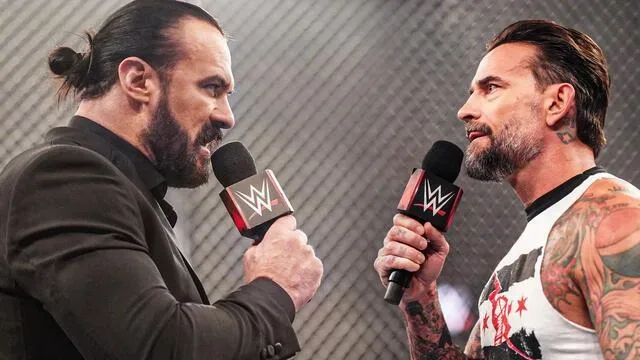
Drew McIntyre has renewed his war of words with CM Punk, delivering another characteristically blunt assessment of his longtime WWE rival while appearing on the AwayDays “Shirt Shopping” series.
McIntyre and Punk produced one of WWE’s most personal rivalries in 2024, a conflict that unfolded across multiple premium live events and repeatedly crossed into discussions about resentment, ego, injuries and each man’s view of the other. While the in-ring chapter of that program included three major singles matches, McIntyre made clear that the animosity remains an easy subject for him to revisit whenever Punk’s name comes up.
During a conversation initially centered around football, McIntyre spoke about Henrik Larsson and the difficult position he found himself in as a Rangers supporter watching a Celtic star. McIntyre stressed that he would not normally wish an injury on another person, though he admitted he had hoped Larsson would leave for another club.
When the topic shifted to Punk, however, McIntyre used the opportunity to continue the antagonistic tone that has defined their WWE interactions.
For more background on this topic, read Brie Bella Targets January Return to In-Ring Training Following Scapula Injury.
“Except CM Punk. I prayed for it, and it happened,” McIntyre said. “Yeah, I genuinely did. I’m not the most religious man in the world, but I got down on my hands and knees, and I said, ‘Just do this for me, big dog.’ He did. That’s how we talk. He calls me G, I call him big dog.”
The remark was presented in the same provocative, darkly humorous manner that has frequently accompanied McIntyre’s comments about Punk. Their rivalry was heavily shaped by Punk’s absence from action following injury, with McIntyre repeatedly making the circumstances part of his television arguments and promotional material.
Asked whether he dislikes Celtic or Punk more, McIntyre did not hesitate in identifying his WWE rival as the stronger source of hostility. He differentiated sporting rivalry from what he views as a far more personal issue with Punk.
“Oh, Punk. Yeah, I don’t hate Celtic. No, no. That’s just rivalry,” McIntyre said. “That’s like me and Seth Rollins. Like, I don’t like Roman Reigns, him and his family keep screwing me over. Punk is just… I can get one swear today. But bleep me. He’s a [bleep]… Yeah, he’s a genuinely horrible person.”
McIntyre also took aim at Punk’s physical condition, sarcastically responding to praise that Punk has received for his recent appearance. McIntyre conceded only that Punk is in good shape relative to his own past standards.
“It’s amazing that he’s got as far as he got, looking as bad as he looked. He decided he found the gym now. Everyone’s like, ‘Oh, he’s in such great shape.’ No, he’s in great shape. Let me finish my sentence. For him. For him. Great shape. Great shape for him.”
A rivalry built on deeply personal insults
The McIntyre-Punk feud became one of the central personal programs in WWE during the latter part of 2024. Their clashes were not framed merely as a fight over rankings or championship opportunities. Instead, both performers made their history, their professional reputations and their conflicting public images central to the story.
McIntyre’s approach throughout the feud was to portray Punk as a manipulator who persuaded fans and colleagues to see him in a favorable light. Punk, in turn, presented McIntyre as someone consumed by bitterness and unable to accept responsibility for his own losses and decisions. The result was a rivalry where every interview, social-media-style message and in-ring promo seemed designed to further sharpen the divide.
The first singles match between the two took place at SummerSlam 2024. Their series continued at Bash in Berlin and then at Bad Blood, giving the rivalry a trilogy of high-profile encounters across WWE’s international and stadium-level event calendar.
Those matches did not remove the edge from their relationship. If anything, the extended series ensured that the verbal warfare around the rivalry would remain just as memorable as the bouts themselves. McIntyre has consistently treated Punk as a uniquely frustrating opponent, someone he believes has been protected by a loyal following despite behavior McIntyre has criticized at length.
McIntyre invokes Charles Manson comparison
McIntyre’s strongest comments came when he described what he sees as Punk’s ability to persuade others. He compared that influence to “Charles Manson-like qualities,” explaining that he believes Punk convinces people to accept his version of events regardless of opposing evidence.
“Yeah, he’s got Charles Manson-like qualities. That, I’ll give it to him,” McIntyre said. “Because he believes the BS he says and everyone follows him like freaking zombies. I’m like, ‘Wow, you are totally Charles Manson.’”
McIntyre went on to invoke his degree in criminology while arguing that he has tried to make a fact-based case against Punk’s character. In McIntyre’s view, fans have been too willing to overlook his allegations and accept Punk’s messaging.
“I could stand there and point out the facts, which I did constantly, and I have my degree in criminology,” McIntyre said. “I’d be like, ‘No, just check the facts beyond all reasonable doubt.’ You know, character witness report on me online. Just type my name in Google. Drew’s a nice guy. He’s the nicest guy. He was always nice to his fans. Always nice…”
McIntyre then contrasted that description of himself with the reputation he believes Punk has earned. He did not soften his conclusion, telling viewers to do their own research before deciding whether Punk deserves the support he receives.
“CM Punk, what’s he like as a person? [bleep] Again, just do your own research. Beyond all reasonable doubt, that’s all I’ll ask for. People would still go, ‘No, he’s got some good points, that Punk.’ I was like, ‘No, he’s just bamboozling you.’ Again, Charles Manson, whatever.”
The comparison is plainly McIntyre’s own hyperbolic characterization of Punk and reflects the heated nature of their wrestling rivalry. Still, it fits the broader argument McIntyre has returned to repeatedly: that Punk’s greatest strength is not only his in-ring ability or promo skill, but his capacity to make supporters believe him.
Survivor Series awaits for Punk
While McIntyre continues to air his grievances, Punk is preparing for a major Survivor Series appearance as part of the upcoming Team USA vs. Team Mexico match. The bout places Punk in a high-stakes international team setting and gives WWE another prominent showcase for one of its most recognizable stars.
McIntyre was not identified as part of that match in his comments, but his latest remarks ensure that the history between him and Punk remains part of the wider WWE conversation. Their feud has always been fueled by the sense that neither man is willing to let the other have the final word. McIntyre’s newest interview continues that trend.
There is also a notable distinction in how McIntyre described his various rivalries. He called the Celtic situation a rivalry rather than hatred. He similarly framed his issues with Seth Rollins and Roman Reigns in terms of competitive conflict and past grievances, including his claim that Reigns and his family have repeatedly cost him. With Punk, McIntyre presented the matter as something altogether more severe.
That level of commitment has been a major reason the Punk-McIntyre program connected so strongly in 2024. Even away from a WWE ring, McIntyre speaks about Punk with the same cutting confidence he brought to their television confrontations. Punk’s presence at Survivor Series, meanwhile, guarantees that he will remain in the spotlight as WWE moves forward.
For McIntyre, the message remains uncomplicated: he does not view Punk as a misunderstood fan favorite, and he does not intend to pretend otherwise. Whether that leads to another collision between the two remains to be seen, but their past makes one thing clear: neither competitor needs much encouragement to restart the argument.

Darryl Polo
Darryl Polo is a passionate wrestling fan covering WWE, AEW, TNA and beyond. He loves great rivalries, breakout stars and the moments that keep fans talking long after the bell. How we work.