
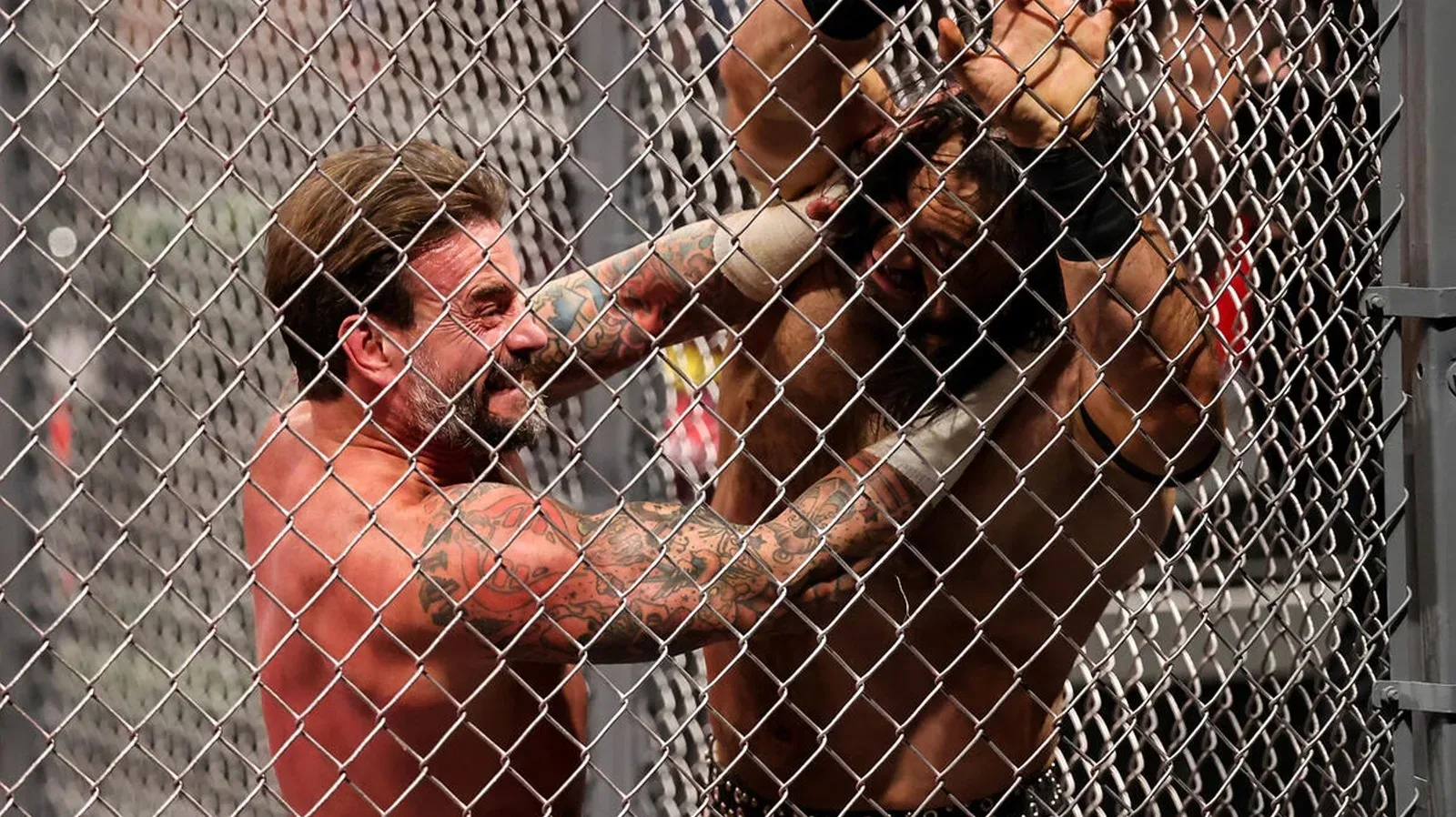
Drew McIntyre has made no secret of how highly he rates his Hell in a Cell match against CM Punk at WWE Bad Blood 2024. The bout was the violent final chapter of an intensely personal feud, featuring weapons, heavy blood loss and an atmosphere built around two rivals who had spent months attacking one another verbally and physically.
Now, McIntyre has placed that contest in especially elite company. Speaking on The Hall of Fame podcast, the former WWE Champion argued that only one other Hell in a Cell match stands with his showdown against Punk: The Undertaker versus Shawn Michaels from Badd Blood 1997, the first match held under the stipulation.
“From a story perspective, from a match perspective, I'll argue all day: it's one and two between us and 'Taker and Shawn, the first ever Hell in a Cell,” McIntyre said on The Hall of Fame podcast.
It is a major claim because the 1997 meeting between The Undertaker and Michaels is foundational to the entire history of the stipulation. That match did not simply establish the physical possibilities of the Cell; it also delivered a landmark moment with the debut of Kane. For nearly three decades, performers and fans have measured later Cell encounters against its combination of spectacle, story and escalation.
For more background on this topic, read Kofi Reflects on KofiMania, WrestleMania 35 Title Win and Its Lasting Meaning.
McIntyre’s argument is not based on the brutality alone. His emphasis is on the complete package: the emotional foundation of the rivalry, the way the feud was presented, and the match itself. In his view, the issue between himself and Punk felt real enough that the Cell became a natural destination rather than merely a familiar WWE attraction placed on the schedule.
A Feud Built on Personal Hostility
The McIntyre-Punk program was defined by its bitterness. Their conflict became increasingly personal before Bad Blood, with McIntyre repeatedly framing Punk as an opponent he could not stand on either a professional or personal level. That animosity was central to the final match’s identity.
Hell in a Cell works best when it is presented as an answer to a rivalry that cannot be contained through ordinary rules. The stipulation is designed to suggest finality: there is nowhere to run, no easy escape and no ambiguity about how far two wrestlers are willing to go to settle a score. McIntyre believes the story with Punk reached that level.
That approach helps explain why he compares the match to Undertaker and Michaels rather than simply calling it one of the bloodiest or most dramatic Cell bouts. The original encounter had years of character history behind it and used the stipulation to turn that tension into an unforgettable fight. McIntyre sees a similar connection between the narrative that preceded Bad Blood and the violence that followed inside the structure.
At Bad Blood 2024, McIntyre and Punk used a range of weapons during the match. The violence produced considerable blood, giving the contest a raw visual intensity. The physical punishment was not treated as incidental; it was a central part of the story being told. Both men had spent the buildup making the conflict feel deeply personal, and the Cell gave them a setting where that hostility could be expressed at its most extreme.
McIntyre Refuses to Credit Punk for the Finish
Even while praising the match, McIntyre has maintained his combative stance toward Punk. His assessment of the result remains characteristically defiant. Rather than conceding that Punk was simply the better man on the night, McIntyre attributed his defeat to the blood he lost during the encounter.
“I lose to blood loss, not CM Punk, 'cause he can't beat me on his best day,” McIntyre said on The Hall of Fame podcast. “17 staples in my head!”
The remark reinforces the core message McIntyre has delivered throughout the rivalry: his hostility toward Punk is not a temporary promotional talking point in his eyes. He continues to speak about “The Second City Saint” as a man he genuinely hates, and that conviction is part of why McIntyre believes their Cell match connected on a higher level.
It also speaks to the unusual balance required in a match of this type. A Hell in a Cell contest needs to feel dangerous and conclusive, but the violence must remain tied to the personalities of the wrestlers involved. McIntyre’s post-match comments keep the issue alive from his perspective. Even after the bout, he is not offering Punk the satisfaction of recognition as the superior competitor. He is instead pointing to the damage he absorbed and insisting that the result did not settle the question of who was tougher.
Why the Comparison Matters
There have been many notable Hell in a Cell matches in WWE history, which makes McIntyre’s ranking especially bold. The stipulation has hosted championship fights, grudge matches, career-defining performances and moments intended to change the direction of major WWE stories. It has also evolved over time, as different eras have approached blood, weapons, match pacing and production in different ways.
McIntyre is specifically drawing a line from Bad Blood 2024 back to Badd Blood 1997. The similarity in event names is coincidental to the larger argument, but the comparison creates an obvious historical symmetry. The original Badd Blood Cell match helped define what the stipulation could be. Twenty-seven years later, Bad Blood presented McIntyre and Punk with an opportunity to use that same environment for a modern rivalry built around resentment and escalating violence.
Whether fans agree with McIntyre’s ranking will naturally be subjective. Hell in a Cell matches are often judged through different lenses. Some viewers prioritize innovation and historical importance. Others focus on physicality, crowd emotion, storytelling, memorable spots or the finality of a feud. McIntyre is clearly asking for his match with Punk to be evaluated on both of the broadest standards: its story and its in-ring execution.
That is why his statement goes beyond a simple boast. He is not only saying that the match was tough or dramatic. He is arguing that it accomplished what a great Hell in a Cell match should accomplish: it made the structure feel necessary, gave the violence emotional context and left a lasting impression because the performers made viewers believe the conflict mattered.
Praise for the Match’s Emotion and Presentation
McIntyre is not alone in offering high praise for the Bad Blood encounter. Eric Bischoff also spoke positively about the match after it took place, particularly highlighting McIntyre’s ability to communicate emotion throughout the performance.
Bischoff’s praise extended beyond McIntyre’s individual work. He pointed to the story surrounding the match, the emotional investment in the feud, the production of the contest and the way blood was used. Those elements align closely with McIntyre’s own case for the bout’s standing among WWE’s best Cell matches.
Production can be an overlooked aspect of a stipulation match’s legacy. The Cell itself is an imposing visual, but the impact of a major match depends on how effectively the performers, camera work and overall presentation communicate the stakes. In the McIntyre-Punk match, the blood and weapon use were not merely visual flourishes. They underscored the level of punishment both men were willing to endure in pursuit of victory.
For McIntyre, the enduring point remains simple: he considers Bad Blood 2024 a match that can withstand comparison to the standard-setter. The Undertaker and Shawn Michaels created the benchmark in 1997. McIntyre believes he and Punk produced the only Hell in a Cell match that belongs directly beside it when story and match quality are weighed together.
That assessment will continue to invite debate, as any ranking involving WWE’s most famous stipulation matches should. But McIntyre’s confidence is unmistakable. He views the match not as a strong entry in the Cell catalog, but as one of the two defining examples of what the concept can deliver when a rivalry is personal enough, intense enough and violent enough to demand the structure around it.
In pictures

Darryl Polo
Darryl Polo is a passionate wrestling fan covering WWE, AEW, TNA and beyond. He loves great rivalries, breakout stars and the moments that keep fans talking long after the bell. How we work.