
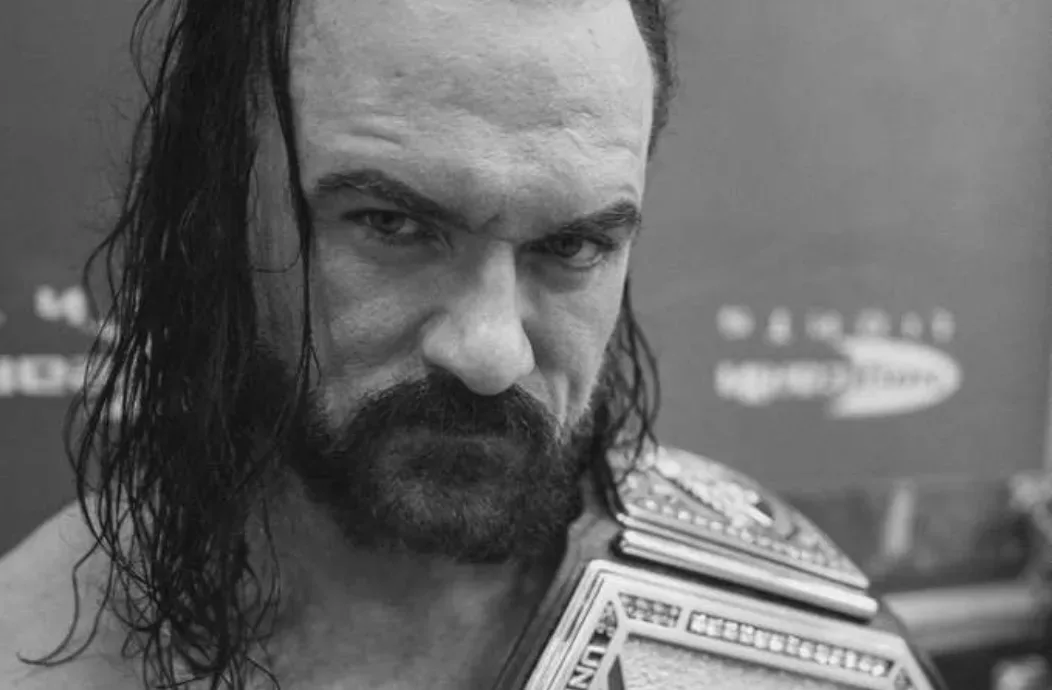
Drew McIntyre has made it clear that, even as his acting opportunities continue to grow, WWE remains at the center of his professional identity.
McIntyre has recently added more acting work to his schedule, taking on movie roles while also being connected with the WWE-related project Agent Of Shadows. The expanded profile has naturally raised a question that follows many wrestlers who move into film and television: whether acting could eventually become the preferred full-time pursuit.
For McIntyre, the answer is rooted in the connection he still feels to wrestling, the WWE environment, and the response of a live audience. He spoke openly about the contrast between the structured, quiet nature of a filmed scene and the immediate energy that comes with performing in front of WWE crowds.
“Yeah, I mean, it’s WWE. It’s my first love. It’s my most dysfunctional relationship, my longest marriage, and we’ll be together as long as we can be together.”
For more background on this topic, read WWE SmackDown Spoilers: Kevin Owens Beats CM Punk, Sami Zayn Explains Reigns Attack.
The comment carries the blend of humor and honesty that has often accompanied McIntyre’s reflections on his wrestling career. WWE has been a defining part of his life for years, with his path including major highs, significant setbacks, a departure from the company, and a return that led him back to the top of the industry.
That history gives additional weight to the way McIntyre describes WWE as a long-term relationship rather than simply a job. His wording acknowledges the difficult moments that can come with a career in a demanding, highly visible industry, but it also emphasizes that he has not lost the attachment that brought him into wrestling in the first place.
The Live Audience Difference
McIntyre pointed to the live WWE audience as the element that acting cannot fully replicate. In wrestling, performers receive a constant, unfiltered reaction from the people in the building. Cheers, boos, chants, and silence can all shape the feeling of a segment or match in real time.
Film work offers a very different process. A scene is performed, stopped, evaluated, and then production moves forward. There is no arena-sized reaction at the end of a take, and no immediate crowd energy for an actor to absorb. McIntyre said that is one of the biggest things he misses when he is working on a set.
“Even Batista says the same, he wishes he could still be wrestling in front of the large crowds. Cause there’s nothing like the live WWE audience, especially the Indian fans, just how passionate and how much they get into the product, and when you get a good scene and it’s cut, and everyone went, good job, move on, and they just leave, and you’re standing there. I wish everybody was clapping or cheering or something, but that’s what I miss. There’s nothing like the WWE fans.”
McIntyre’s mention of Batista highlights a familiar theme among wrestlers who have crossed into acting. Film can provide a major creative opportunity, but wrestling presents a singular form of performance. It is live, physical, and dependent on the relationship between the performer and the audience at that exact moment.
In a WWE arena, there is no opportunity to reset a crowd reaction the way a filmed scene can be performed again. The response is instant, and the performers must adjust instantly as well. A wrestler can feel whether the audience is invested, hostile, excited, or waiting to be won over. That unpredictability is part of what makes the experience unique.
McIntyre’s Connection To WWE Fans
McIntyre specifically praised the passion of WWE’s Indian fans. WWE’s global audience has long been a major component of its identity, and McIntyre’s comments focused on how intensely fans can engage with what they are watching. For a performer accustomed to live crowds, that investment is not an abstract measure of popularity; it is a feeling that directly affects the presentation in the ring.
The Scottish star’s appreciation for audience response also fits the nature of his WWE career. McIntyre’s presentation has often relied on a larger-than-life presence, from his entrance to his promos and the physical intensity of his matches. Those elements are designed for an arena setting, where a reaction can make an entrance feel enormous or raise the stakes of a confrontation before a match even begins.
His remarks do not frame acting and wrestling as competing interests that require an immediate choice. Instead, McIntyre described WWE as something deeply ingrained in his life, even as he explores another medium. The growth of his acting career has created new professional possibilities, but he did not suggest that those possibilities have replaced wrestling.
McIntyre also discussed that he is not actively chasing acting roles. That distinction is important in understanding his current approach. He is taking on opportunities that arise, but his comments about WWE underline that he is not presenting acting as an exit strategy from the ring.
A Career Defined By Resilience
McIntyre’s view of WWE as a lasting relationship is especially notable considering the route his career has taken. His journey in wrestling has not been straightforward, and that history is part of the reason his connection to WWE can be described in such personal terms.
A career with dramatic changes can create a perspective that goes beyond championships, television time, or any single storyline. McIntyre has experienced different stages of being a WWE performer, and he has remained closely associated with the company through those shifts. His latest comments suggest that the experience of being in front of WWE crowds continues to matter as much as any opportunity outside the ring.
There is also a practical creative difference between the two forms of performance. Acting allows for character work in a controlled environment, with separate takes and a production team shaping the final version of a scene. Wrestling demands performance under pressure, often in front of thousands of people, where the audience response becomes part of the finished product immediately.
McIntyre did not diminish the value of acting. His work in movies and on Agent Of Shadows reflects the range of opportunities available to him beyond WWE programming. However, his description of the lack of applause on a set illustrates why the emotional payoff of wrestling remains difficult to match.
No Indication Of A Choice Between Two Careers
At present, McIntyre’s comments point toward a desire to continue balancing the two areas rather than choosing one over the other. His acting work is developing, and his willingness to take part in new projects shows an interest in expanding his creative portfolio. At the same time, he was unequivocal about WWE being his “first love.”
That phrase is the clearest takeaway from his remarks. Whatever other roles McIntyre may take on, the live connection he has with wrestling fans remains a central part of what drives him. He described WWE as dysfunctional, but he also described it as his longest marriage, a comparison that makes clear both the endurance and importance of that bond.
For WWE fans, McIntyre’s words offer a direct statement of where his priorities stand. Acting may give him a new challenge and a different kind of spotlight, but the ring still provides something he does not find anywhere else: the sound and energy of a live crowd reacting in the moment.
As McIntyre continues to work across wrestling and acting, that contrast will remain a compelling part of his story. He is embracing opportunities outside WWE without treating them as a replacement for the industry that shaped his career. For now, McIntyre sees WWE not as a chapter that is closing, but as a relationship he intends to maintain for as long as both sides can remain together.

Darryl Polo
Darryl Polo is a passionate wrestling fan covering WWE, AEW, TNA and beyond. He loves great rivalries, breakout stars and the moments that keep fans talking long after the bell. How we work.