
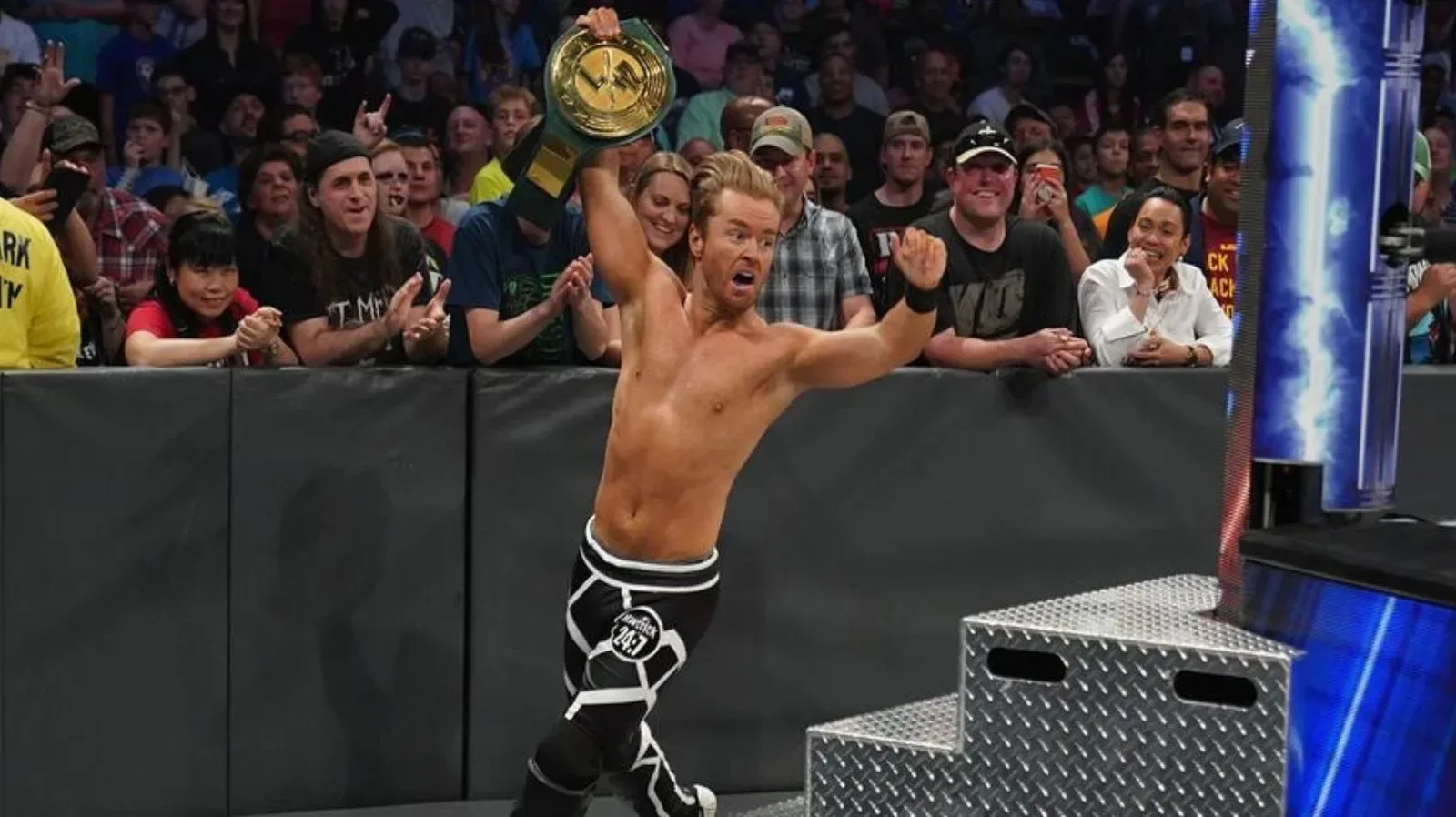
Drake Maverick looks back on WWE’s 24/7 Championship era with the kind of appreciation that often arrives only after the cameras have stopped rolling and the madness has become a memory.
The former WWE performer was one of the most recognizable personalities attached to the title after it was introduced in 2019. While R-Truth became the championship’s defining figure through an extraordinary collection of reigns and celebrity-driven encounters, Maverick became a crucial part of the wider ensemble. His frantic pursuit of the championship, his willingness to play into the absurdity of the concept, and his ability to make a few seconds of backstage television feel consequential helped give the division its identity.
Speaking with Simon Miller, Maverick said he did not fully understand at the time how fondly he would eventually view those recurring 24/7 scenes.
“When I look back at it, didn’t realize in the moment [they were] the good ol’ days,” Maverick said. “When I look back on it, it’s just the best.”
For more background on this topic, read Karl Fredericks Looks Back On NXT Underground, Strap Match Legacy And Working With Dijak.
That reflection speaks to an unusual period in WWE programming. The 24/7 Championship was intentionally built around unpredictability. Its rules allowed the title to be defended at any time, at any location, as long as a WWE referee was present. That framework turned hallways, parking lots, airports, weddings, golf courses, red carpets and other unlikely settings into potential championship battlegrounds. It also created a place on television for wrestlers who were not always positioned in featured matches on Raw or SmackDown.
Maverick was particularly effective in that environment because he embraced the title’s presentation without treating it as beneath him. The comedy was broad, but the performers chasing the championship had to sell the urgency of the chase. Every surprise roll-up, every sprint through a backstage corridor and every near miss needed someone willing to treat a notoriously unconventional prize as the most important thing in the building.
An Opportunity That Was Not Initially Planned
Maverick explained that he was not originally expected to be part of the 24/7 Championship material. At the time, he was serving as the on-screen general manager of 205 Live, WWE’s cruiserweight-focused program. That role nevertheless put him in position to be useful when Raw was being produced.
“Wasn’t even supposed to be involved in it,” Maverick said. “I got brought to ‘Raw’ every week because I was the ‘205 Live’ general manager at the time... I was always brought to TV on a Monday just in case they needed me for anything, whether it be digital or stuff.”
That type of availability can be vital in WWE, particularly for a performer who is capable of working in several different formats. Maverick had experience as an on-screen authority figure, a manager, a wrestler, a character actor and a reliable presence in short-form digital content. The 24/7 Championship required many of those skills at once. Segments often had limited time, but they needed clear characters, immediate stakes and a memorable punchline or visual.
His weekly schedule also reflected the demands of WWE’s production model at the time. Maverick recalled making the drive from Raw to SmackDown, which was filmed on Tuesdays during that period. Being consistently present gave him the chance to become part of stories that could develop rapidly from one show to the next.
Rather than waiting for a major storyline assignment, Maverick found a way to make himself valuable within a concept that was evolving in real time. The 24/7 Championship did not operate like a traditional title scene built around ranked contenders, lengthy feuds and major premium live event matches. It was a fast-moving, flexible device that could be used to fill a brief gap in a show, create social-media-friendly content or involve personalities from outside wrestling.
For Maverick, that flexibility became an opening.
Adam Pearce’s Support and a Crowded Chase
Maverick identified Adam Pearce as a key supporter in helping him get an opportunity in the 24/7 Championship division. He described himself as being near “the bottom tier list,” a candid acknowledgment of where he believed he stood in the internal pecking order at the time.
That context makes Maverick’s eventual visibility in the division more significant. The 24/7 scenes frequently involved a large group of wrestlers and personalities racing after a champion. In a crowded field, simply appearing was not enough. A performer had to find a way to stand out without disrupting the basic structure of the segment.
Maverick’s approach was to commit fully. His character was not merely another anonymous body in the chase; he played the pursuit as a personal mission. That commitment became especially memorable when his real-life relationship with Renee Michelle was incorporated into 24/7 Championship material, illustrating how the title’s stories could blend exaggerated comedy with character-based stakes.
The division could be deliberately ridiculous, but Maverick understood that the best wrestling comedy still relies on emotional clarity. The audience had to understand why a wrestler was desperate to win, why a champion was terrified of losing and why a sudden change mattered. His performances helped provide that clarity.
Seizing the Moment Backstage
Maverick also recalled one of the early scenes after Titus O’Neil won the 24/7 Championship in the ring. Once the bell rang and the championship changed hands, the usual pursuit began, with wrestlers pouring into the backstage area to chase the new champion.
During that sequence, Maverick found himself running past Bobby Lashley and Baron Corbin. He remembered taking a small but distinctive moment for himself, briefly stopping to acknowledge both men before continuing his sprint.
“I remember we busted a Bobby Lashley and a Baron Corbin backstage, everyone runs through,” Maverick said. “This was, not going into business for myself, I don’t want to call it, but seizing the moment. But, believe me, I went into a lot of business for myself with this. I stopped, looked at Bobby, looked at Corbin, went, ‘Sorry.’ And just kept on running.”
It was a simple choice, but it captures why Maverick worked so well in the format. He recognized that a chase scene can become visually repetitive if every wrestler reacts the same way. By pausing for a beat, offering a quick apology and then running off, he gave viewers a character moment without derailing the segment.
The distinction Maverick makes between “seizing the moment” and “going into business for yourself” is also revealing. In wrestling, performers often have to make quick creative decisions in the middle of a live or taped production. The most effective choices are usually those that enhance the segment, protect the larger story and make everyone involved look more interesting. Maverick’s recollection suggests he saw the 24/7 scenes as a place where initiative was rewarded, provided the performer understood the tone.
That tone was different from almost everything else on WWE television. The 24/7 Championship could involve established names such as Lashley and Corbin in a chaotic sprint, while also giving lesser-used talent a chance to appear alongside them. It could feature celebrities holding the title, putting R-Truth in a new comedic situation, or creating a surprise title change away from the ring. The entire premise depended on wrestlers being adaptable.
The Legacy of WWE’s 24/7 Championship
WWE retired the 24/7 Championship in 2022, closing a chapter that had produced a remarkable number of title changes and an enormous range of segments. Its legacy remains divisive among viewers because it was never designed to satisfy the same expectations as WWE’s major singles championships. It was not meant to be a centerpiece sporting prize. It was a vehicle for spontaneity, comedy, cameo appearances and undercard character work.
For performers like Maverick, however, it was also a chance to demonstrate versatility. Not every WWE opportunity arrives with a lengthy promo, a featured match or a clear road to a championship program. Sometimes the assignment is a hallway sprint, a reaction shot or a brief interaction with a much higher-profile talent. The wrestlers who maximize those moments can earn a lasting connection with the audience.
Maverick’s 24/7 Championship run showed how much personality could be conveyed in those short bursts. Whether he was chasing R-Truth, navigating the confusion caused by celebrity titleholders or trying to turn a backstage stampede into a memorable beat, he consistently treated the material as an opportunity rather than an obligation.
Years later, he sees that period with affection. The “good old days” description is not simply nostalgia for a discontinued championship. It is a reflection on a creative space where he could contribute, take risks and become an essential part of one of WWE’s most unusual modern concepts.
For Maverick, the 24/7 Championship was never just a prop being passed around backstage. It was proof that a performer can make an impact by being prepared, embracing the assignment and recognizing the instant when it is time to run through the frame, say “sorry,” and keep moving.
In pictures

Darryl Polo
Darryl Polo is a passionate wrestling fan covering WWE, AEW, TNA and beyond. He loves great rivalries, breakout stars and the moments that keep fans talking long after the bell. How we work.