
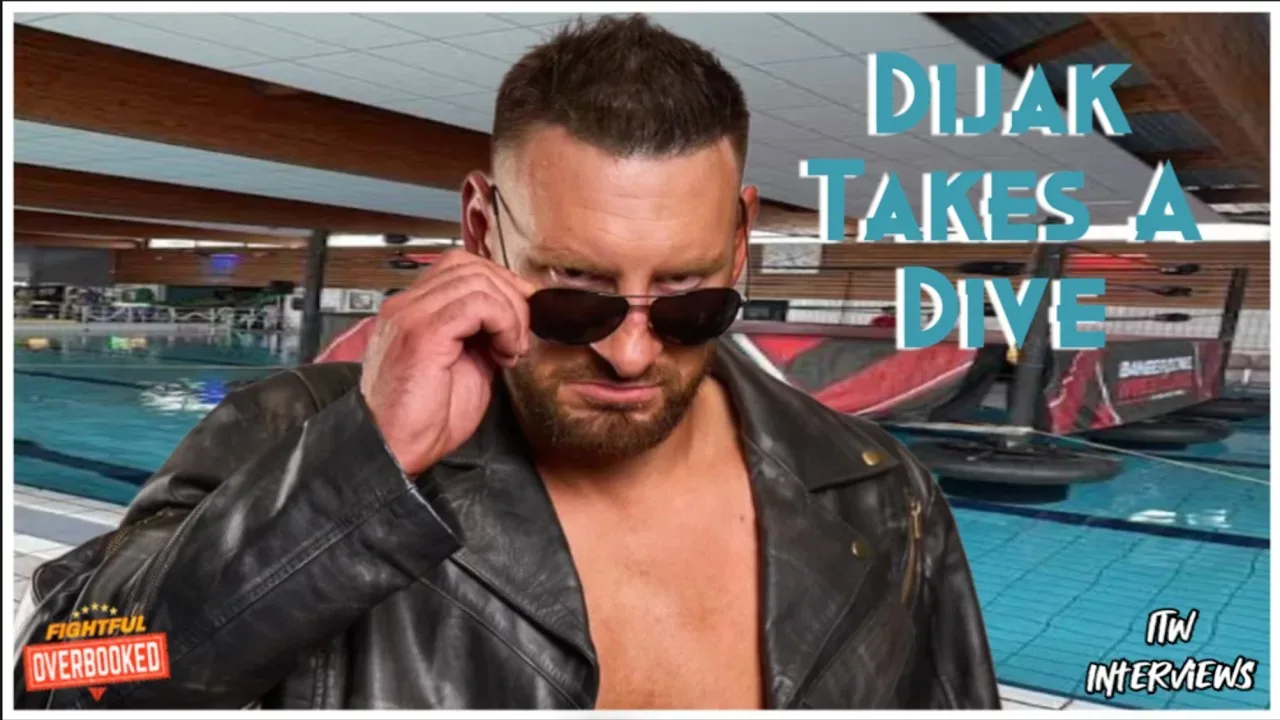
Donovan Dijak believes the timing of a wrestler’s entry into WWE can have a major effect on the performer they ultimately become.
Speaking in a recent interview, Dijak looked back at his first WWE tryout in 2013, which came roughly seven or eight months after he had begun training for professional wrestling. While the opportunity arrived extremely early in his journey, Dijak said he is convinced that signing with WWE at that particular stage would have sent his career down a very different path.
“It certainly was unique for me, and I had my first WWE tryout in 2013, which was maybe seven or eight months after I started training,” Dijak said. “So it was incredibly early in my career. If I had been signed right then, there’s no doubt in my mind that I’d be a completely different professional wrestler, right?”
The comment offers a revealing look at the balance between WWE’s structured developmental environment and the experience gained by wrestlers who spend more time working outside that system. Dijak did not frame WWE’s approach as inherently negative, nor did he place the responsibility solely on trainers. Instead, he emphasized that performers themselves still have agency in choosing what they want to pursue in the ring.
For more background on this topic, read Sami Zayn Calls CM Punk ‘Phony’ but Gives Rival Credit for In-Ring Greatness.
At the same time, he acknowledged that the setting naturally creates a different level of caution. A wrestler working in WWE’s developmental pipeline has a job, an evaluation process, and a larger organizational structure around every choice. For a young wrestler still learning what works, that can change the way risks are assessed.
“Because when you go there, they’re a little more reserved, right?” Dijak said. “I almost don’t want to put it on the trainers, because if I had decided in the Performance Center, I guess at that time it would have been FCW and then it would have turned into the Performance Center. If I had decided that I wanted to do all sorts of cool high-flying stuff, like they might have discouraged it or whatever, but ultimately if you want to do it, you’re going to do it.”
An Early Tryout at a Crucial Point
Dijak’s recollection puts the 2013 tryout in important perspective. He was not an experienced independent wrestler with years of matches, a fully established style, or a refined sense of what kind of performer he wanted to be. He was still at the beginning of his training, well before the kind of repetition and trial-and-error process that helps many wrestlers identify their strengths.
That timing is central to his point. A WWE contract is a major goal for countless wrestlers, and receiving a tryout so soon after beginning training can represent an enormous opportunity. But Dijak’s reflection is not about dismissing that opportunity. It is about recognizing how much development can occur when a wrestler has room to make imperfect choices, learn from them, and keep moving without the pressure of a job potentially hanging in the balance.
WWE’s developmental structure has evolved over the years. Dijak specifically noted that, had he been brought in at the time of his tryout, he would have entered an environment connected to FCW before it became the WWE Performance Center model. Regardless of the name attached to the system, the broader point remains that development inside WWE comes with expectations, oversight, and the need to progress while representing the company.
For Dijak, remaining outside that environment during his earliest period gave him the freedom to discover his abilities in a less restrictive professional setting. His remarks suggest that this freedom was not merely about having permission to attempt spectacular moves. It was also about accepting the possibility that those attempts would not work.
The Value of Failing Without a Contract at Stake
The clearest distinction Dijak made between the independent scene and working under the WWE umbrella involved the consequences of failure. In his view, an independent wrestler can take a chance, miss the mark, and use the experience as part of the learning process. The stakes are different when a wrestler’s employment is directly connected to how they perform and develop.
“If you try and fail under the WWE umbrella, your job’s on the line,” Dijak said. “I didn’t have a job to be on the line. So I was, I was failing left and right, and it was like, whatever, I don’t care. You know, what are you not going to give me my hot dog? Like, I don’t- it doesn’t matter, you know?”
The humorous reference to a “hot dog” underscores the larger idea: early independent wrestling opportunities may not carry the same financial security or institutional support as a WWE deal, but they can provide a lower-pressure venue for experimentation. A developing wrestler may work through mistakes in front of smaller crowds and learn what fits their physical style, personality, and instincts before taking those lessons into a higher-stakes environment.
That does not mean independent wrestling is without pressure. Wrestlers still need to earn bookings, build trust with promoters and peers, and develop enough consistency to continue receiving opportunities. But Dijak’s comments draw a meaningful line between trying something that does not land on an independent show and doing so while employed by the industry’s largest company.
His perspective also reflects why there is no single ideal route into WWE. Some prospects thrive after being recruited quickly from athletics or other backgrounds and learning the craft within the company’s system. Others may benefit from spending years building experience elsewhere before entering WWE with a more developed in-ring identity. Dijak’s own answer is clearly shaped by the latter possibility.
Recruitment Beyond Traditional Wrestling Paths
Dijak’s discussion came in the context of WWE’s wider recruitment process, which can include performers from throughout professional wrestling as well as athletes with backgrounds outside the business. WWE has long looked for different types of prospects, and the traits required to earn a tryout or a contract can differ from the traits that define a polished, seasoned wrestler.
That recruiting reality can create an interesting tension for prospects. An athlete may be identified early because of size, conditioning, charisma, coordination, or potential. Yet potential is not the same thing as a finished professional wrestling style. Dijak’s experience illustrates how an early opportunity can arrive before a wrestler feels they have fully explored what they are capable of becoming.
He was careful not to make his reflection an indictment of coaches or the developmental process. Dijak openly said that, if he had strongly wanted to pursue more ambitious high-flying ideas, he could have chosen to do so. His argument is more nuanced: a structured environment may be more reserved, while a wrestler outside that environment can feel freer to take risks repeatedly because there is less to lose in the immediate sense.
That distinction matters when evaluating development. Training is not only about being taught moves, drills, television mechanics, or conditioning standards. It is also about finding an individual rhythm and learning which risks are productive. A wrestler who can try something, fail, adjust, and try again may come away with a stronger understanding of their own limits and possibilities.
Dijak’s Reflection on Career Development
Dijak’s comments do not rewrite the value of WWE developmental training, nor do they establish that one route is universally superior to another. Instead, they provide a personal assessment of what he believes he needed at that early moment in 2013. Given how new he was to wrestling at the time, he feels the experience of learning outside WWE was crucial to the wrestler he became.
It is also notable that he did not present growth as a clean or glamorous process. His description of failing “left and right” is a reminder that professional wrestling development often involves awkward attempts, unsuccessful ideas, and the willingness to look imperfect before a performer becomes more confident. Those experiences can be difficult, but they can also be formative.
For aspiring wrestlers, Dijak’s account highlights the importance of readiness beyond simply being offered a chance. A major opportunity can come early, but each performer must determine what environment will allow them to continue learning. Some may be prepared to flourish inside WWE’s structure from day one. Others may need the independent scene’s flexibility to test themselves and develop their voice.
Elsewhere in the interview, Dijak also discussed wrestling in a swimming pool with BZW last month, another example of the unusual settings and varied experiences that can emerge outside the traditional confines of major-company wrestling. Taken together, his remarks present a wrestler who sees value in embracing unconventional experiences and allowing the learning process to be messy.
For Dijak, the question is not whether an early WWE signing would have been significant. It plainly would have been. The question is what it would have cost him in terms of exploration at a stage when he was still figuring out the kind of wrestler he wanted to be. His answer is direct: had he signed after that first tryout, he believes he would have been a completely different professional wrestler.

Darryl Polo
Darryl Polo is a passionate wrestling fan covering WWE, AEW, TNA and beyond. He loves great rivalries, breakout stars and the moments that keep fans talking long after the bell. How we work.