
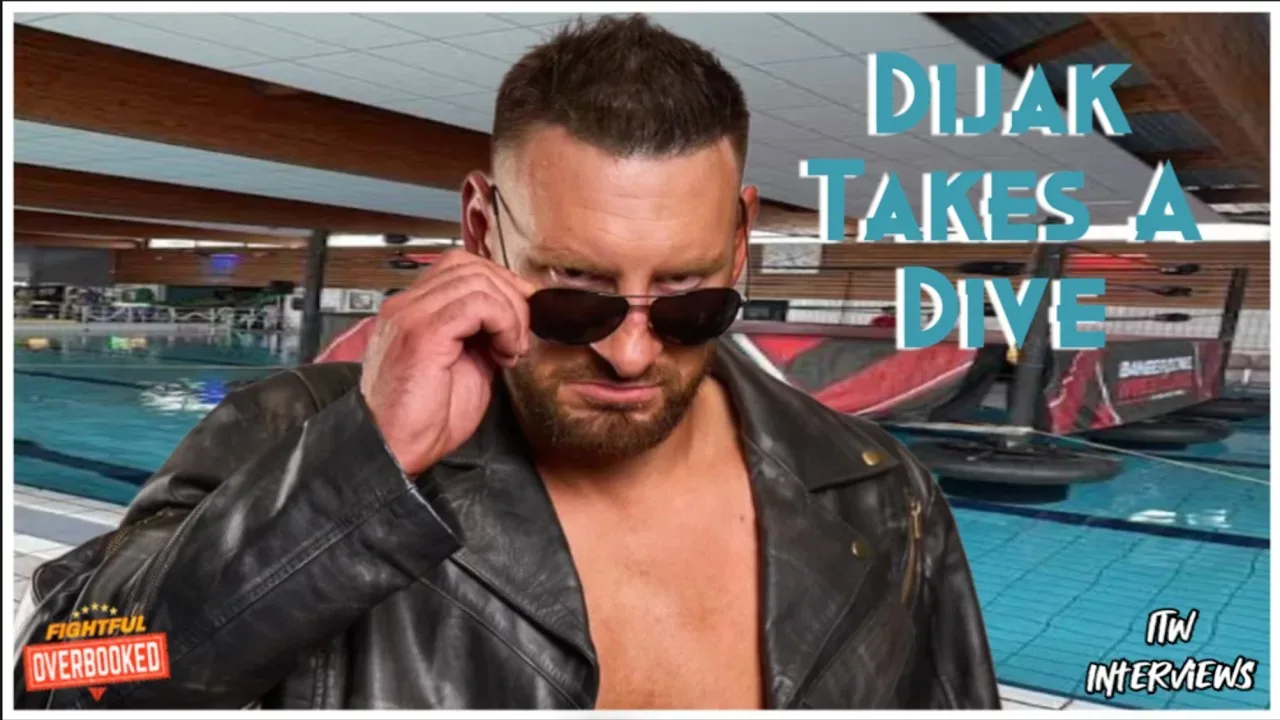
Donovan Dijak’s independent wrestling schedule has taken him to a broad range of promotions and venues, but BZW WaterMania presented a challenge unlike a conventional wrestling booking. The event, held in Paris at the end of August, placed its ring directly on a floating platform in a swimming pool, creating a setting where balance, footing and even the basic act of pushing off the mat became major factors in every movement.
Dijak recently discussed his WaterMania experience, explaining that his interest in the concept began about a year before he ultimately appeared on the card. A social-media post showing a floating ring first caught his attention, though he initially assumed the striking visual had been created with artificial intelligence.
“Whenever you scroll your feed, you’re like, AI, AI, AI, AI,” Dijak said. “I scrolled by his, and I was like, AI, and then I was like, wait, that was Sean.”
The post had been shared by Sean Ross Sapp, and Dijak said he went back to examine it more closely. He was stunned to learn that the floating-ring footage was real rather than digitally generated. After he asked online whether it was authentic, people directed him to video that confirmed the concept had actually been staged.
For more background on this topic, read Yuki Kamifuku Explains Why Retirement Feels Right Despite Fear Of Life After TJPW.
The image clearly stuck with Dijak. He said BZW, or a group connected to the promotion, later contacted him about potentially taking part in a future floating-ring event. His answer was immediate.
“BZW basically hit me up and said, ‘Hey, we’re doing a floating ring pool at some point. Would you like to be part of it?’ I said, ‘Yes, absolutely I would.’”
That first conversation happened roughly a year before WaterMania came together. When the promotion eventually returned with a firm date, Dijak initially believed he would have to turn down the opportunity because he was already committed elsewhere. The situation changed when that separate booking fell through.
At that point, the timing became especially favorable. Dijak was scheduled to travel to London the following day for PROGRESS, where he was making his first appearance for the British promotion in a decade. Rather than simply arrive in the United Kingdom for that return date, he reached out to BZW to see whether a WaterMania spot was still available.
The promotion was able to accommodate him, allowing Dijak to rearrange his travel and make the trip to Paris before heading on to London. It was a demanding bit of logistical work, but it gave him the chance to take part in a wrestling event he had wanted to experience since first seeing the floating ring online.
“They made room for me on the card, which I was very thankful for,” Dijak said. “I was able to switch up all the flights and get all the arrangements made and get myself to Paris for BZW WaterMania.”
The result lived up to the unusual expectations surrounding the show. Dijak described WaterMania as “everything I expected it to be and more,” but that enthusiasm did not mean the match could be approached as though it were taking place in an ordinary venue.
A Ring Where Stability Cannot Be Taken for Granted
The defining obstacle of a floating ring is clear before the bell ever rings: the platform moves. Wrestling rings are designed to provide a stable surface, even as their boards, ropes and padding absorb impact. At WaterMania, the ring was positioned on the water, and that meant its movement was directly affected by where the wrestlers stood and how their weight shifted.
Dijak said the talents had time to familiarize themselves with the setup before fans arrived. They were out in the ring for about an hour ahead of doors opening, and the instability was immediately noticeable.
“You can feel it,” he said of the floating structure. “It’s wobbling and it’s teetering. If you get too many people on one side, it starts to kind of sink in that direction.”
That reality changes the calculations behind virtually every sequence in a wrestling match. Movement that would be routine in a regular ring can become unpredictable when the mat gives way under a wrestler’s feet or tilts toward one side. Dijak specifically noted that the ring did not provide the same push or lift that performers normally rely on.
“Things that we take for granted in terms of the stability of the ring aren’t necessarily there,” he explained. “You sink and you don’t get as much push or as much lift as you’re looking for.”
The issue was not merely presentation. It required practical adjustments to protect both wrestlers. Dijak praised the opponent he worked at WaterMania, calling him excellent and easy to work with. More importantly, he said his opponent understood the special circumstances they were dealing with and was prepared to alter their plans as the situation demanded.
The pair discussed material for the match, but they did so with a major condition attached: every idea had to remain safe on the floating ring. Dijak estimated that about half of what they had mapped out was ultimately removed because it was not safe enough to attempt in that environment.
“We called a lot of stuff and basically said put a big asterisk next to all of it,” Dijak said. “If it’s safe... we probably axed about like half of it because it was not safe.”
That approach illustrates the balance demanded by specialty wrestling events. The novelty of a ring in a pool is the attraction, but the talent still has to execute a match while accounting for the risks created by that novelty. There is a temptation to lean into the setting with bigger movements and dramatic falls, yet performers must be able to recognize when a planned maneuver is too hazardous for the surface beneath them.
Slippage Was the Biggest Concern
Water was never far from the action, whether through the ring’s surroundings or moisture tracked onto the platform. For Dijak, that made slippage the primary danger. A loss of footing can disrupt an entrance, throw off timing during a sequence, or turn a controlled bump into something far more dangerous.
Dijak said he did go into the water, though he did not take a bump in the ring itself. He characterized the bumps on the ring as potentially the worse aspect of the experience, underscoring how difficult it was to generate normal impact and body control on the floating platform.
Even before the match properly began, he had to negotiate the threat of losing his footing. Dijak joked that he struggled simply to make his entrance without slipping, a reminder that the usual walk to the ring became a legitimate test at WaterMania.
Still, the match avoided the kind of frightening mishap everyone wanted to prevent.
“Slippage was probably our number one concern,” Dijak said. “But thankfully, there was no catastrophic slips. So I’m very thankful about that.”
That successful outcome speaks to the precautions taken by the participants, as well as the importance of working with someone who could adjust on the fly. Wrestling often demands trust between opponents under standard conditions. A floating ring magnifies that need, because even a simple shift in positioning can affect the platform’s balance and alter the feel of a planned exchange.
A Memorable Stop Before Dijak’s PROGRESS Return
The WaterMania appearance also became a unique opening act for Dijak’s return to PROGRESS. His London booking marked his first match for the promotion in 10 years, making the trip noteworthy on its own. The late change in travel plans gave him the opportunity to combine that milestone with one of the more unconventional events on the independent wrestling calendar.
For Dijak, the Paris experience was driven by curiosity as much as anything else. He had seen proof that the floating-ring idea was real, wanted to participate, and kept that interest alive long enough for the right scheduling break to arrive. When it did, he made the necessary adjustments to get to BZW WaterMania.
He even found a humorous practical concern in the aftermath, joking that spray tan would have created a serious mess in a pool-based match. It was a lighthearted final detail from an event that demanded a great deal of genuine preparation.
BZW WaterMania offered Dijak an opportunity few wrestlers can claim: competing in a ring that could wobble, tilt and sink toward the side carrying too much weight. The spectacle delivered the visual appeal that first stopped him in his social-media scroll, but his account also makes clear that it required caution, adaptability and a willingness to discard familiar assumptions about how a wrestling ring works.
In the end, Dijak got the experience he had been waiting for, made it through without a catastrophic slip, and left Paris with a story unlike nearly any standard wrestling booking can provide.

Darryl Polo
Darryl Polo is a passionate wrestling fan covering WWE, AEW, TNA and beyond. He loves great rivalries, breakout stars and the moments that keep fans talking long after the bell. How we work.