
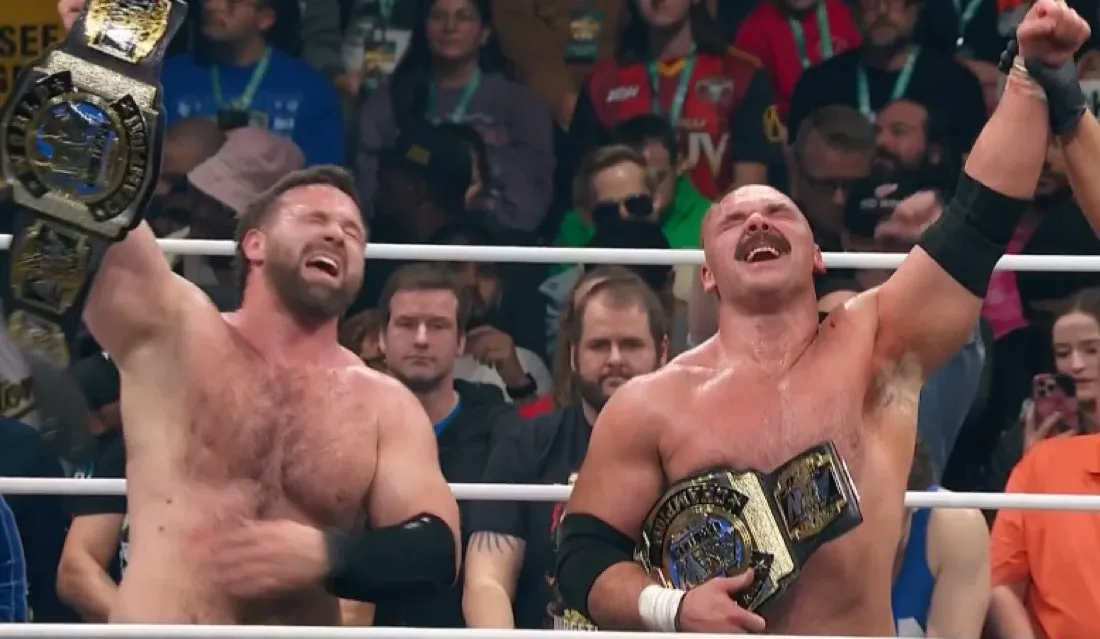
FTR’s return to tag team competition at AEW All Out will come under some of the most demanding circumstances possible. Dax Harwood and Cash Wheeler are scheduled to challenge for the tag team titles in a ladder match also featuring the Young Bucks and the team of Christian Cage and Adam Copeland, known as Cage & Cope.
It will be FTR’s first tag team match since Adam Copeland and Christian Cage defeated them for the titles at AEW Double or Nothing. Rather than framing the All Out bout solely as a chance to immediately reclaim championship gold, Harwood has also used the moment to raise a broader question about AEW’s tag division: which younger team, if any, is prepared to assume the responsibility and expectations that come with following FTR’s path?
Harwood said he would prefer not to have FTR’s first major match back be a ladder match, particularly if it means a younger tandem could receive that platform instead. At the same time, he made clear that he does not believe a team has yet demonstrated it is ready to replace what FTR represents.
“We don’t want to come back in our first real major high-profile match [and have it] be a ladder match. I’d rather a young tag team take our spot,” Harwood said. “But the thing is, I don’t know if any tag teams have stepped up to the plate and want to take what FTR has built, because that’s a hefty thing to take. I’m begging any tag team to take our spot.”
For more background on this topic, read The Butcher To Remain Permanently Listed On AEW Roster Page.
FTR’s Challenge Extends Beyond the Championship Match
The remarks are consistent with the identity FTR have cultivated throughout their run together. Harwood and Wheeler have built their reputation around traditional tag team structure, physical pacing, continuity between partners, and the belief that tag wrestling should be treated as a featured discipline rather than a secondary attraction. Their list of accomplishments supports the confidence behind Harwood’s challenge.
FTR are among the most decorated teams of their era, having won championship gold in WWE, AEW, and NJPW. That cross-promotional record has helped establish the pair as a benchmark for teams who want to be viewed as more than occasional allies or singles wrestlers temporarily aligned for a storyline.
Harwood’s comments are not simply an invitation for another team to imitate FTR’s style. Instead, they place the emphasis on carrying the same degree of significance. In his view, the next team to occupy that position would need to bring its own identity while accepting the pressure that comes with being measured against a tandem with FTR’s experience, résumé, and consistency.
“We just bring something completely different,” Harwood said. “We are our own men. We are our own team, and no one can ever emulate what we do. I would love for them to try to, but I don’t think they’re going to take the spot that FTR has filled.”
There is an important distinction in that statement. Harwood is not arguing that another team cannot become important. He is arguing that FTR cannot be duplicated, and that any group hoping to occupy a similarly central role must establish a standard of its own. The challenge, then, is not to become another version of Harwood and Wheeler. It is to prove capable of leading a division with the same confidence and sustained presence.
A Difficult Return at AEW All Out
For now, FTR’s attention turns to a title match with no shortage of history attached to it. The All Out ladder match brings together three teams whose relationships have already been shaped by championship competition and personal stakes. FTR enter after their title loss to Copeland and Cage at Double or Nothing, while the Young Bucks bring another major layer of rivalry and familiarity to the contest.
The ladder stipulation also changes the nature of the challenge. A conventional tag match would put the focus more directly on combinations, isolation, timing, and the in-ring structure with which FTR are closely associated. A ladder match introduces a different set of demands, where momentum can shift quickly and where every participant is forced to balance the immediate pursuit of the titles with the risk involved in taking—or avoiding—major punishment.
That is why Harwood’s preference for a young team to receive this kind of high-profile opportunity carries additional weight. Ladder matches are naturally memorable and can become defining moments for those involved. Being placed in one for championships at an event such as All Out offers visibility that many teams spend years seeking. Yet FTR’s place in the match also reflects why they remain difficult to move past: when AEW needs a major tag title bout with established credibility, Harwood and Wheeler are still part of the equation.
FTR’s return is therefore not a quiet re-entry into the division. It is a direct move back into the championship picture, in a match that includes former rivals and current titleholders. If Harwood wants another team to take the place FTR have held, the All Out match demonstrates the level that team would have to reach. It would need not only strong matches and fan support, but also the ability to remain relevant when the biggest title opportunities are being assembled.
What It Means to “Take Our Spot”
Tag team wrestling is often judged differently than singles competition. A successful tandem must establish each wrestler as a distinctive performer while making the partnership feel essential. The best teams develop recognizable rhythm, shared instincts, and a body of work that makes their matches feel important regardless of the opponents or the stipulation. FTR have spent years pursuing that kind of status.
Harwood’s comments suggest that he sees succession as something that must be earned rather than handed down. A younger team may receive an opportunity, a major match, or even a championship victory, but those milestones alone would not necessarily mean it has become the division’s standard-bearer. Maintaining that position is the heavier task. It requires delivering repeatedly, adapting to changing opponents, and making audiences believe that a tag title match matters because that team is involved.
It is also a challenge that can benefit AEW as a whole. A deep tag division does not rely on a single established act forever. New teams need opportunities to create their own rivalries, championship pursuits, and defining performances. Harwood’s public callout puts that burden plainly on the division: FTR are willing to be challenged, but they are not prepared to pretend their place has been claimed before someone proves it.
That confidence is especially notable considering that Harwood and Wheeler are heading into a match where the titles will be suspended above the ring and where winning depends on more than simply defeating an opponent by pinfall or submission. In a three-team ladder match, there is no room for a slow build back into contention. Each team can alter the outcome, and a single opening can determine who leaves with the championships.
All Out Offers an Immediate Test
FTR’s focus will remain on the task in front of them: the Young Bucks, Cage & Cope, and the tag team titles. Harwood’s remarks, however, ensure that the conversation around the match will extend beyond the ladders and the championships. He has framed FTR’s position as both an accomplishment and an open challenge.
For the teams currently trying to rise within AEW, the message is straightforward. FTR do not believe their influence can be copied, but Harwood wants to see someone make the attempt to match the importance, commitment, and body of work that he and Wheeler have built. Until that happens, FTR intend to remain a defining presence in the division.
At AEW All Out, they will have the opportunity to reinforce that claim in one of the event’s most consequential matches. A victory would return the titles to Harwood and Wheeler after the loss at Double or Nothing. A defeat would not erase their legacy, but it could further intensify the question Harwood has placed before AEW’s tag teams: who is ready to step forward and make a lasting claim to the spot FTR believe remains theirs?

Darryl Polo
Darryl Polo is a passionate wrestling fan covering WWE, AEW, TNA and beyond. He loves great rivalries, breakout stars and the moments that keep fans talking long after the bell. How we work.