
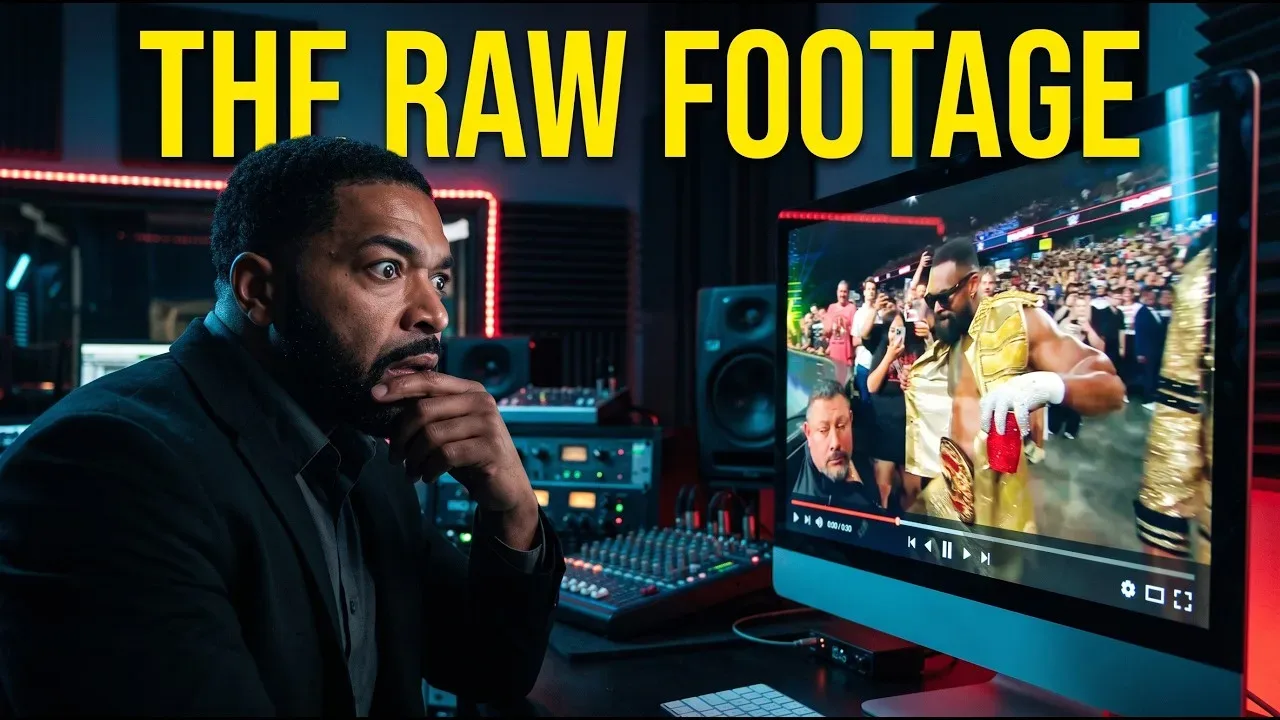
David Otunga has offered a detailed legal perspective on the lawsuit filed against Montez Ford and WWE by Cook County Sheriff’s officer Noel Lucas, saying the publicly circulated video of the July 6 edition of WWE Raw does not clearly show the intentional physical contact alleged in the complaint.
Lucas filed suit on October 14 against Ford and WWE in connection with an in-ring-side interaction that occurred while Ford was performing during the show. The lawsuit alleges 14 counts, including battery, assault, intentional infliction of emotional distress, and alleged violations of the Illinois Gender Violence Act. The filing centers on a comedic moment in which Ford appeared to perform a lap-dance-style routine near Lucas, who was working security.
Among the allegations described in the filing is a claim that Ford, identified by his legal name, Kenneth Crawford, repeatedly rubbed his left inner thigh against Lucas’ leg. Otunga, a former WWE performer who is also a Harvard Law graduate and an Illinois attorney, reviewed the social-media video that has circulated in the wake of the lawsuit and repeatedly noted the limitations of the available footage.
Otunga’s early conclusion was that the clip does not visibly substantiate a deliberate repeated touching claim. He also emphasized that a video review from one angle is not the same thing as a complete evaluation of all evidence that could ultimately become available in litigation.
For more background on this topic, read AEW Teases WrestleDream Arrival as Ilja Dragunov Speculation Builds.
Otunga Sees a Comedic Interaction in Available Footage
While studying the sequence, Otunga said Lucas appeared to be attempting to remain serious before showing signs that he was amused by what was happening. Otunga interpreted Ford’s conduct as an effort to entertain the live crowd and get a reaction from the security officer, as well as from Ford’s tag team partner Angelo Dawkins and others nearby.
“You see Lucas trying to keep a straight face. There, he’s starting to crack a smile. Tez is really getting into there. He’s smiling and looking away, trying to conceal his laugh. He looks a little uncomfortable, but at the same time, it does seem that he’s aware this is a joke.”
Otunga said that, from the angle he reviewed, he could not see the physical contact that forms a central part of Lucas’ allegations. He noted that the image does not show every portion of the men’s legs at all times, leaving open the possibility that another camera angle could present additional context. Still, he believed the clip at hand raised questions for the battery claim.
“The interesting thing is, from this vantage point, I don’t see the physical contact. Now, the screen is cut off a little bit, but remember, it alleges that Montez’s left thigh, his inner thigh, makes unwanted contact. I’m keeping my eye on it there. It’s further away from him. So, if there is contact, it would appear to only be incidental. Like, it doesn’t look like it’s intentional.”
Otunga added that he had not seen contact in the footage he examined and said that absence could present a problem for a civil battery allegation. At the same time, he was careful not to state that the video definitively resolves the issue, as the lawsuit could involve testimony, other recordings, or evidence that is not public.
Why Physical Contact Matters to the Claims
The legal discussion focused heavily on the difference between an incidental brush and the allegation of repeated, intentional unwanted contact. Otunga stated that a separate video angle could materially change the evaluation if it clearly showed deliberate touching. As he described it, the claims must be assessed based on what can be proven, rather than merely what is alleged in a complaint.
“If there was a brief brush,” Otunga said, “I’d want to know whether it was incidental. That would be different from the repeated intentional rubbing that’s alleged in lawsuit.”
He described the moment as a “comedic spot” that appeared harmless to him based on the footage, saying Ford seemed to be playing to the audience and trying to make Lucas laugh. The context of a live WWE event, where performers regularly use exaggerated gestures and interact with people at ringside, is likely to be relevant to how both sides frame the encounter.
However, context alone would not end a legal dispute if evidence established conduct beyond what is visible in the viral clip. Otunga acknowledged that Lucas’ subjective reaction and the full surrounding circumstances could be examined in court. He specifically stated that his viewing of the video was an interpretation, not proof of either man’s private intent.
“That’s my interpretation of what we’re seeing. It isn’t proof of what either man was thinking, though.”
That qualification is significant. Lawsuits are not decided through a single online video alone, particularly when footage may be cropped, obstructed, or incomplete. Depositions, witness accounts, production records, alternate footage, and the precise language of the complaint and any response could all shape the eventual legal path.
Otunga Leans Toward Ford and WWE on the Public Record
After reviewing the issues, Otunga gave his overall assessment: based only on the public material he discussed, he leans toward the defense regarding the claims tied to Ford’s behavior. He was particularly doubtful that the currently known facts support an intentional infliction of emotional distress claim.
“Well, on the public evidence we’ve discussed, I lean towards the defense on the claims about Ford’s conduct. I’m particularly skeptical of the emotional distress claim on the record. I really am. It looks like Lucas knew that this was a joke. Clearly, Montez intended this to be a joke. I just don’t see there being legitimate emotional distress.”
Otunga also cautioned that his view was not a prediction of an automatic dismissal or a guaranteed victory for Ford and WWE. He noted that surviving a preliminary legal stage is different from persuading a jury, that prevailing on one legal count is different from prevailing across an entire lawsuit, and that establishing liability is separate from proving substantial damages.
In Otunga’s view, several claims would face major obstacles if the evidence ultimately shows no contact, no reasonable anticipation of unwanted contact, and no legally sufficient severe emotional distress. He said a lack of contact would affect the battery theory, while the question of whether Lucas had reason to anticipate unwanted contact would be pertinent to an assault claim.
“If another angle or credible testimony establishes deliberate repeated contact, then the battery analysis changes substantially,” Otunga said. “But from the video angles we’ve seen, I don’t see any contact. If there’s any contact, it does not look deliberate to me. So I think battery fails.”
He further noted that an injury does not necessarily have to be visibly present for a battery claim. But he said that a major damages award would still require supporting evidence. Lucas is seeking punitive damages and restrictions connected to the use of his identity, but Otunga stressed that requesting a remedy does not itself establish legal entitlement to it.
Settlement Remains Possible, but Not Certain
Even with his belief that Ford and WWE have a strong case based on the currently available material, Otunga said a settlement remains a realistic possibility. Civil litigation can bring legal fees, time commitments, uncertainty, and public-relations considerations that companies weigh independently of their confidence in the merits of a defense.
“Could WWE settle anyway? Potentially. I mean, settlement is a realistic possibility, even when the defendant believes it has a strong case. I think that Montez Ford and WWE have a strong case. I really do. However, is it worth it for them to go through this? It might be more cost effective and from a PR standpoint to come to a settlement and just make this go away.”
Otunga stressed that a settlement would not necessarily mean that the allegations had been proven or accepted. Conversely, he said it should not be assumed that WWE will simply pay to end the matter. The company could determine that the available evidence supports Ford, reject any proposed figure, or decide that defending the lawsuit is the appropriate course.
No information discussed by Otunga established whether settlement negotiations have happened, what either side might seek, or whether either side would be willing to compromise. He said he would not call a settlement inevitable.
The central factual question, as Otunga framed it, remains whether Ford intentionally made the repeated unwanted physical contact described in Lucas’ complaint. The video clip in public circulation does not, in Otunga’s estimation, clearly answer that question in Lucas’ favor. He instead sees a plausible explanation that Ford was working a lighthearted entertainment moment and attempting to draw a reaction from a security officer trying to maintain composure.
That does not prevent Lucas from presenting more evidence as the case develops. Another angle, credible testimony, or other documentation could change the discussion surrounding the alleged contact. For now, Otunga’s assessment is limited to the public footage and allegations discussed, and he believes that material gives Ford and WWE meaningful grounds to contest the claims.
Ford and WWE’s formal legal response, as well as any future evidence filed in the case, will provide a clearer picture of how the dispute proceeds. Until then, the lawsuit remains an allegation-based civil matter, with the available video continuing to be the focal point of the conversation surrounding the incident.

Darryl Polo
Darryl Polo is a passionate wrestling fan covering WWE, AEW, TNA and beyond. He loves great rivalries, breakout stars and the moments that keep fans talking long after the bell. How we work.