
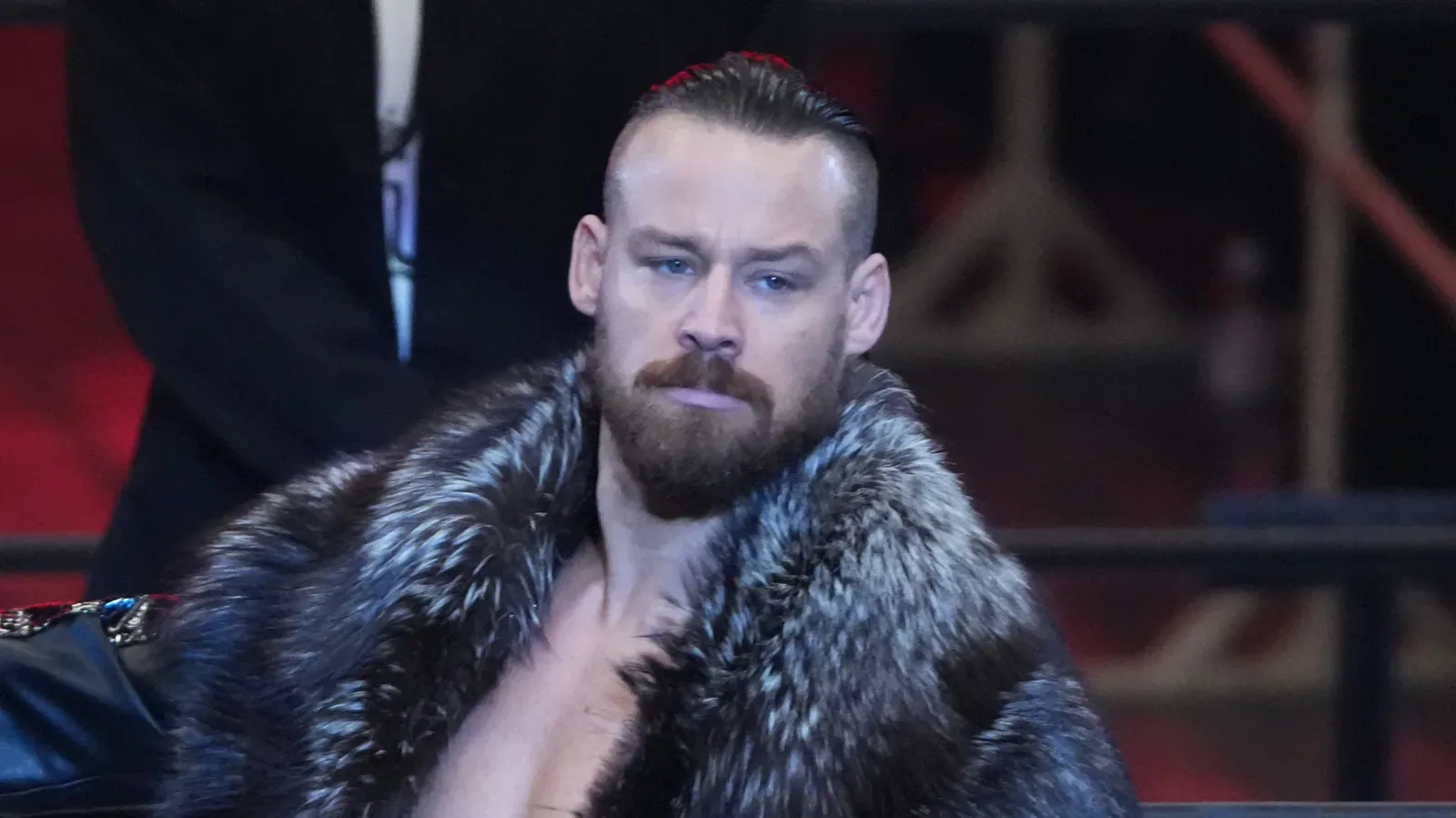
David Finlay says the financial difference between All Elite Wrestling and New Japan Pro-Wrestling has been impossible to ignore following his move to AEW earlier this year.
Finlay and Clark Connors, now two prominent members of The Cut alongside Gabe Kidd, reflected on their transitions during an appearance on What Happened When. The group previously operated under the name The Last Outfit, but Finlay and Connors have made a quick impression as regular AEW performers despite having been with the company for less than a year.
The conversation offered a straightforward look at how the two wrestlers arrived in AEW on different timelines. Though their “All Elite” announcements were released at the same time, Connors explained that he had already begun working around the company before Finlay officially joined the roster.
“We got the ‘All Elite’ graphic at the same time, but I came in a little bit beforehand,” Connors said. “I got pulled in. I was kind of helping out with Gabe at the start of the year...right at the end of January.”
For more background on this topic, read David Harbour Praises MJF’s Stunt Work And Comedy In ‘Violent Night 2’.
Finlay confirmed that his full-time arrival came later, in March, after he took additional time to handle the business side of his career. His comments indicate that the decision was not merely a case of following his stablemates immediately, but one that involved a broader negotiation process.
“Yeah, and I came in March,” Finlay said. “I took a little longer playing the contract chess game with everybody. And then ended up with my boys in March.”
Finlay Describes a Different Path Into AEW
The phrase “contract chess game” is notable because it frames Finlay’s move as a measured professional decision. Finlay did not provide specific details about every party involved in those discussions, nor did he outline the terms that were considered. Still, he made clear that his route was different from Connors’ earlier entry, even as the two were ultimately presented together in AEW.
That distinction matters for a group such as The Cut. The act’s identity is built around the connection among Finlay, Connors, and Kidd, but the members did not necessarily arrive through identical circumstances. Connors was assisting with Kidd at the end of January, while Finlay joined in March after working through his own negotiations. Their joint announcement may have created the appearance of a single, simultaneous arrival, but their accounts show a more gradual process behind it.
For Finlay, however, the outcome has been clear: he is working alongside the people he wanted to be with. That familiarity has evidently helped make the adjustment to AEW’s schedule and television environment an enjoyable one.
Asked about his experience so far, Finlay pointed to the core attractions of his current situation: teaming with his friends, performing regularly, traveling to new cities, and having opportunities to antagonize people on television. His answer was delivered with the kind of confidence expected from someone thriving in a new setting.
“I like it,” Finlay said. “It’s pretty sick. You know, I get to kick a** and be with my boys. Different city twice a week. What’s not to like? I get to mess with you on TV, make your life miserable. Life’s good, there’s nothing really to complain about.”
Clark Connors and David Finlay Praise AEW Experience
Both Connors and Finlay gave a positive assessment of their first months in AEW. Their comments were not focused solely on money or exposure. Finlay specifically emphasized the appeal of being reunited with his allies and having a regular platform to present their group’s personality on television.
That combination is significant for any wrestler changing promotions. A move can offer a fresh audience and a new set of opponents, but it can also require performers to establish themselves again in an unfamiliar environment. Arriving with a defined unit can reduce that adjustment period. In Finlay and Connors’ case, their association with Kidd gave The Cut an existing foundation from which to build following the group’s rebranding from The Last Outfit.
Connors’ comments also suggest that he had time to acclimate before the announcement that formally placed him alongside Finlay under the AEW banner. By coming in near the end of January to help with Kidd, Connors was able to experience the environment before the public confirmation of the group’s AEW status. Finlay’s March arrival then completed the trio’s presence.
While their answers were lighthearted, they also conveyed satisfaction with the practical realities of the move. Finlay cited working in different cities twice each week, a schedule that provides a consistent rhythm of television appearances and travel. For a wrestler whose work is tied to a stable presentation, that regularity can be particularly useful in maintaining momentum and reinforcing the group’s identity.
The Money Conversation Was Blunt
The clearest headline from the discussion came when Connors interjected after Finlay finished describing the positives of life in AEW. Connors brought up the financial component without hesitation.
“And the money,” Connors said. “I like the money too. A lot of it.”
Finlay then answered directly, offering an unambiguous comparison between his current employer and his former promotion.
“Yes,” Finlay said. “AEW money is way better than New Japan money.”
Finlay did not disclose a salary figure, contract length, bonus structure, or any other financial terms. He also did not elaborate on whether he was speaking only about his own deal or making a broader comparison of pay structures between the two companies. What he did provide was a plainly stated personal assessment: in his experience, AEW compensation is substantially better than what he received in New Japan.
It is a revealing remark because wrestlers do not always speak so openly about the financial reasons behind a change of employer. Performers often focus on creative opportunities, career goals, scheduling, or the chance to work with particular friends and rivals. Finlay did identify several of those factors as positives, but he and Connors did not avoid the economic side of the decision.
There is no contradiction in those two perspectives. Finlay described being happy to work with his “boys,” enjoy the travel, and create television chaos, while Connors underscored that getting paid more is also a meaningful part of the experience. Taken together, their comments present a practical picture of why the AEW arrangement has worked for them so far.
What the Comments Mean for The Cut
The Cut’s current makeup gives Finlay, Connors, and Kidd a shared direction in AEW, even though Finlay’s contract discussions took longer to resolve than Connors’ initial involvement. Finlay’s description of eventually ending up “with my boys” places the group dynamic at the center of his move.
That is especially important as the stable continues to establish itself following the shift away from the former Last Outfit name. The group has the benefit of members who appear comfortable with one another, and the interview makes clear that their relationship is not simply a television construction. Finlay’s enthusiasm about working with Connors and Kidd was one of the main themes of his remarks.
At the same time, the candid pay comparison adds a business dimension to the story. Finlay’s experience illustrates that contract negotiations can take time even when a wrestler is ultimately headed toward a familiar group of collaborators. Connors entered first, Finlay arrived later, and the public saw them announced together. Behind that final presentation were separate timelines and, in Finlay’s case, a period of negotiation he characterized as a chess game.
For now, neither Finlay nor Connors sounded conflicted about where they landed. Their assessment of AEW was overwhelmingly positive, from the travel and television opportunities to the ability to work as part of The Cut. And when the subject turned to compensation, they were even more direct: both see the financial arrangement as a major upside of their AEW run.
Finlay’s move to AEW came in March, months after Connors began helping out near the end of January. Less than a year into their full-time run with the company, both men are already speaking publicly about the benefits of the decision. For Finlay, the contract chess game ended with a spot beside his allies, a regular place on television, and, by his own account, a considerably better payday than he had in New Japan.
In pictures

Darryl Polo
Darryl Polo is a passionate wrestling fan covering WWE, AEW, TNA and beyond. He loves great rivalries, breakout stars and the moments that keep fans talking long after the bell. How we work.