
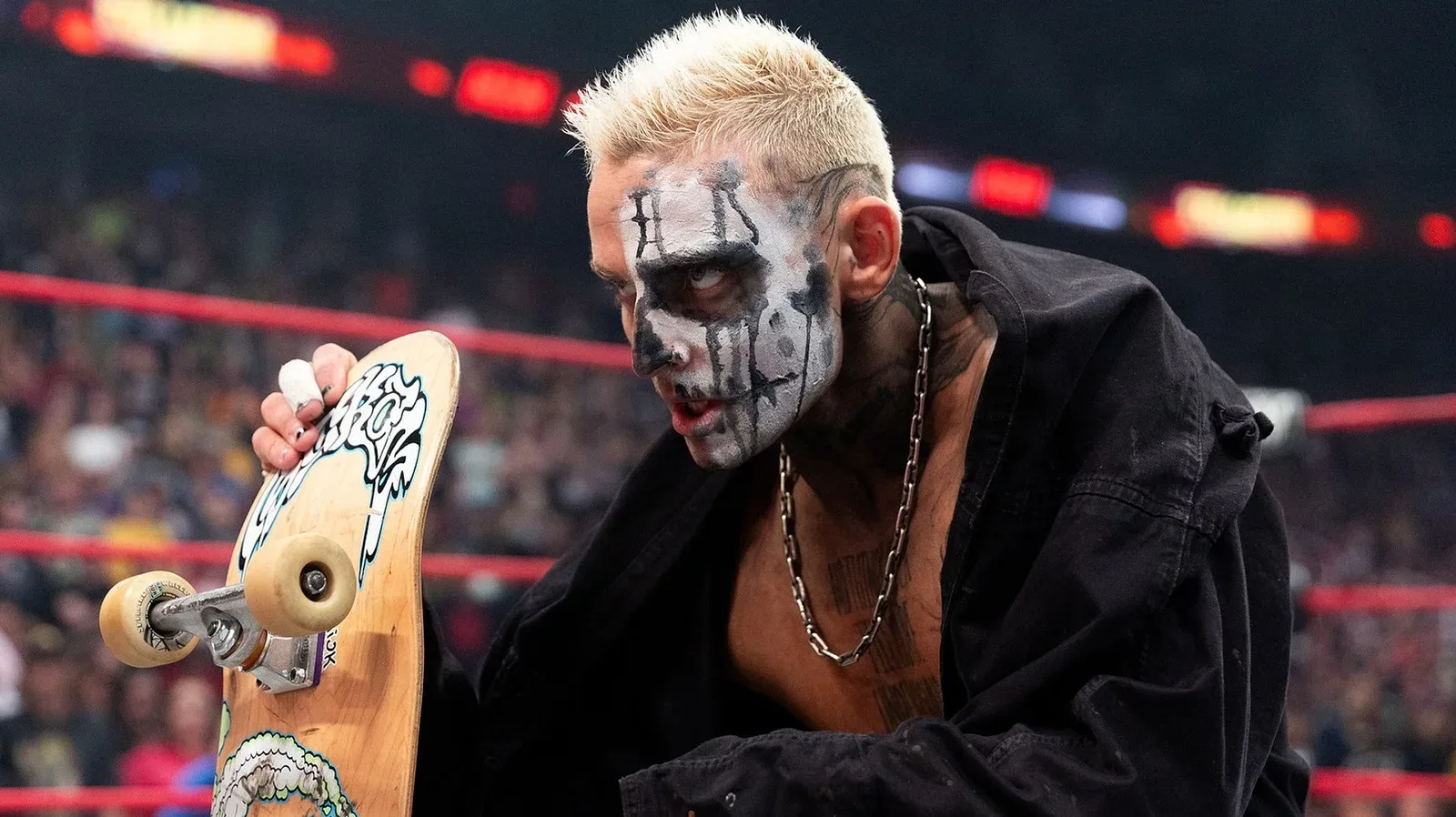
Darby Allin has built much of his reputation on accepting challenges that most people would not consider attempting. That mindset has carried into his AEW career, where his risk-heavy style has made him one of the promotion’s most recognizable performers, and it has also defined his life outside the ring.
In 2025, Allin reached the summit of Mount Everest, adding a major mountaineering accomplishment to a résumé already full of extreme pursuits. His latest test was much more familiar to the mainstream sporting world but proved punishing in its own way: the New York Marathon.
Speaking with 1010 XL – Jacksonville’s Sports Radio alongside Steven Borden, Allin revealed that he entered the marathon without training for it. The decision became even more difficult because the race came only days after AEW Blood & Guts, a match environment known for its physical demands.
“Yeah, dude, I’m feeling every ounce of that,” Allin said. “Everyone’s like, ‘Yo, congratulations!’ And then I was like, ‘Dude, I wish I trained for that.’ I didn’t train once for it, and then little did I know, it was only going to be a few days removed from Blood & Guts.”
For more background on this topic, read Speedball Mike Bailey Says AEW Singles Gold Remains the Goal Ahead of Continental Classic.
A Different Kind of Endurance Test
Completing a marathon is an accomplishment under any circumstances. Running 26.2 miles requires pacing, conditioning, recovery, and mental discipline, even for athletes who have spent months preparing. Allin’s admission that he did not train at all puts the scale of the effort into sharper focus, particularly when it was placed so close to an AEW appearance in Blood & Guts.
Allin did not present the experience as an easy victory or another story about effortless toughness. Instead, he was candid about the aftermath. He felt the full physical toll, and his takeaway was straightforward: preparation matters.
That honesty is notable because Allin’s public image has long been connected to pushing beyond conventional limits. Whether he is competing inside an AEW ring or taking on a personal adventure away from wrestling, he has often embraced the uncertainty of the situation. The marathon did not change that impulse, but it gave him a hard lesson about taking on a long-distance race immediately after a major wrestling event.
Blood & Guts is not the sort of match that naturally lends itself to quick recovery. The structure, the intensity, and the physical style associated with the bout create a difficult setting for anyone scheduled to compete. Adding a marathon just days later presented a uniquely demanding combination, especially without a dedicated running regimen beforehand.
Allin Does Not Plan His Challenges Far in Advance
After climbing Everest and completing the New York Marathon, Allin was asked what could be next. He did not identify a specific goal, event, or expedition. Rather than mapping out a long-term checklist, he explained that these ambitions tend to emerge organically.
“Honestly, I don’t even know; it just comes to me naturally,” Allin said on 1010 XL – Jacksonville’s Sports Radio. “I never grew up wanting to do Mount Everest, and I never grew up wanting to do a New York Marathon either. It just kind of falls into you.”
That approach fits the way Allin described his broader outlook. He said his personal motto is to see where “the wind” takes him. In practice, that philosophy has led him toward experiences that he did not necessarily imagine pursuing when he was younger.
Everest and the New York Marathon are dramatically different undertakings, but both reflect the same willingness to step into an unfamiliar environment and find out what it demands. One is a high-altitude expedition associated with elite mountaineering. The other is a grueling distance race that tests endurance over hours of sustained effort. Allin’s comments suggest that he does not need to have a childhood dream attached to a challenge before committing to it.
For AEW audiences, that mentality is easy to recognize. Allin’s persona and body of work have regularly been tied to a willingness to absorb punishment, take chances, and compete with an urgency that separates him from more measured opponents. His outside pursuits appear to come from the same place, even if the risks and preparation requirements are entirely different.
The Kevin Knight Match That Changed His Perspective
Allin also discussed a moment from earlier in the year that stands out because it made him feel something he rarely associates with wrestling: fear.
During a Continental Classic match against Kevin Knight, Allin attempted a backflip spot from a guardrail. The maneuver nearly went wrong. Although he was still able to complete the move, he said the close call left him with “spaghetti legs” for the remainder of the match.
The physical sensation was only part of the story. Allin acknowledged that the incident left him concerned about the possibility of being seriously hurt. He described the Knight match as the first time he had felt scared in the ring.
That is a meaningful admission from a wrestler whose career has been shaped by dangerous-looking offense and a deep comfort with discomfort. Fear is often treated as something performers are expected to conceal, especially when their in-ring identities are built around being fearless. Allin’s recollection instead underlines the difference between accepting risk and being unaffected by it.
The guardrail spot did not stop the match, and Allin continued competing despite the instability he felt afterward. Still, the experience remained with him. It showed that even a wrestler accustomed to difficult physical situations can have a moment where the consequences become especially real.
His account of the match also creates an interesting contrast with the marathon story. In the ring against Knight, an unexpected near-miss triggered immediate fear and forced Allin to manage his body through the rest of a match. In New York, the difficulty came from entering a known endurance challenge without the training needed to properly prepare for it. Both situations involved endurance, pain, and uncertainty, but each exposed a different limit.
Risk, Recovery, and the Next Unplanned Goal
Allin has not named another major objective following Everest and the marathon. Based on his comments, that may be because he is not searching for one in a conventional sense. He appears comfortable allowing the next challenge to arrive rather than setting a rigid plan.
That does not mean every future pursuit will look exactly like the last one. His reflections on the marathon make clear that he recognizes the value of preparation after attempting such a demanding race without it. The experience did not diminish the accomplishment, but it did leave him wishing he had approached it differently.
For now, Allin’s immediate focus remains tied to AEW, where he continues to compete in a setting that can be as physically intense as any of his outside adventures. The Continental Classic bout with Knight showed him how quickly a single risky moment can alter the emotional temperature of a match. Blood & Guts, meanwhile, was close enough to the New York Marathon to amplify the physical strain of both events.
There is no indication yet of whether his next personal undertaking will involve another athletic event, an expedition, or something entirely unexpected. What is clear is that Allin remains motivated by discovery rather than routine. Everest was not always a goal. Neither was the New York Marathon. Both eventually became part of his story.
His marathon experience will likely stand as a reminder that determination can get someone to the finish line, but it does not erase the demands of preparation and recovery. For a performer who has consistently tested himself in public, that lesson may be as significant as the medal and the completion itself.
In pictures

Darryl Polo
Darryl Polo is a passionate wrestling fan covering WWE, AEW, TNA and beyond. He loves great rivalries, breakout stars and the moments that keep fans talking long after the bell. How we work.