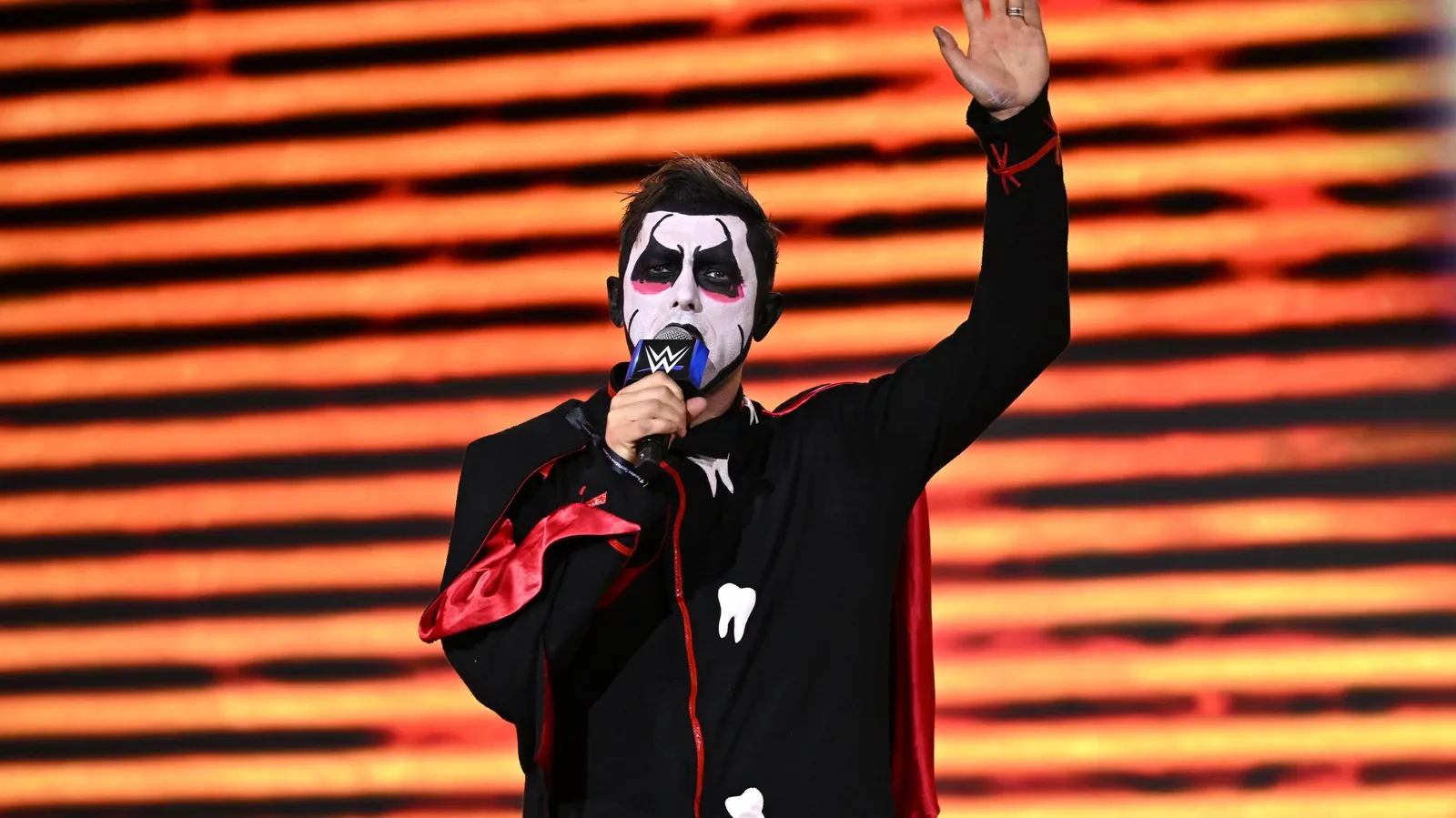
Danhausen has never presented himself as a conventional professional wrestler, and his latest stated ambition fits neatly into the character’s peculiar universe. The WWE star wants to make an appearance on The Simpsons, preferably in the annual Halloween tradition that has welcomed countless offbeat figures and horror-inspired concepts over the years.
Speaking with BANG Showbiz, Danhausen identified an animated cameo as a genuine career goal. “That’s a dream. So, we gotta make that dream come true,” he said. He specifically suggested that the “Very Nice, Very Evil” character could work as a guest presence in a Treehouse of Horror installment, adding, “Even if you want to put Danhausen in a ‘Treehouse of Horror’ as a guest star, that would be great. Let’s get it in there. Let’s put it out in the universe.”
It is an aspiration that makes sense for a performer whose appeal has been built around more than match results. Danhausen’s presentation combines comedy, menace, vintage horror imagery, curses, unusual speech patterns, and a deliberate sense that the character exists slightly outside normal wrestling logic. A place like Springfield, particularly its more supernatural and absurd Halloween setting, is the kind of pop-culture world where that combination could translate naturally.
A Character Built for More Than Wrestling
Danhausen’s WWE run has included a difficult in-ring starting point. His debut at WWE Elimination Chamber earlier this year was lackluster, but the larger profile of the character has continued to grow through avenues beyond a single event or match. His visibility in popular culture has been especially notable following his public association with the NBA’s New York Knicks.
For more background on this topic, read Omos Says He Is Available to Join Dominik Mysterio and The Judgment Day ‘For the Right Price’.
Danhausen became widely discussed for cursing, and later uncursing, the Knicks. The storyline around that curse gained even more attention when New York went on to win its first championship in more than 50 years. Whether viewed as a joke, a lucky charm, or simply an example of how quickly a memorable wrestling personality can become part of a wider sports conversation, the episode created an opening that few wrestlers receive.
Since the Knicks’ victory, Danhausen has reportedly drawn interest from various sports teams before their own seasons. He has also continued appearing on ESPN, where he has heckled Stephen A. Smith, the original target of the Knicks curse. Those appearances reinforce the element that has always been central to Danhausen’s success: he can be placed in settings that have little to do with a wrestling ring and still remain immediately recognizable.
For WWE, that kind of recognition has value. Wrestling has long depended on performers who can carry their identities into music, film, television, advertising, sports coverage, and mainstream comedy. Not every crossover appearance needs to be a major acting role to matter. A sharply used cameo can introduce a wrestler’s personality to viewers who may never have seen a premium live event, followed a weekly show, or understood why fans are chanting along with an eccentric character’s catchphrases.
Why ‘Treehouse of Horror’ Would Be a Natural Fit
The Simpsons is an especially logical target because its style allows for a broad range of guest appearances. Its long-running format can accommodate celebrities playing themselves, exaggerated versions of themselves, or entirely fictionalized characters. The Treehouse of Horror episodes take that flexibility further, leaning into monsters, nightmares, genre parodies, curses, and visual ideas that would be out of place in a standard episode.
Danhausen would not need an elaborate premise to make such an appearance effective. His existing visual identity and way of speaking already provide the outline. The character’s frequent references to curses and his horror-influenced look could be adapted to a brief gag, a supporting role in a supernatural segment, or a larger parody within the special. His desire to be included is also consistent with the way he has approached his persona: the joke is often that Danhausen sees no boundary between the wrestling world and the wider world that ought to recognize his importance.
That is what makes the character’s self-promotion more effective than a generic celebrity request. Danhausen is not merely asking to appear on a famous television program. He is pitching a version of the appearance that reflects an established aspect of his identity. A Halloween episode provides an obvious creative home for “Very Nice, Very Evil,” while the performer’s comic timing could give the cameo a reason to exist beyond simple name recognition.
‘The Danhausens: Love that Danhausen’
The Simpsons idea is not Danhausen’s only television ambition. He also described a concept for a sitcom centered on himself, with the proposed title The Danhausens: Love that Danhausen. As explained by Danhausen, the show would place him in an intentionally mundane situation: rather than wrestling, he would receive what he called “a lot of human monies” to work an ordinary office job.
The premise is unmistakably Danhausen. The comedy comes from the mismatch between the character and the task. An office job is normally associated with routine, meetings, paperwork, commutes, and a strict professional environment. Danhausen’s persona is built around grandiose demands, curses, unpredictable behavior, and the insistence that the strange is perfectly normal. Putting that figure into an everyday workplace would allow the absurdity to come from his attempts to treat a standard job as if it were another stage for his particular ambitions.
It also highlights a useful aspect of the performer’s range. Wrestling characters often succeed because they can be summarized quickly, but the best ones also create questions about how they would function outside a match. Danhausen’s character invites those questions. What does he do when there is no opponent to curse? How does he navigate an office hierarchy? What does “Very Nice, Very Evil” mean when applied to a typical workday? The imagined sitcom is a comedic answer to those questions without requiring the character to be fundamentally changed.
Danhausen named Conan O’Brien, Danzig, Sabrina Carpenter, and Megan Thee Stallion as dream guest stars for the hypothetical series. He also said Weird Al Yankovic would perform its theme song. The list reflects the unusually broad set of cultural influences that the character has embraced: late-night comedy, heavy music, contemporary pop, hip-hop, parody, and wrestling’s own tradition of outsized entertainment.
At this point, the sitcom remains a stated wish rather than an announced production. There is no indication that a show is in development, that a network or streaming platform is attached, or that any of the proposed guest stars are involved. Still, the concept provides a clear view of how Danhausen sees the potential of his brand. He is not limiting the character to being a wrestler who occasionally appears in entertainment. He is imagining an entertainment character who can also be a wrestler.
The Value of Keeping the Character Distinct
Danhausen’s goals come at a time when wrestling personalities are increasingly expected to establish a presence across multiple platforms. Social media, sports television, podcasts, gaming, voice work, scripted programming, and live appearances all offer ways to deepen a connection with audiences. The challenge is that a wider reach can sometimes dilute a character if every appearance feels detached from what made that person compelling in the first place.
Danhausen has avoided that problem by maintaining a highly recognizable voice. The Knicks curse, the ESPN appearances, and the sitcom concept all sound like extensions of the same figure. Even the language about “human monies” is tied to the stylized manner in which he presents himself. The details may be comic, but they are not random. They reinforce the idea that Danhausen is always operating by his own rules.
That consistency could make a future television cameo more effective if it happens. Audiences do not need extensive wrestling knowledge to understand a character who looks like a horror-comedy creation, speaks with theatrical certainty, and believes he deserves wealth and attention for reasons that may only make complete sense to him. The best crossover moments are often built on that kind of immediate clarity.
A Dream Worth Putting Into the Universe
There is no timetable for a Simpsons appearance, and no confirmation that the show has considered Danhausen for any future episode. His comments are a public expression of a hope, not an announcement. But the prospect is easy to understand, especially when framed around Treehouse of Horror.
Danhausen has turned a distinct character into a vehicle for appearances that move between WWE, sports talk, and broader entertainment. His uneven Elimination Chamber debut has not defined the scope of his public profile. Instead, the character remains visible because it is adaptable, memorable, and deliberately unusual.
For now, Danhausen has put the idea forward: a cameo in Springfield, a possible Halloween setting, and perhaps one day an office sitcom where an otherworldly personality gets paid vast amounts of human monies to do the most ordinary work imaginable. In the world of Danhausen, that may be the most sensible career plan of all.
In pictures
Darryl Polo
Darryl Polo is a passionate wrestling fan covering WWE, AEW, TNA and beyond. He loves great rivalries, breakout stars and the moments that keep fans talking long after the bell. How we work.