
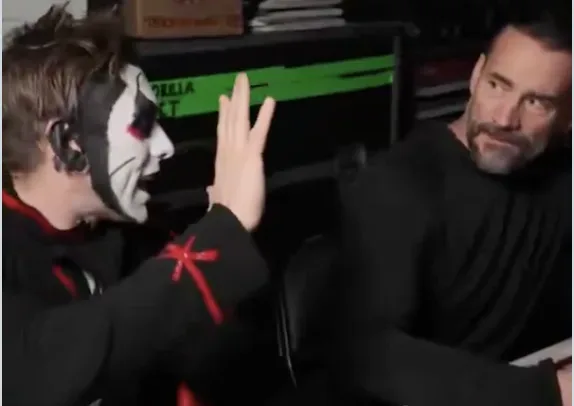
Danhausen has offered a clear and deeply personal explanation for CM Punk’s importance in his professional wrestling journey, saying he would not have become a wrestler without him.
Speaking on a new episode of Hot Ones: Extra Heat, the “Very Nice, Very Evil” WWE superstar discussed the connection he feels to Punk, whose work helped pull him back toward wrestling at a point when he had drifted away from it. Danhausen said Punk’s mixture of interests, presentation, and attitude made an immediate impression, ultimately helping inspire the character and career fans now know.
“Well, he’s Danhausen’s reason for wrestling. Danhausen wouldn’t be a wrestler without CM Punk. So he got Danhausen to rewatch wrestling and then decide, ‘oh, I should take over the world with wrestling. That’s a good idea.’”
View the referenced post on X
The statement puts a finer point on a friendship that has long been visible to wrestling fans. Danhausen and Punk have shared frequent backstage interactions and have remained associated with one another through their respective paths in major promotions. But Danhausen’s comments make clear that their relationship was meaningful well before it became a friendship within the business.
For more background on this topic, read Corey Graves Urges WWE Talent to Share Match Stories With Commentary Teams.
For Danhausen, Punk represented more than a wrestler he enjoyed watching. He represented a version of wrestling that felt aligned with the things Danhausen already cared about outside the ring. That overlap helped make wrestling feel relevant again and gave him a creative reference point as he began considering a future in the industry.
“Because you dip out of stuff sometimes and then you see something that sucks you back in. Inspiration. He was the person who sucked me back in with the… the horror and the comics and the hardcore punk music and everything like that was all drawn back in.”
CM Punk’s presentation resonated with Danhausen
Professional wrestling careers can begin in many ways. Some performers grow up never missing a show, while others find their way back after years away from the product. Danhausen described himself as someone who had stepped back from wrestling before Punk’s presence gave him a reason to revisit it.
The appeal was not limited to matches or championships. Danhausen specifically pointed to the shared cultural touchstones he saw in Punk: horror, comic books, and hardcore punk music. Those elements mattered because they made Punk appear distinct from a more conventional idea of what a televised wrestler was supposed to be.
That kind of connection is especially notable when considering Danhausen’s own eventual identity. His “Very Nice, Very Evil” persona is built around an unmistakably theatrical and offbeat sensibility. The character’s presentation has always drawn on unusual humor, horror-inflected imagery, and a delivery that separates him from a standard wrestling archetype. Danhausen did not say that he simply copied Punk’s approach. Instead, he described seeing a performer whose interests made wrestling feel like a place where his own creative instincts could belong.
“These were similar interests, and I went, ‘I like that guy. That guy is Danhausen on TV.’ Then that’s where Danhausen comes in with that.”
It is an important distinction. Inspiration in wrestling does not always mean recreating someone else’s act. In Danhausen’s telling, Punk helped validate the possibility that an unconventional personality could connect with an audience and exist within the wrestling world on their own terms.
That idea has been central to Danhausen’s career. His character became recognizable because it does not attempt to fit neatly into a single familiar mold. The mix of comedy, menace, eccentricity, and self-aware ambition has given Danhausen a voice that is instantly identifiable. His remarks suggest that Punk’s influence was part of the foundation that allowed him to pursue that voice.
From acquaintances to friends and mentors
Danhausen also addressed how the relationship developed after he entered the wrestling industry. What began with admiration from afar eventually turned into a personal connection. He described the progression in simple terms: they became acquaintances, then friends, with Punk also taking on a mentoring role.
“We become friends. We become acquaintances and then friends, and then he’s a bit of a mentor but also a great friend. But he owes me money.”
The final line was delivered in the playful style that has become synonymous with Danhausen’s public persona, adding a humorous note to an otherwise sincere reflection. Still, the larger point was unmistakable. Danhausen sees Punk as a close friend and someone whose guidance has mattered to him.
Mentorship can take many forms in wrestling, particularly for talent navigating the demands of nationally visible promotions. It can mean advice about working in front of large audiences, developing a character, handling the pressures of the industry, or simply having someone familiar to turn to backstage. Danhausen did not specify the particular advice Punk has given him, and there is no need to assume details beyond what he shared. His description of Punk as “a bit of a mentor” nevertheless indicates that their bond extends beyond casual friendship.
For Punk, the comments add another chapter to a career that has influenced wrestlers and fans across multiple generations. His work has often stood out because of how directly it reflected his interests and worldview. Danhausen’s account is a reminder that the impact of that approach can reach beyond the ring and beyond the immediate audience response to a match or promo.
Danhausen’s WWE chapter continues
Danhausen’s comments arrive during his time as a WWE superstar, following a career that has included a run in AEW. His singular character has made him one of the more unusual personalities to move through prominent wrestling stages in recent years, and his connection to Punk has been a recurring point of interest for fans familiar with both performers.
The friendship has also occasionally become part of the on-screen and backstage conversation around Danhausen. Last month, Kevin Owens hit Danhausen with a Stunner because of Danhausen’s friendship with Punk. That moment underscored how Punk’s relationships can create attention around the people connected to him, even when the interaction is framed with the kind of humor that frequently surrounds Danhausen.
There is no indication in Danhausen’s remarks that he wants his accomplishments reduced to being associated with another wrestler. His comments instead explain the origin of his motivation. He made the choice to pursue wrestling, created an original identity, and built a career that brought him to WWE. Punk, in Danhausen’s view, was the figure who reignited the interest that made all of those later steps possible.
That is why the interview stands out as more than a friendly endorsement. Danhausen was speaking about the moment wrestling became compelling to him again. He saw a performer who combined the ring with the cultural passions he recognized in himself, and it prompted him to imagine a place for his own ideas in the industry.
For a character as deliberately distinct as Danhausen, that initial spark was evidently crucial. The performer now known for being “Very Nice, Very Evil” may have become a fixture in major wrestling environments, but he credits Punk with helping set the entire journey in motion.
As Danhausen put it plainly, CM Punk is the reason he is wrestling at all.
Darryl Polo
Darryl Polo is a passionate wrestling fan covering WWE, AEW, TNA and beyond. He loves great rivalries, breakout stars and the moments that keep fans talking long after the bell. How we work.